
No period published by Québec.ca
Québec.ca publishes no hunting or trapping period for this species. Check the official regulations.
Wikipedia
Aigrette bleue
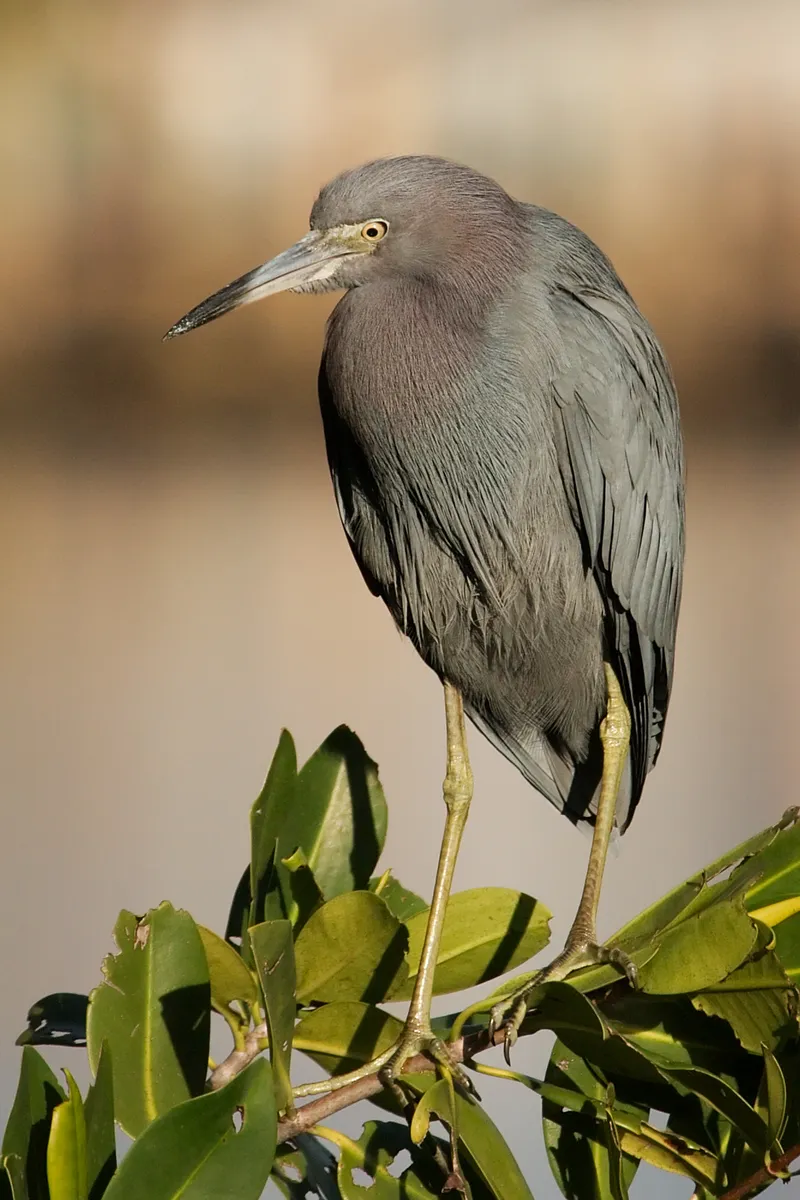
The little blue heron (Egretta caerulea) is a small heron of the genus Egretta. It is a small, darkly colored heron with a two-toned bill. Juveniles are entirely white, bearing resemblance to the snowy egret. During the breeding season, adults develop different coloration on the head, legs, and feet. They have a range that encompasses much of the Americas, from the United States to northern South America. Some populations are migratory. They can be found in both saltwater and freshwater ecosystems. Their preference for either one depends on where they live. Nesting behaviors are documented by numerous sources. The adults build nests in trees, in colonies with other bird species. The number of eggs laid varies from place to place. The young mature quickly, requiring little attention from adults after about nineteen days of age. Both young and adults are sometimes preyed on by other species. As with clutch sizes, diet can vary regionally. The population of E. caerulea is declining. Many possible reasons for this have been proposed. Exposure to heavy metals has been found to have detrimental effects on young birds.
Description
Males and females have the same coloration. The adults are darkly colored, with purple-maroon heads and blue bodies. During the breeding season, their heads turn dark red. They have two-toned bills, which are a light blue at the base, with black tips. Their eyes are yellow and their legs are greenish. Juveniles are almost completely white, although the upper primaries are somewhat dark in color. Like adults, their bills are two-toned. Immature birds transitioning from the juvenile to adult phase have a combination of light and dark feathers. Both sexes are about 56–74 centimetres (22–29 in), with a wingspan of 100–105 centimetres (39–41 in). They weigh about 397 grams (14.0 oz). The lores, which are normally a dull green, become a shade of turquoise during breeding season. They also develop long plumes on the crest and back, which can stretch 20–30 centimetres (7.9–11.8 in) past the tail. The legs and feet become black. The eggs are typically smooth, light blue, and unmarked, measuring about 31.7–43.2 millimetres (1.25–1.70 in), and weighing around 23.1 grams (0.81 oz).
Text from Wikipedia — Little blue heron, revision 1357481632, CC BY-SA 4.0, retrieved 2026-09-04. Encyclopedic text reused under CC BY-SA 4.0. Sentences about hunting or regulation are removed: on this site, the rule comes from Québec.ca.
Other names
French
English
Presence in Quebec
- Origin
- Indigène
- Occurrence
- Régulier
- Population status
- Migrateur
- Certainty
- Confirmé
Conservation
Québec.ca
Official periods
Source: Québec.ca — tables reproduced as published (retrieved 2026-08-30).
Regulations change. Always check Québec.ca before hunting or trapping.
Where this data comes from
This species is listed in an official government dataset. The identification and status shown in the data sheet are reproduced from it.
Source: List of Quebec’s vertebrate wildlife (LFVQ) — Ministère de l’Environnement, de la Lutte contre les changements climatiques, de la Faune et des Parcs. File LFVQ_25_03_2026.csv, retrieved 2026-08-30 · CC BY 4.0.
Measurements, habitat, diet and reproduction are not shown: no official source is attached to them yet.