
No period published by Québec.ca
Québec.ca publishes no hunting or trapping period for this species. Check the official regulations.
Wikipedia
Aigrette garzette
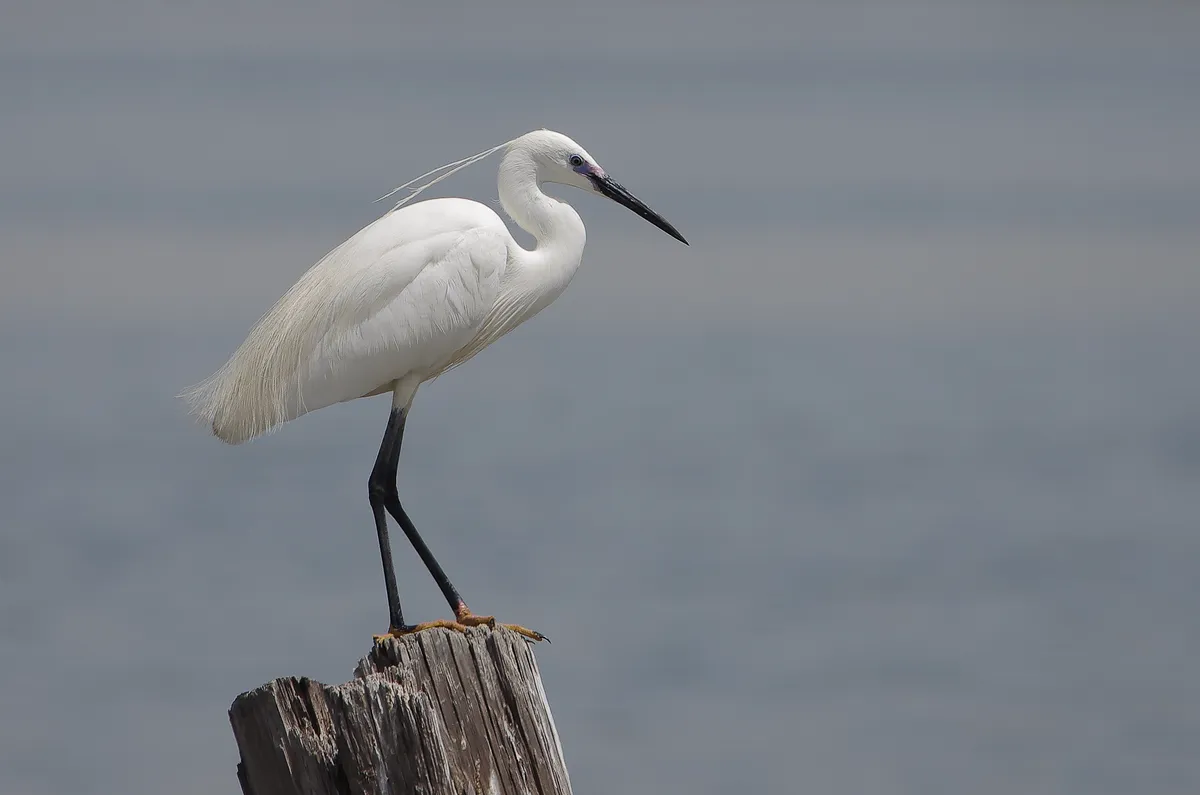
The little egret (Egretta garzetta) is a species of small heron in the family Ardeidae. It is a white bird with a slender black beak, long black legs and, in the western race, yellow feet. As an aquatic bird, it feeds in shallow water and on land, consuming a variety of small creatures. It breeds colonially, often with other species of water birds, making a platform nest of sticks in a tree, bush or reed bed. A clutch of three to five bluish-green eggs is laid and incubated by both parents for about three weeks. The young fledge at about six weeks of age. It is a polytypic species with two or arguably more subspecies. Its breeding distribution comprises the wetlands, waterways and shorelines of warm temperate to tropical parts of Asia, Africa, Australia, and Europe. A successful colonist, its range has gradually expanded north, with stable and self-sustaining populations now present in the United Kingdom. In warmer locations, most birds are permanent residents; northern populations, including many European birds, migrate to Africa and southern Asia to over-winter there. The birds may also wander north in late summer after the breeding season, and their tendency to disperse may have assisted in the recent expansion of the bird's range. Around 1950, conservation laws were introduced in southern Europe to protect the species and their numbers began to increase. By the beginning of the 21st century the bird was breeding again in France, the Netherlands, Ireland and Britain. Its range is continuing to expand westward, and the species has begun to colonise the New World; it was first seen in Barbados in 1954 and first bred there in 1994. The International Union for Conservation of Nature has assessed the bird's global conservation status as being of "least concern".
Description
The adult little egret is 55–65 cm (22–26 in) long with an 88–106 cm (35–42 in) wingspan, and weighs 350–550 g (12–19 oz). Its plumage is normally entirely white, although there are dark forms with largely bluish-grey plumage. In the breeding season, the adult has two long plumes on the nape that form a crest. These plumes are about 150 mm (6 in) and are pointed and very narrow. There are similar feathers on the breast, but the barbs are more widely spread. There are also several elongated scapular feathers that have long loose barbs and may be 200 mm (8 in) long. During the winter the plumage is similar but the scapulars are shorter and more normal in appearance. The bill is long and slender and it and the lores are black. There is an area of greenish-grey bare skin at the base of the lower mandible and around the eye which has a yellow iris. The legs are black and the feet yellow. Juveniles are similar to non-breeding adults but have greenish-black legs and duller yellow feet, and may have a certain proportion of greyish or brownish feathers. The subspecies nigripes differs in having yellow skin between the bill and eye, and blackish feet.
Text from Wikipedia — Little egret, revision 1356733933, CC BY-SA 4.0, retrieved 2026-09-04. Encyclopedic text reused under CC BY-SA 4.0. Sentences about hunting or regulation are removed: on this site, the rule comes from Québec.ca.
Other names
French
Presence in Quebec
- Origin
- Indigène
- Occurrence
- Accidentel/non régulier
- Population status
- Migrateur
- Certainty
- Confirmé
Conservation
Québec.ca
Official periods
Source: Québec.ca — tables reproduced as published (retrieved 2026-08-30).
Regulations change. Always check Québec.ca before hunting or trapping.
Where this data comes from
This species is listed in an official government dataset. The identification and status shown in the data sheet are reproduced from it.
Source: List of Quebec’s vertebrate wildlife (LFVQ) — Ministère de l’Environnement, de la Lutte contre les changements climatiques, de la Faune et des Parcs. File LFVQ_25_03_2026.csv, retrieved 2026-08-30 · CC BY 4.0.
Measurements, habitat, diet and reproduction are not shown: no official source is attached to them yet.