
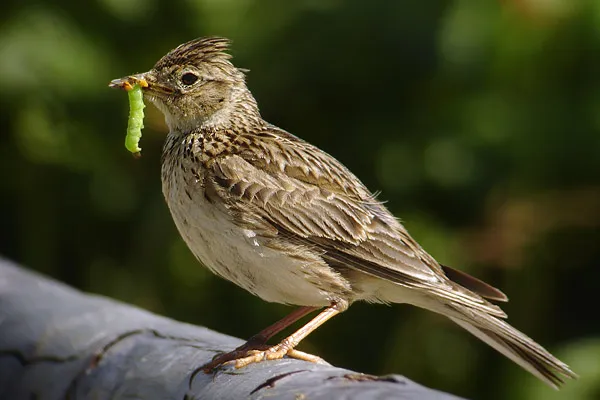
Alouette des champs— Quebec wildlife
Alauda arvensis
AlaudidaeNo period published by Québec.ca
Québec.ca publishes no hunting or trapping period for this species. Check the official regulations.
Wikipedia
Alouette des champs
The Eurasian skylark (Alauda arvensis), commonly referred to in Europe as the lark, is a passerine bird in the lark family, Alaudidae. It is a widespread species found across Europe and the Palearctic with introduced populations in Australia, New Zealand, Canada, and on the Hawaiian Islands. It is a bird of open farmland and heath, known for the song of the male, which is delivered in hovering flight from heights of 50 to 100 metres (160 to 330 ft). The sexes are alike. It is streaked greyish-brown above and on the breast and has a buff-white belly. The female Eurasian skylark builds an open nest in a shallow depression on open ground well away from trees, bushes and hedges. She lays three to five eggs which she incubates for around 11 days. The chicks are fed by both parents but leave the nest after eight to ten days, well before they can fly. They scatter and hide in the vegetation but continue to be fed by the parents until they can fly at 18 to 20 days of age. Nests are subject to high predation rates by larger birds and small mammals. The parents can have several broods in a single season.
Description
The Eurasian skylark is 18–19 cm (7.1–7.5 in) in length. Like most other larks, the Eurasian skylark is a rather dull-looking species, being mainly brown above and paler below. It has a short blunt crest on the head, which can be raised and lowered. In flight it shows a short tail and short broad wings. The tail and the rear edge of the wings are edged with white, which are visible when the bird is flying away, but not if it is heading towards the observer. The male has broader wings than the female. This adaptation for more efficient hovering flight may have evolved because of female Eurasian skylarks' preference for males that sing and hover for longer periods and so demonstrate that they are likely to have good overall fitness. It is known for the song of the male, which is delivered in hovering flight from heights of 50 to 100 m, when the singing bird may appear as just a dot in the sky from the ground. The long, unbroken song is a clear, bubbling warble delivered high in the air while the bird is rising, circling or hovering. The song generally lasts two to three minutes, but it tends to last longer later in the mating season, when songs can last for 20 minutes or more. At wind farm sites, male skylarks have been found to sing at higher frequencies as a result of wind turbine noise. Male Eurasian skylarks display local microdialects, with neighbouring birds sharing distinctive song patterns that function as group signatures and help distinguish local from non-local individuals.
Text from Wikipedia — Eurasian skylark, revision 1371230946, CC BY-SA 4.0, retrieved 2026-09-04. Encyclopedic text reused under CC BY-SA 4.0. Sentences about hunting or regulation are removed: on this site, the rule comes from Québec.ca.
Presence in Quebec
- Origin
- Indigène
- Occurrence
- Accidentel/non régulier
- Population status
- Migrateur
- Certainty
- Confirmé
Conservation
Québec.ca
Official periods
Source: Québec.ca — tables reproduced as published (retrieved 2026-08-30).
Regulations change. Always check Québec.ca before hunting or trapping.
Where this data comes from
This species is listed in an official government dataset. The identification and status shown in the data sheet are reproduced from it.
Source: List of Quebec’s vertebrate wildlife (LFVQ) — Ministère de l’Environnement, de la Lutte contre les changements climatiques, de la Faune et des Parcs. File LFVQ_25_03_2026.csv, retrieved 2026-08-30 · CC BY 4.0.
Measurements, habitat, diet and reproduction are not shown: no official source is attached to them yet.