
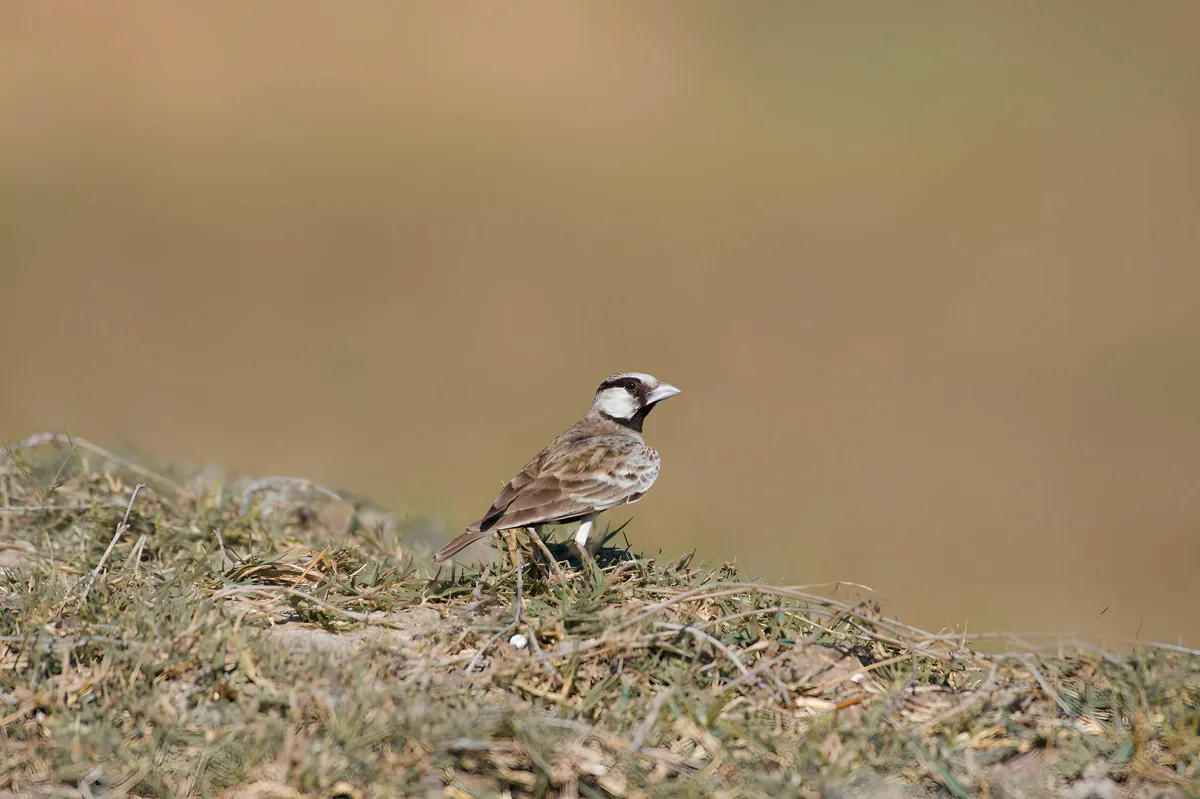
Alouette hausse-col alpestris— Quebec wildlife
Eremophila alpestris alpestris
AlaudidaeNo period published by Québec.ca
Québec.ca publishes no hunting or trapping period for this species. Check the official regulations.
Overview
Alouette hausse-col alpestris
The Horned Lark, or Eremophila alpestris alpestris, is a medium-sized bird measuring approximately 18 to 20 cm in length and weighing between 40 to 50 grams. Its plumage is primarily brown and beige, featuring patterns that enable it to blend into its surroundings. Males often display a distinctive small black horn on their head, which gives them their name, while females have slightly less contrasting plumage. This dimorphism is subtle, but the bright colors of the males are particularly pronounced during the breeding season, attracting the attention of females.
This species is mainly found in open and cleared areas of Quebec, particularly in the Montérégie and Laurentians regions. The Horned Lark prefers prairies, cultivated fields, and grassy zones, where it finds suitable food and nesting sites.
The Horned Lark is an insectivorous bird that primarily feeds on insects and seeds. Its breeding period begins in spring, typically between April and June, when it builds its nest on the ground, often in natural depressions. The female lays 3 to 5 eggs, which hatch after about two weeks. The young larks leave the nest after about ten days but remain dependent on their parents for several more weeks.
Observing the Horned Lark can be done by visiting its preferred habitats, such as prairies and fields, especially in spring and summer when the males sing to establish their territory and attract females. Their distinctive song and aerial behaviors make them fascinating subjects to observe for amateur ornithologists and nature enthusiasts.
Presence in Quebec
- Origin
- Indigène
- Occurrence
- Régulier
- Population status
- Reproductrice
- Certainty
- Confirmé
Conservation
Québec.ca
Official periods
Source: Québec.ca — tables reproduced as published (retrieved 2026-08-30).
Regulations change. Always check Québec.ca before hunting or trapping.
Where this data comes from
This species is listed in an official government dataset. The identification and status shown in the data sheet are reproduced from it.
Source: List of Quebec’s vertebrate wildlife (LFVQ) — Ministère de l’Environnement, de la Lutte contre les changements climatiques, de la Faune et des Parcs. File LFVQ_25_03_2026.csv, retrieved 2026-08-30 · CC BY 4.0.
Measurements, habitat, diet and reproduction are not shown: no official source is attached to them yet.