
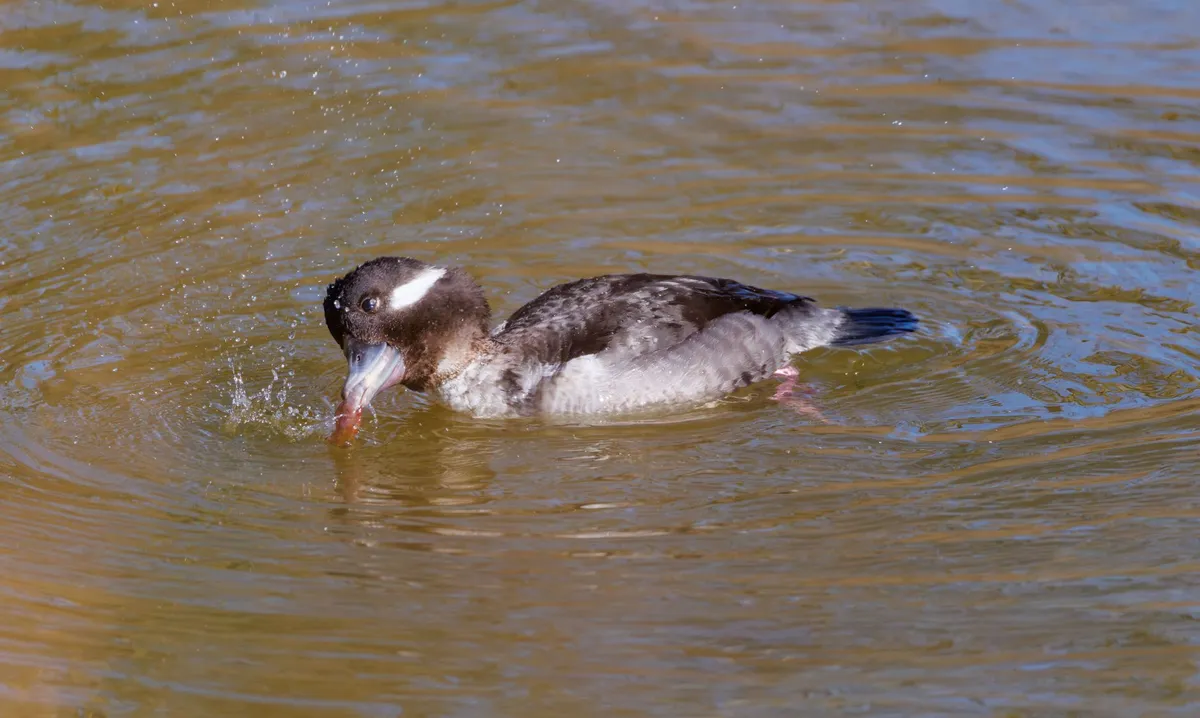
Arlequin plongeur, pop. de l'Est— Quebec wildlife
Histrionicus histrionicus pop. 1
AnatidaeMigratory game bird — federal regulations
Seasons and bag limits are set by Environment and Climate Change Canada.
Overview
Arlequin plongeur, pop. de l'Est
The Eastern Harlequin Duck is a medium-sized waterbird measuring about 45 to 51 cm in length and weighing between 600 and 1,200 grams. Its plumage is particularly distinctive, with males showcasing a blend of blue, black, and white, while females are more subdued, displaying shades of brown and gray. This sexual dimorphism allows for easy differentiation between the sexes, although young birds resemble females more closely. The physical characteristics of the Harlequin Duck, such as its short, broad bill and webbed feet, make it an agile swimmer and an efficient diver.
In Quebec, the Eastern Harlequin Duck is primarily found in the coastal regions of the St. Lawrence, particularly in the eastern areas like Gaspésie and the Magdalen Islands. It frequents rivers, lakes, and marine areas, especially in rocky habitats with fast currents, where it finds shelter and food.
Regarding behavior, the Harlequin Duck is a migratory bird that typically breeds between May and July. Nesting often occurs in remote sites near water, where the female builds a well-camouflaged nest. This species primarily feeds on crustaceans, mollusks, and aquatic insects, which it captures by diving underwater. During the breeding season, males engage in courtship displays, showcasing their colorful plumage to attract females.
Its status is due to habitat loss and population sensitivity. As a key species, it plays an important role in the aquatic ecosystem by regulating prey populations it consumes. To observe these birds, it is advisable to visit quiet coastal areas with binoculars and be attentive to their presence near rivers and rocky coastlines, especially during the breeding season.
Other names
French
Presence in Quebec
- Origin
- Indigène
- Occurrence
- Régulier
- Population status
- Reproducteur
- Certainty
- Confirmé
Conservation
Québec.ca
Official periods
Source: Québec.ca — tables reproduced as published (retrieved 2026-08-30).
Regulations change. Always check Québec.ca before hunting or trapping.
SIT Québec register
Outfitters hunting this species
90 outfitters list this species among the game they hunt.
Where this data comes from
This species is listed in an official government dataset. The identification and status shown in the data sheet are reproduced from it.
Source: List of Quebec’s vertebrate wildlife (LFVQ) — Ministère de l’Environnement, de la Lutte contre les changements climatiques, de la Faune et des Parcs. File LFVQ_25_03_2026.csv, retrieved 2026-08-30 · CC BY 4.0.
Measurements, habitat, diet and reproduction are not shown: no official source is attached to them yet.