
No period published by Québec.ca
Québec.ca publishes no hunting or trapping period for this species. Check the official regulations.
Wikipedia
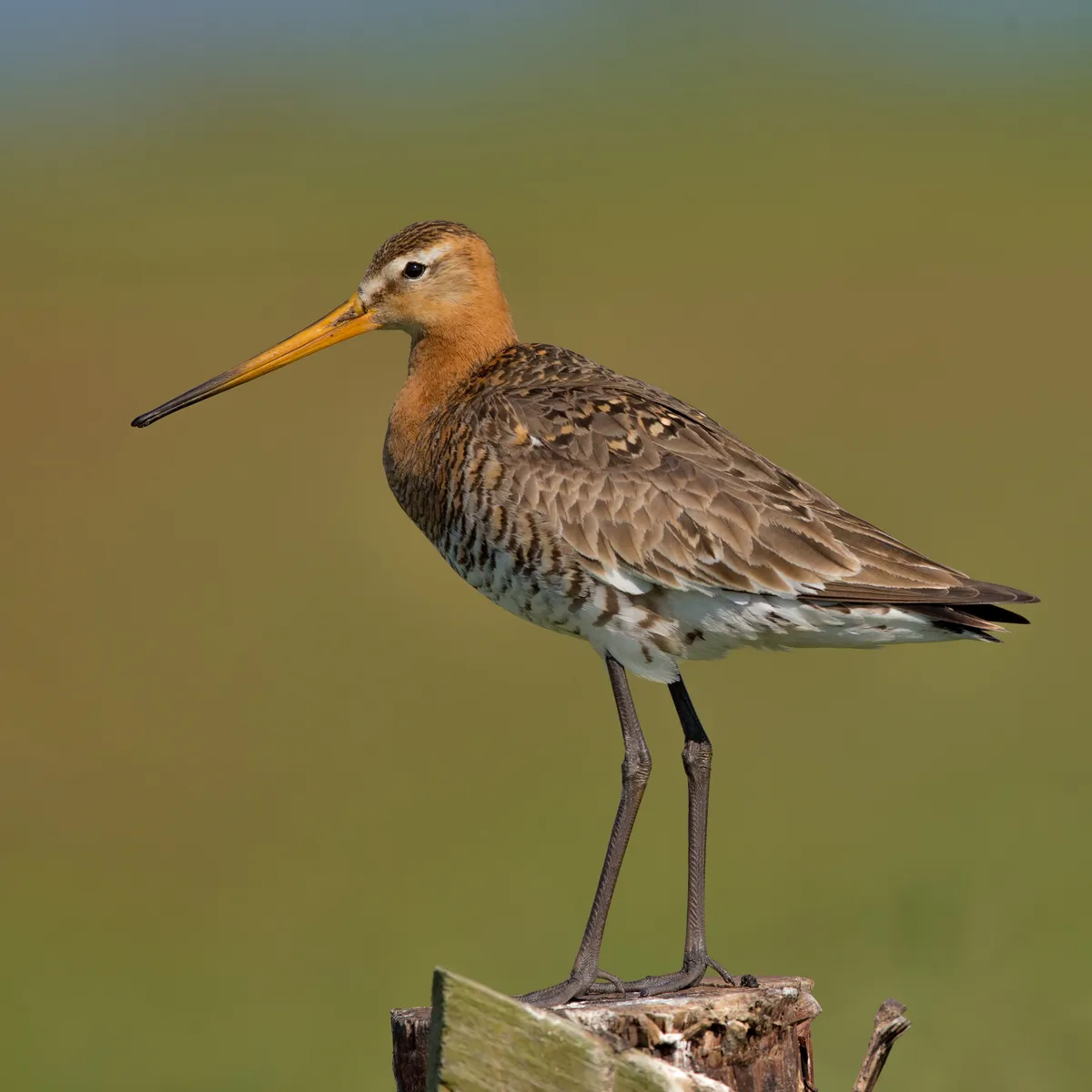
Barge à queue noire
The black-tailed godwit (Limosa limosa) is a large, long-legged, long-billed shorebird first described by Carl Linnaeus in 1758. It is a member of the godwit genus, Limosa. There are four subspecies, all with orange head, neck and chest in breeding plumage and dull grey-brown winter coloration, and distinctive black and white wingbar at all times. Its breeding range stretches from Iceland through Europe and areas of central Asia. Black-tailed godwits spend (the northern hemisphere) winter in areas as diverse as the Indian subcontinent, Australia, New Zealand, western Europe and west Africa. The species breeds in fens, lake edges, damp meadows, moorlands and bogs and uses estuaries, swamps and floods in (the northern hemisphere) winter; it is more likely to be found inland and on freshwater than the similar bar-tailed godwit. The world population is estimated to be 634,000 to 805,000 birds and is classified as Near Threatened.
Description
The black-tailed godwit is a large wader with long bill (7.5 to 12 cm (3.0 to 4.7 in) long), neck and legs. During the breeding season, the bill has a yellowish or orange-pink base and dark tip; the base is pink in winter. The legs are dark grey, brown or black. The sexes are similar, but in breeding plumage, they can be separated by the male's brighter, more extensive orange breast, neck and head. In winter, adult black-tailed godwits have a uniform brown-grey breast and upperparts (in contrast to the bar-tailed godwit's streaked back). Juveniles have a pale orange wash to the neck and breast. In flight, its bold black and white wings and white rump can be seen readily. When on the ground it can be difficult to separate from the similar bar-tailed godwit, but the black-tailed godwit's longer, straighter bill and longer legs are diagnostic. Black-tailed godwits are similar in body size and shape to bar-taileds, but stand taller. It measures 42 cm (17 in) from bill to tail with a wingspan of 70–82 cm (28–32 in). Males weight around 280 g (9.9 oz) and females 340 g (12 oz). The female is around 5% larger than the male, with a bill 12–15% longer. The most common call is a strident weeka weeka weeka. A study of black-tailed godwits in the Netherlands found a mortality rate of 37.6% in the first year of life, 32% in the second year, and 36.9% thereafter. The oldest recorded, as of 8 November 2025, is 29 years 2 months, for a bird of the Icelandic subspecies L. l. islandica; it was colour ringed as a juvenile on 30 August 1996 on The Wash in Lincolnshire, England, and has subsequently been seen on a total of 91 occasions, including breeding in northern Iceland.
Text from Wikipedia — Black-tailed godwit, revision 1371058663, CC BY-SA 4.0, retrieved 2026-09-04. Encyclopedic text reused under CC BY-SA 4.0. Sentences about hunting or regulation are removed: on this site, the rule comes from Québec.ca.
Other names
French
Presence in Quebec
- Origin
- Indigène
- Occurrence
- Accidentel/non régulier
- Population status
- Migrateur
- Certainty
- Confirmé
Conservation
Québec.ca
Official periods
Source: Québec.ca — tables reproduced as published (retrieved 2026-08-30).
Regulations change. Always check Québec.ca before hunting or trapping.
Where this data comes from
This species is listed in an official government dataset. The identification and status shown in the data sheet are reproduced from it.
Source: List of Quebec’s vertebrate wildlife (LFVQ) — Ministère de l’Environnement, de la Lutte contre les changements climatiques, de la Faune et des Parcs. File LFVQ_25_03_2026.csv, retrieved 2026-08-30 · CC BY 4.0.
Measurements, habitat, diet and reproduction are not shown: no official source is attached to them yet.