
No period published by Québec.ca
Québec.ca publishes no hunting or trapping period for this species. Check the official regulations.
Wikipedia
Barge rousse
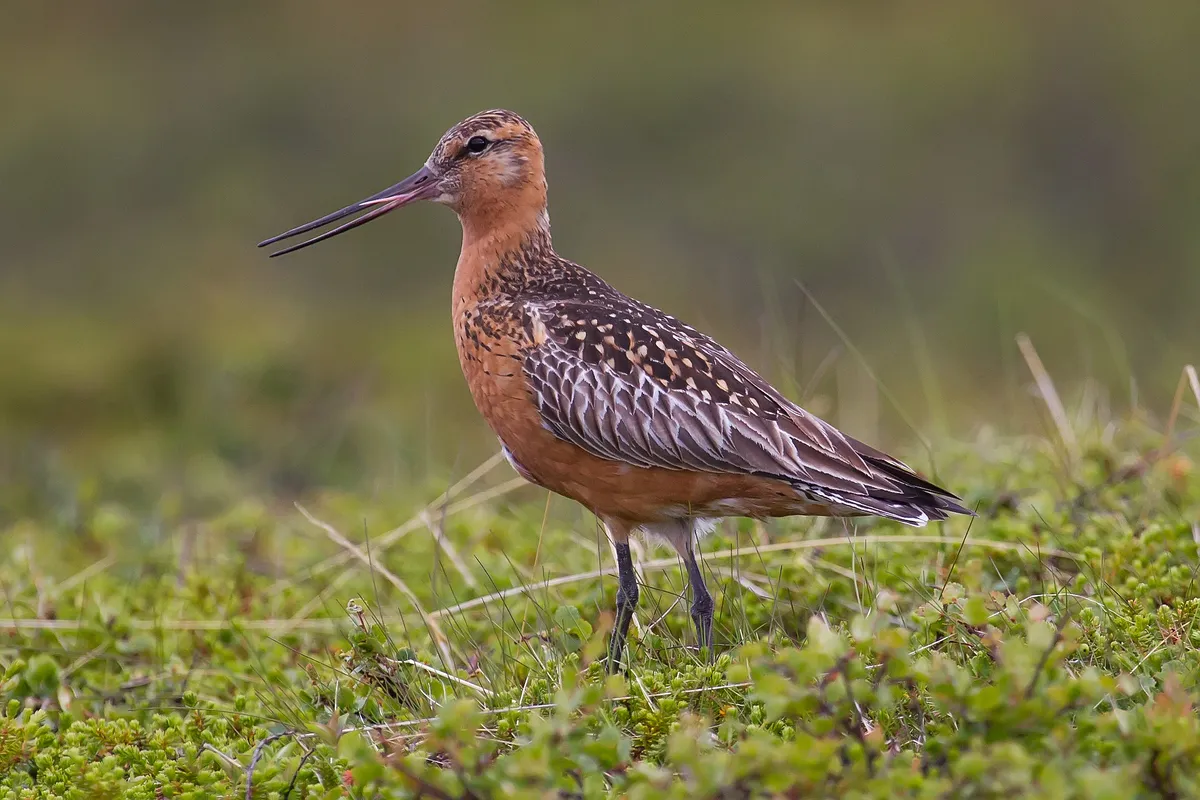
The bar-tailed godwit (Limosa lapponica) is a large and strongly migratory wader in the family Scolopacidae, which feeds on bristle-worms and shellfish on coastal mudflats and estuaries. It has distinctive red breeding plumage, long legs, and a long upturned bill. Bar-tailed godwits breed on Arctic coasts and tundra from Scandinavia to Alaska, and overwinter on coasts in temperate and tropical regions of Australia and New Zealand. The migration of the subspecies Limosa lapponica baueri across the Pacific Ocean from Alaska to New Zealand is the longest known non-stop flight of any bird, and also the longest journey without pausing to feed by any animal. The round-trip migration for this subspecies is over 29,000 km (18,020 mi).
Description
The bar-tailed godwit is a relatively short-legged species of godwit. The bill-to-tail length is 37–41 cm (15–16 in), with a wingspan of 70–80 cm (28–31 in). Males average smaller than females but with much overlap; males weigh 190–400 g (6.7–14.1 oz), while females weigh 260–630 g (9.2–22.2 oz); there is also some regional variation in size (see subspecies, below). The adult has blue-grey legs and a long, tapering, slightly upturned bi-coloured bill, pink at the base and black towards the tip. The neck, breast and belly are unbroken brick red in breeding plumage, and dark brown above. Females breeding plumage is much duller than males, with a chestnut to cinnamon belly. Breeding plumage is not fully apparent until the third year, and there are three distinguishable age classes; during their first migration north, immature males are noticeably paler in colour than more mature males. Non-breeding birds seen in the Southern Hemisphere are plain grey-brown with darker feather centres, giving them a striped look, and are whitish underneath. Juveniles are similar to non-breeding adults but more buff overall with streaked plumages on flanks and breast. Alaska-breeding bar-tailed godwits show an increase in body size from north to south, but this trend is not apparent in their non-breeding grounds in New Zealand; birds of different sizes mix freely. The bar-tailed godwit is distinguished from the black-tailed godwit (Limosa limosa) by its black-and-white horizontally-barred (rather than wholly black) tail, and lack of white wing bars. The most similar species is the Asian dowitcher (Limnodromus semipalmatus).
Text from Wikipedia — Bar-tailed godwit, revision 1368950868, CC BY-SA 4.0, retrieved 2026-09-04. Encyclopedic text reused under CC BY-SA 4.0. Sentences about hunting or regulation are removed: on this site, the rule comes from Québec.ca.
Presence in Quebec
- Origin
- Indigène
- Occurrence
- Accidentel/non régulier
- Population status
- Migrateur
- Certainty
- Confirmé
Conservation
Québec.ca
Official periods
Source: Québec.ca — tables reproduced as published (retrieved 2026-08-30).
Regulations change. Always check Québec.ca before hunting or trapping.
Where this data comes from
This species is listed in an official government dataset. The identification and status shown in the data sheet are reproduced from it.
Source: List of Quebec’s vertebrate wildlife (LFVQ) — Ministère de l’Environnement, de la Lutte contre les changements climatiques, de la Faune et des Parcs. File LFVQ_25_03_2026.csv, retrieved 2026-08-30 · CC BY 4.0.
Measurements, habitat, diet and reproduction are not shown: no official source is attached to them yet.