
Bec-croisé bifascié— Quebec wildlife
Loxia leucoptera
FringillidaeNo period published by Québec.ca
Québec.ca publishes no hunting or trapping period for this species. Check the official regulations.
Wikipedia
Bec-croisé bifascié
The two-barred crossbill or white-winged crossbill (Loxia leucoptera) is a small passerine bird in the finch family Fringillidae. It breeds in the coniferous forests of North America and the Palearctic.
Description
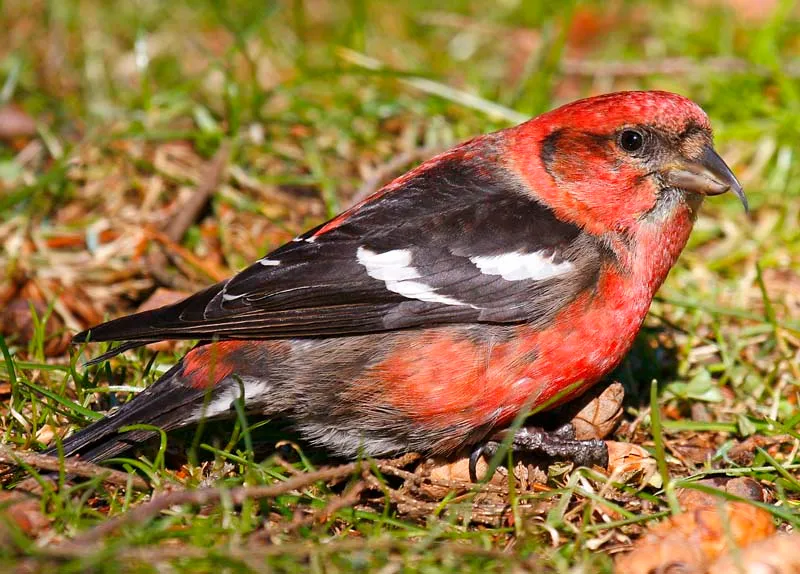
The two-barred crossbill is 14.5–17 cm (5.7–6.7 in) in length and weighs 25–40 g (0.88–1.41 oz). It has short legs, a forked tail, a crossed bill and two prominent white wing-bars. The male of the nominate subspecies has forehead, crown, nape and upper-parts bright raspberry-red. The scapulars are black or blackish brown with pink edges. The upper tail coverts are black with white fringes. The female lacks the pink and instead has greenish-yellow head and upperparts. The two-barred is easier to identify than other crossbills, especially in North America, where only the red crossbill (Loxia curvirostra) and this species occur. Within its Palearctic range, this species is smaller-headed and smaller-billed than the parrot crossbill and Scottish crossbill, so the main confusion between species both there and in North America is with the red or common crossbill. The main plumage distinction from the red crossbill is the white wingbars which give this species its English and scientific names. There are also white tips to the tertials. The adult male is also a somewhat brighter (pinker) red than other male crossbills. Some red crossbills occasionally show weak white wingbars, so care is needed with the correct identification of this species. The chip call is weaker and higher than that of the red crossbill. Another crossbill species on Hispaniola in the Caribbean was previously treated as a subspecies (Loxia leucoptera megaplaga), but is now treated as a distinct species: the Hispaniolan crossbill (Loxia megaplaga). It is associated with the Hispaniolan pine tree (Pinus occidentalis), and differs from the two-barred crossbill in darker plumage, a stouter bill, and its geographic isolation compared to other crossbill species.
Text from Wikipedia — Two-barred crossbill, revision 1348773819, CC BY-SA 4.0, retrieved 2026-09-04. Encyclopedic text reused under CC BY-SA 4.0. Sentences about hunting or regulation are removed: on this site, the rule comes from Québec.ca.
Other names
French
English
Presence in Quebec
- Origin
- Indigène
- Occurrence
- Régulier
- Population status
- Toute l'année
- Certainty
- Confirmé
Conservation
Québec.ca
Official periods
Source: Québec.ca — tables reproduced as published (retrieved 2026-08-30).
Regulations change. Always check Québec.ca before hunting or trapping.
Where this data comes from
This species is listed in an official government dataset. The identification and status shown in the data sheet are reproduced from it.
Source: List of Quebec’s vertebrate wildlife (LFVQ) — Ministère de l’Environnement, de la Lutte contre les changements climatiques, de la Faune et des Parcs. File LFVQ_25_03_2026.csv, retrieved 2026-08-30 · CC BY 4.0.
Measurements, habitat, diet and reproduction are not shown: no official source is attached to them yet.