
No period published by Québec.ca
Québec.ca publishes no hunting or trapping period for this species. Check the official regulations.
Wikipedia
Bec-croisé des sapins
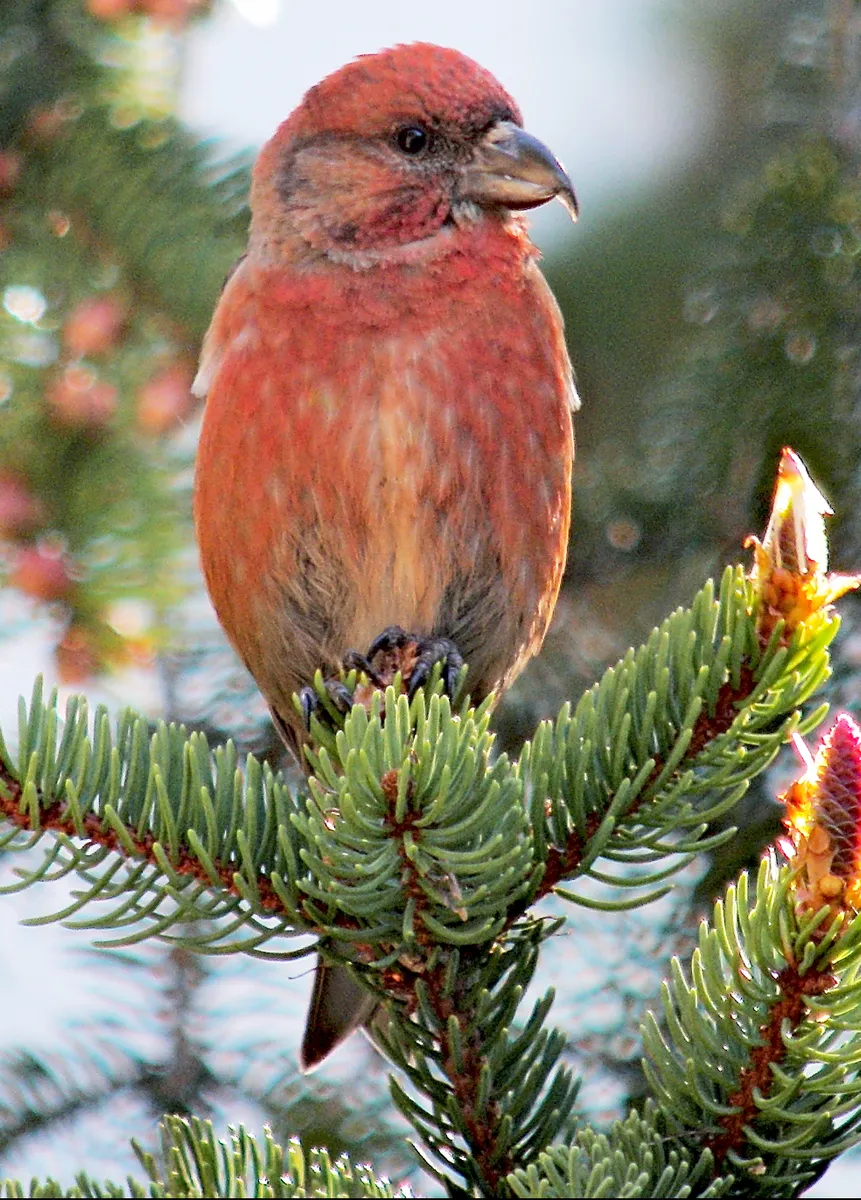
The red crossbill or common crossbill (Loxia curvirostra) is a small passerine bird in the finch family Fringillidae. Crossbills have distinctive mandibles, crossed at the tips, which enable them to extract seeds from conifer cones and other fruits. Adults are often brightly coloured, with red or orange males and green or yellow females, but there is wide variation in beak size and shape, and call types, leading to different classifications of variants, some of which have been named as subspecies. The species is known as "red crossbill" in North America and "common crossbill" in Europe.
Description
Crossbills are distinguished by the mandibles crossing at their tips, which gives the group its English name. Using their crossed mandibles for leverage, crossbills are able to efficiently separate the scales of conifer cones and extract the seeds on which they feed. Adult males tend to be red or orange in colour, and females green or yellow, but there is much variation; juveniles are greyish-green and streaked.
Text from Wikipedia — Red crossbill, revision 1367582542, CC BY-SA 4.0, retrieved 2026-09-04. Encyclopedic text reused under CC BY-SA 4.0. Sentences about hunting or regulation are removed: on this site, the rule comes from Québec.ca.
Other names
French
English
Presence in Quebec
- Origin
- Indigène
- Occurrence
- Régulier
- Population status
- Toute l'année
- Certainty
- Confirmé
Conservation
Québec.ca
Official periods
Source: Québec.ca — tables reproduced as published (retrieved 2026-08-30).
Regulations change. Always check Québec.ca before hunting or trapping.
Where this data comes from
This species is listed in an official government dataset. The identification and status shown in the data sheet are reproduced from it.
Source: List of Quebec’s vertebrate wildlife (LFVQ) — Ministère de l’Environnement, de la Lutte contre les changements climatiques, de la Faune et des Parcs. File LFVQ_25_03_2026.csv, retrieved 2026-08-30 · CC BY 4.0.
Measurements, habitat, diet and reproduction are not shown: no official source is attached to them yet.