
No period published by Québec.ca
Québec.ca publishes no hunting or trapping period for this species. Check the official regulations.
Wikipedia
Bec-en-ciseaux noir
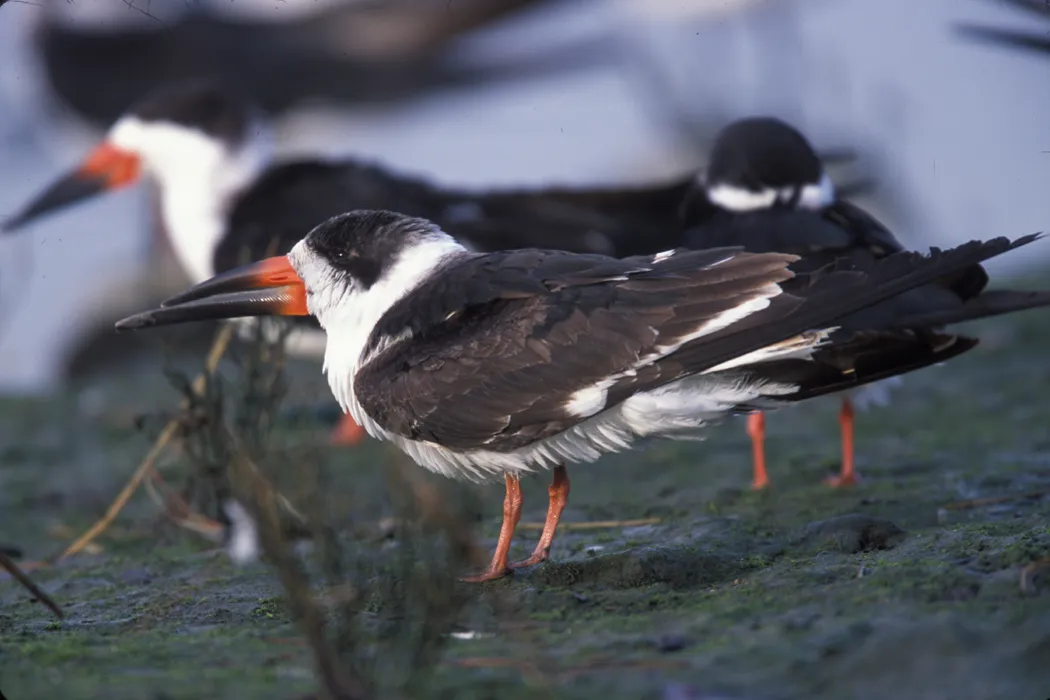
The black skimmer (Rynchops niger) is a tern-like seabird, one of three similar bird species in the skimmer genus Rynchops in the gull family Laridae. It breeds in North and South America. Northern populations winter in the warmer waters of the Caribbean and the tropical and subtropical Pacific and Atlantic coasts, but South American populations make only shorter movements in response to annual floods which extend their feeding areas in the river shallows.
Description
The black skimmer is the largest of the three skimmer species. It measures 40–50 cm (16–20 in) long with a 107–127 cm (42–50 in) wingspan. This species ranges from 212 to 447 g (7.5 to 15.8 oz), with males averaging about 349 g (12.3 oz), as compared to the smaller females 254 g (9.0 oz). The basal half of the bill is red, the rest mainly black, and the lower mandible is much-elongated. The eye has a dark brown iris and catlike vertical pupil, unique for a bird. The legs are red. The call is a barking kak-kak-kak. Adults in breeding plumage have a black crown, nape and upper body. The forehead and underparts are white. The upper wings are black with white on the rear edge, and the tail and rump are dark grey with white edges. The underwing colour varies from white to dusky grey depending on region. Non-breeding adults have paler and browner upperparts, and a white nape collar. Immature birds have brown upperparts with white feather tips and fringes. The underparts and forehead are white, and the underwings as the adult.
Text from Wikipedia — Black skimmer, revision 1358471368, CC BY-SA 4.0, retrieved 2026-09-04. Encyclopedic text reused under CC BY-SA 4.0. Sentences about hunting or regulation are removed: on this site, the rule comes from Québec.ca.
Other names
French
English
Presence in Quebec
- Origin
- Indigène
- Occurrence
- Accidentel/non régulier
- Population status
- Migrateur
- Certainty
- Confirmé
Conservation
Québec.ca
Official periods
Source: Québec.ca — tables reproduced as published (retrieved 2026-08-30).
Regulations change. Always check Québec.ca before hunting or trapping.
Where this data comes from
This species is listed in an official government dataset. The identification and status shown in the data sheet are reproduced from it.
Source: List of Quebec’s vertebrate wildlife (LFVQ) — Ministère de l’Environnement, de la Lutte contre les changements climatiques, de la Faune et des Parcs. File LFVQ_25_03_2026.csv, retrieved 2026-08-30 · CC BY 4.0.
Measurements, habitat, diet and reproduction are not shown: no official source is attached to them yet.