
Migratory game bird — federal regulations
Seasons and bag limits are set by Environment and Climate Change Canada.
Wikipedia
Bécasse d'Amérique
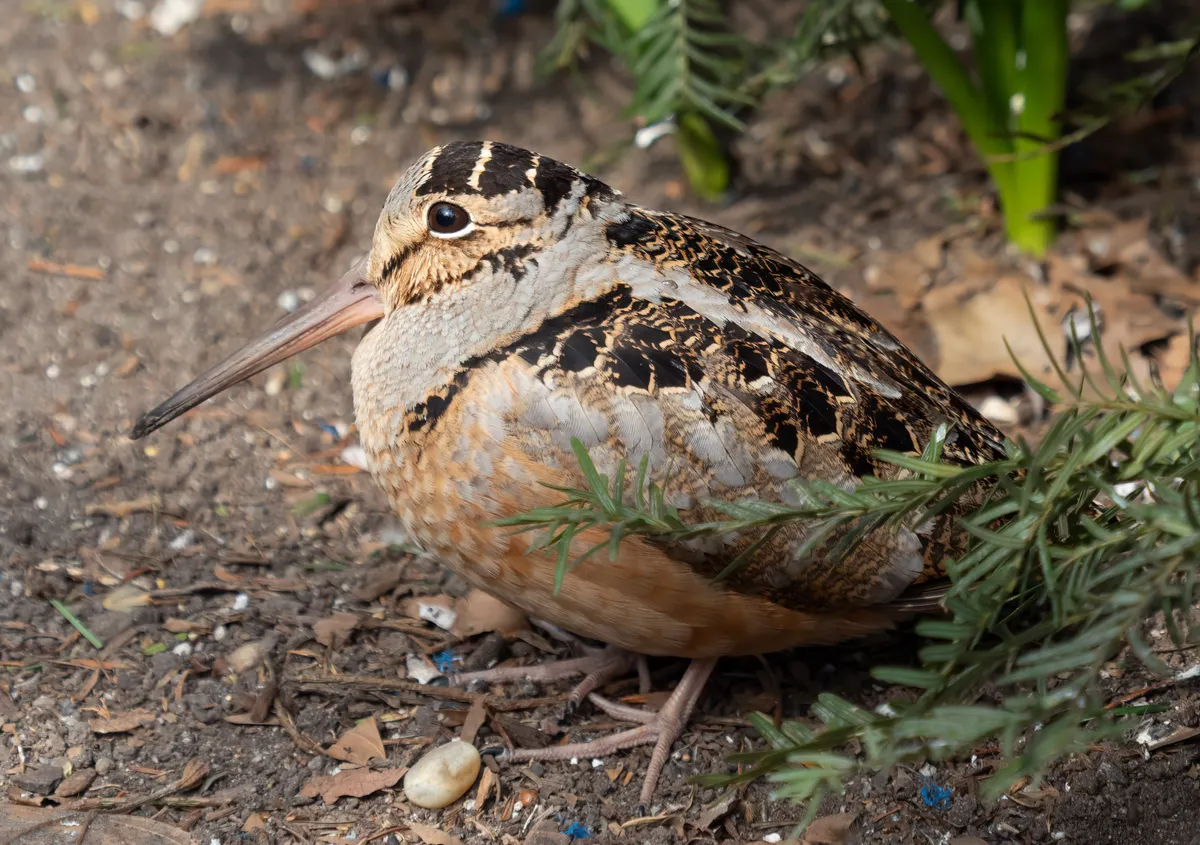
The American woodcock (Scolopax minor), sometimes colloquially referred to as the timberdoodle, mudbat, becasse, bogsucker, brush snipe, night partridge, or Labrador twister is a small shorebird species found primarily in the eastern half of North America. Woodcocks spend most of their time on the ground in brushy, young-forest habitats, where the birds' brown, black, and gray plumage provides excellent camouflage. The American woodcock is the only species of woodcock inhabiting North America. Although classified with the sandpipers and shorebirds in the family Scolopacidae, the American woodcock lives mainly in upland settings. The population of the American woodcock has fallen by an average of slightly more than 1% annually since the 1960s. Most authorities attribute this decline to a loss of habitat caused by forest maturation and urban development. In 2008, wildlife biologists and conservationists released an American woodcock conservation plan presenting figures for the acreage of early successional habitat that must be created and maintained in the United States and Canada to stabilize the woodcock population at current levels, and to return it to 1970s densities.
Description
The American woodcock has a plump body, short legs, a large, rounded head, and a long, straight prehensile bill. Adults are 10 to 12 inches (25 to 30 cm) long and weigh 5 to 8 ounces (140 to 230 g). Females are considerably larger than males. The bill is 2.5 to 2.8 inches (6.4 to 7.1 cm) long. Wingspans range from 16.5 to 18.9 inches (42 to 48 cm). The plumage is a cryptic mix of different shades of browns, grays, and black. The chest and sides vary from yellowish-white to rich tans. This mottled coloring provides camouflage against surrounding leaves and earth. The nape of the head is black, with three or four crossbars of deep buff or rufous. The feet and toes, which are small and weak, are brownish gray to reddish brown. Woodcocks have large eyes located high in their heads, and their visual field is probably the largest of any bird, 360° in the horizontal plane and 180° in the vertical plane. The woodcock uses its long, prehensile bill to probe in the soil for food, mainly invertebrates and especially earthworms. A unique bone-and-muscle arrangement lets the bird open and close the tip of its upper bill, or mandible, while it is sunk in the ground. Both the underside of the upper mandible and the long tongue are rough-surfaced for grasping slippery prey.
Text from Wikipedia — American woodcock, revision 1365203236, CC BY-SA 4.0, retrieved 2026-09-04. Encyclopedic text reused under CC BY-SA 4.0. Sentences about hunting or regulation are removed: on this site, the rule comes from Québec.ca.
Other names
French
English
Presence in Quebec
- Origin
- Indigène
- Occurrence
- Régulier
- Population status
- Reproducteur
- Certainty
- Confirmé
Conservation
Québec.ca
Official periods
Source: Québec.ca — tables reproduced as published (retrieved 2026-08-30).
Regulations change. Always check Québec.ca before hunting or trapping.
SIT Québec register
Outfitters hunting this species
82 outfitters list this species among the game they hunt.
On this site
Related articles
Where this data comes from
This species is listed in an official government dataset. The identification and status shown in the data sheet are reproduced from it.
Source: List of Quebec’s vertebrate wildlife (LFVQ) — Ministère de l’Environnement, de la Lutte contre les changements climatiques, de la Faune et des Parcs. File LFVQ_25_03_2026.csv, retrieved 2026-08-30 · CC BY 4.0.
Measurements, habitat, diet and reproduction are not shown: no official source is attached to them yet.