
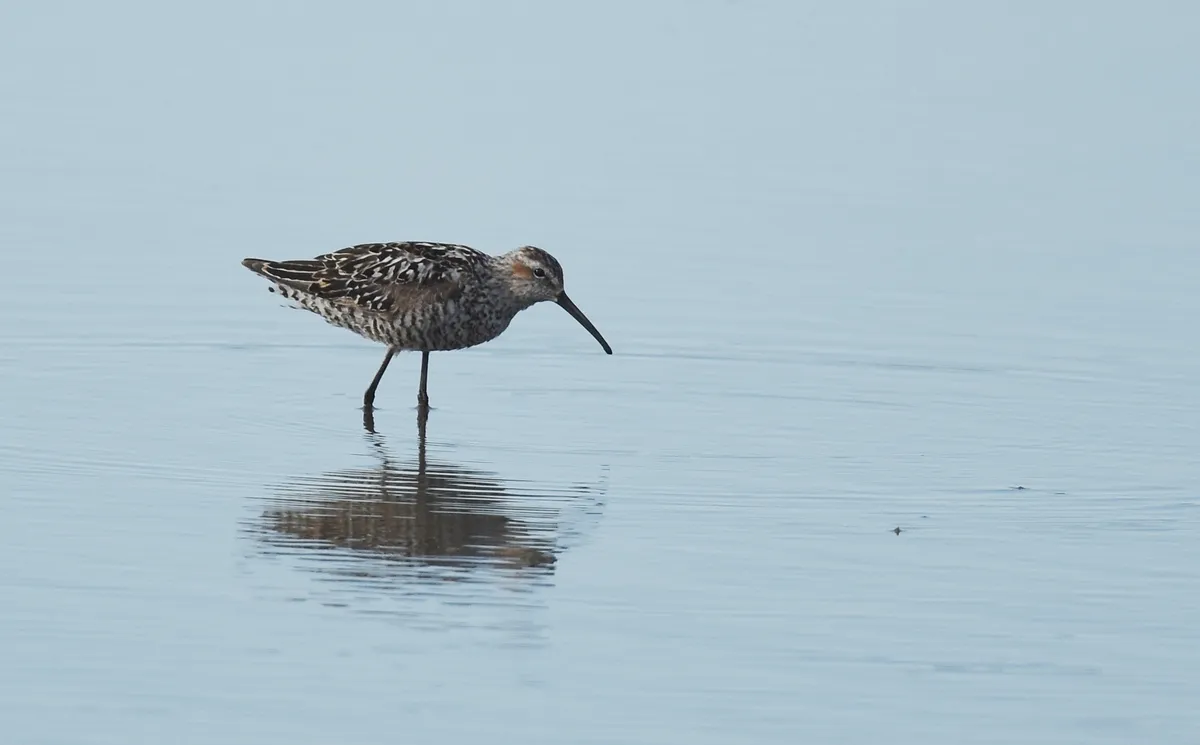
Bécasseau à échasses— Quebec wildlife
Calidris himantopus
ScolopacidaeNo period published by Québec.ca
Québec.ca publishes no hunting or trapping period for this species. Check the official regulations.
Wikipedia
Bécasseau à échasses
The stilt sandpiper (Calidris himantopus) is a small shorebird. The scientific name is from Ancient Greek; the genus name kalidris or skalidris is a term used by Aristotle for a gray-colored waterside bird. The specific himantopus means "strap foot" or "thong foot", and also refers to the stilt.
Description
The stilt sandpiper resembles the curlew sandpiper in its long bill, long neck, pale supercilium and white rump. It is readily distinguished from that species by its straighter bill (only slightly curved, not obviously so), its longer and greenish-yellow (not black) legs, and in flight, by the lack of a wingbar. It also lacks an obvious wing bar in flight. Breeding adults are distinctive, heavily barred with blackish bars on a white background beneath, and with reddish-orange patches above and below the white supercilium. The back is brown with darker feather centres. The winter plumage is gray above and white below, and still has a white supercilium. Juveniles resemble the adults in their strong head pattern and brownish back, but they are not barred below, and show white fringes on the back feathering. Measurements: Length: 18–23 cm (7.1–9.1 in) Wingspan: 37–42 cm (15–17 in) Weight: 50–70 g (1.8–2.5 oz)
Text from Wikipedia — Stilt sandpiper, revision 1354264845, CC BY-SA 4.0, retrieved 2026-09-04. Encyclopedic text reused under CC BY-SA 4.0. Sentences about hunting or regulation are removed: on this site, the rule comes from Québec.ca.
Other names
French
English
Former scientific names
Presence in Quebec
- Origin
- Indigène
- Occurrence
- Régulier
- Population status
- Migrateur
- Certainty
- Confirmé
Conservation
Québec.ca
Official periods
Source: Québec.ca — tables reproduced as published (retrieved 2026-08-30).
Regulations change. Always check Québec.ca before hunting or trapping.
SIT Québec register
Outfitters hunting this species
82 outfitters list this species among the game they hunt.
Where this data comes from
This species is listed in an official government dataset. The identification and status shown in the data sheet are reproduced from it.
Source: List of Quebec’s vertebrate wildlife (LFVQ) — Ministère de l’Environnement, de la Lutte contre les changements climatiques, de la Faune et des Parcs. File LFVQ_25_03_2026.csv, retrieved 2026-08-30 · CC BY 4.0.
Measurements, habitat, diet and reproduction are not shown: no official source is attached to them yet.