
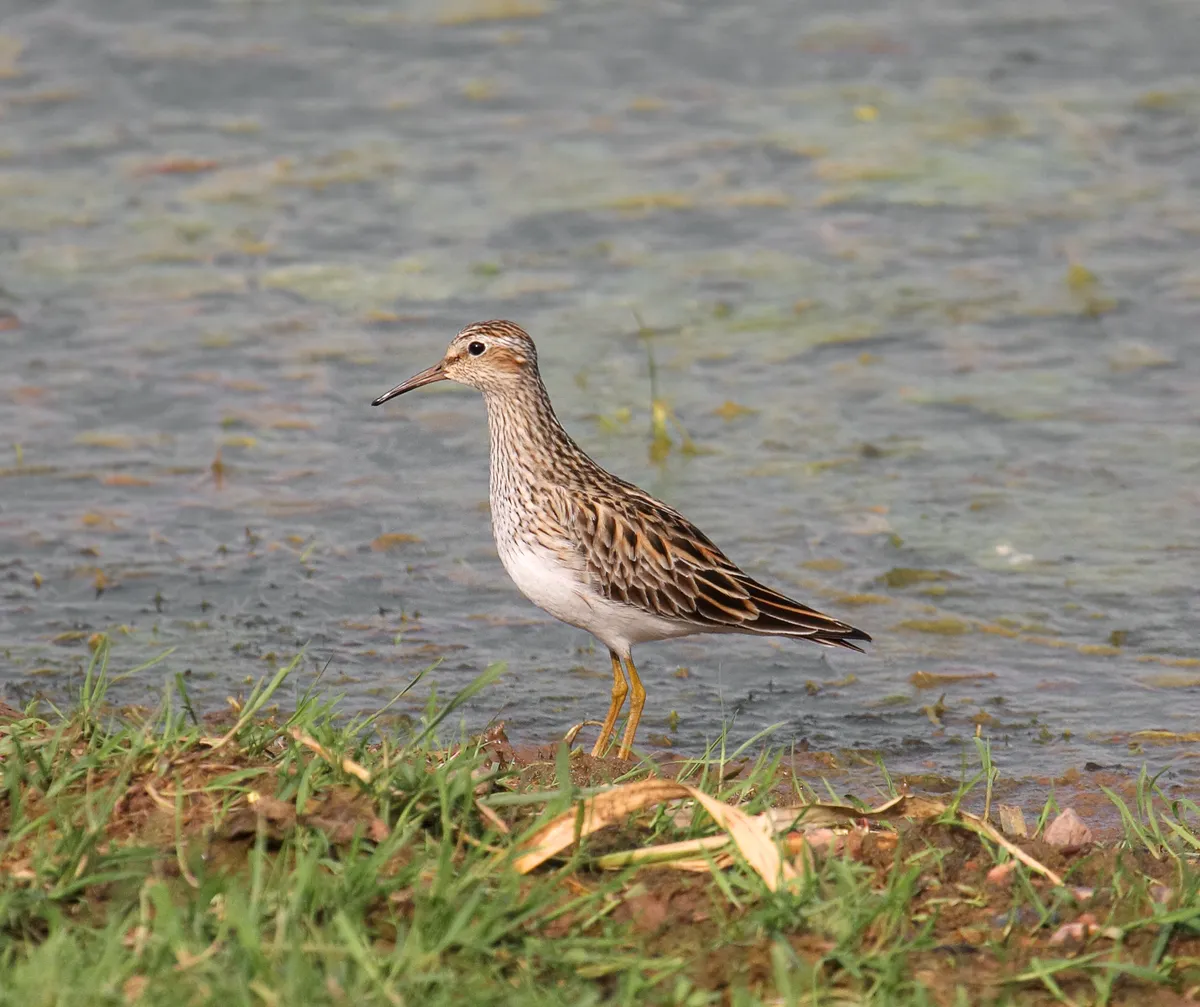
Bécasseau à poitrine cendrée— Quebec wildlife
Calidris melanotos
ScolopacidaeNo period published by Québec.ca
Québec.ca publishes no hunting or trapping period for this species. Check the official regulations.
Wikipedia
Bécasseau à poitrine cendrée
The pectoral sandpiper (Calidris melanotos), often abbreviated pec, is a small, migratory wader that breeds in arctic regions of North America and Asia, wintering in South America and Oceania. It eats small invertebrates. Its nest, a hole scraped in the ground and with a thick lining, is deep enough to protect its four eggs from the cool breezes of its breeding grounds. The pectoral sandpiper is 19–23 cm (7.5–9.1 in) long, with a wingspan of 38–46 cm (15–18 in).
Description
This bird looks similar to the widely sympatric sharp-tailed sandpiper (C. acuminata), which is not however a member of the same clade in the genus. The pectoral sandpiper is a largish calidrid (19–23 cm (7.5–9.1 in) in length, with a wingspan of 37–46 cm (15–18 in)) with a grey-brown back, brownest in the summer male, and greyest in winter. The pectoral sandpiper has a grey breast, sharply demarcated at its lower edge, which gives this species its English name; this clear dividing line is particularly conspicuous if the birds are turned towards the observer. The legs are yellowish, and the bill is olive with a darker tip. The males are on average heavier than the females, but with much overlap; in breeding plumage, males also have a blacker breast spotted whitish. The juveniles are more brightly patterned above with rufous coloration and white mantle stripes. This species differs from the sharp-tailed sandpiper in its strong breast band pattern, weaker supercilium and browner, less rufous crown.
Text from Wikipedia — Pectoral sandpiper, revision 1348840754, CC BY-SA 4.0, retrieved 2026-09-04. Encyclopedic text reused under CC BY-SA 4.0. Sentences about hunting or regulation are removed: on this site, the rule comes from Québec.ca.
Other names
French
Presence in Quebec
- Origin
- Indigène
- Occurrence
- Régulier
- Population status
- Reproducteur
- Certainty
- Confirmé
Conservation
Québec.ca
Official periods
Source: Québec.ca — tables reproduced as published (retrieved 2026-08-30).
Regulations change. Always check Québec.ca before hunting or trapping.
SIT Québec register
Outfitters hunting this species
82 outfitters list this species among the game they hunt.
Where this data comes from
This species is listed in an official government dataset. The identification and status shown in the data sheet are reproduced from it.
Source: List of Quebec’s vertebrate wildlife (LFVQ) — Ministère de l’Environnement, de la Lutte contre les changements climatiques, de la Faune et des Parcs. File LFVQ_25_03_2026.csv, retrieved 2026-08-30 · CC BY 4.0.
Measurements, habitat, diet and reproduction are not shown: no official source is attached to them yet.