
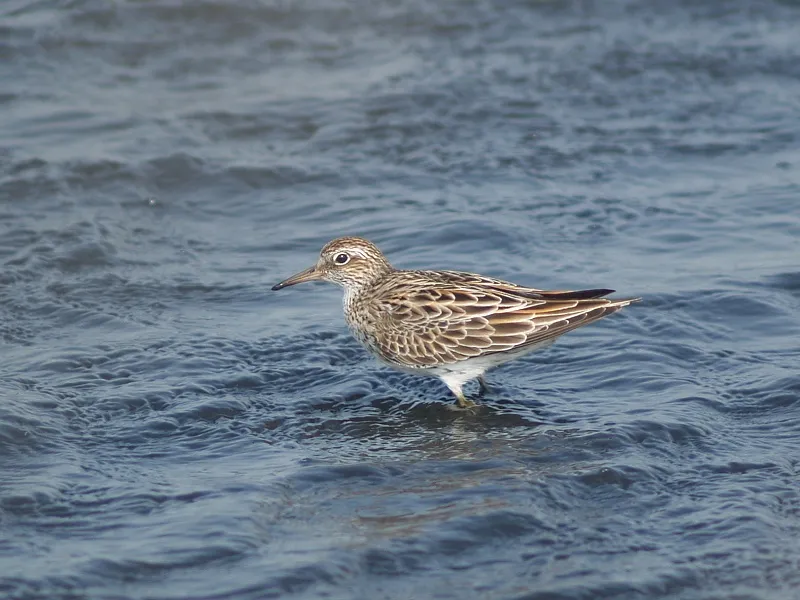
Bécasseau à queue pointue— Quebec wildlife
Calidris acuminata
ScolopacidaeNo period published by Québec.ca
Québec.ca publishes no hunting or trapping period for this species. Check the official regulations.
Wikipedia
Bécasseau à queue pointue
The sharp-tailed sandpiper (Calidris acuminata) is a small-medium migratory wader or shorebird, found mostly in Siberia during the summer breeding period (June to August) and Australia for wintering (September to March).
Description
A small-medium wader, the portly sandpiper has a pot belly, flat back and somewhat drawn-out rear end. It has a mottled chestnut-brown upper body with sharp-looking feathers with a dark centre, a chestnut cap on its head and a brown stripe through each eye. Its bill is dark grey to black and straight, and its legs are olive- to yellow-coloured. The underparts are white or paler in colour, with the mottling similar to that on the breast and sides of the belly. The plumage is more vivid during the breeding season and duller in its winter plumage. The juveniles are brighter in colour in autumn and early winter than adults, with sharper feathers and brighter chestnut-coloured crowns contrasting with the white mantle stripes and bright, buffy chests. The most similar-looking species is the pectoral sandpiper, within whose Asian range the sharp-tailed sandpiper breeds. It differs from that species in its breast pattern, lacking the strongly demarcated breast band, and instead having '>'-shaped marks on the flanks; a stronger supercilium, and more chestnut-coloured crown. It has some similarities to the long-toed stint, but is much larger.
Habitat and range
In Siberia, the breeding ground is mostly tundra made up of peat-hummock and lichen. On passage between breeding and wintering areas they favor the muddy edges of shallow freshwater or brackish wetlands with grass, emergent or inundated sedges, saltmarsh or other low vegetation. These include swamps, lakes, lagoons, and pools near coasts, waterholes, dams, saltpans and hypersaline salt lakes inland. In Alaska they seem to prefer coastal moist graminoid meadows and riverine intertidally exposed mudbanks. In Australia they are largely found around wetlands, preferring freshwater inland wetlands with grassy edges. Once the ephemeral terrestrial wetlands have dried out, they tend to be seen on coastal mudflats, salt marsh and brackish lagoons and less often on similar wet fields of short grass. Other areas they have been spotted in Australia include around sewage farms, flooded fields, mangroves, rocky shores and beaches.
Text from Wikipedia — Sharp-tailed sandpiper, revision 1351000369, CC BY-SA 4.0, retrieved 2026-09-04. Encyclopedic text reused under CC BY-SA 4.0. Sentences about hunting or regulation are removed: on this site, the rule comes from Québec.ca.
Other names
French
Presence in Quebec
- Origin
- Indigène
- Occurrence
- Accidentel/non régulier
- Population status
- Migrateur
- Certainty
- Confirmé
Conservation
Québec.ca
Official periods
Source: Québec.ca — tables reproduced as published (retrieved 2026-08-30).
Regulations change. Always check Québec.ca before hunting or trapping.
SIT Québec register
Outfitters hunting this species
82 outfitters list this species among the game they hunt.
Where this data comes from
This species is listed in an official government dataset. The identification and status shown in the data sheet are reproduced from it.
Source: List of Quebec’s vertebrate wildlife (LFVQ) — Ministère de l’Environnement, de la Lutte contre les changements climatiques, de la Faune et des Parcs. File LFVQ_25_03_2026.csv, retrieved 2026-08-30 · CC BY 4.0.
Measurements, habitat, diet and reproduction are not shown: no official source is attached to them yet.