
No period published by Québec.ca
Québec.ca publishes no hunting or trapping period for this species. Check the official regulations.
Wikipedia
Bécasseau cocorli
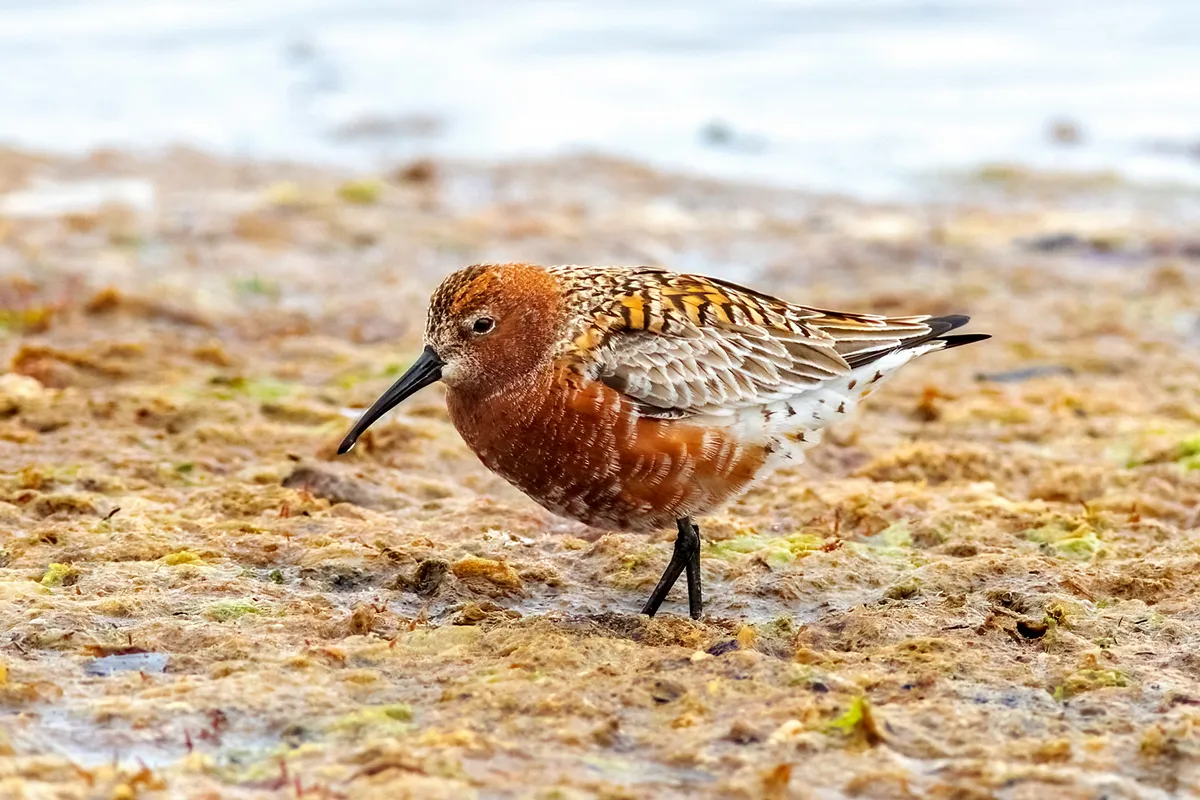
The curlew sandpiper (Calidris ferruginea) is a small wader. It is a long-distance migrant, breeding in the bogs and coastal lowlands of the Siberian Arctic, arriving there in June and staying until August or September. After the breeding season, it migrates south to spend the winter in Africa and along the coasts of Oceania and southern Eurasia, occupying tidal mudflats and saltpans. It has three main plumages that change with maturity and season. The non-breeding plumage shows brown-greyish upperparts and white underparts. The breeding plumage is much more striking, with the entire front tinted a deep rusty colour, more intensely so in males. The first-year bird does not migrate or breed, instead remaining in its overwintering range throughout the breeding season. It may occasionally moult into its breeding plumage, which is largely similar to that of an adult but with white spots on the chest. The non-breeding juvenile plumage is also like that of an adult, except with creamy-coloured streaking on the breast and pale fringes on some of the wing feathers, leading to a scaly appearance. Adults superficially resemble the larger but shorter-billed red knot and the red phalarope in breeding plumage, and the dunlin and stilt sandpiper while not breeding. Juveniles may be confused with the larger and yellow-legged juvenile ruff, or the juvenile dunlin, which has a streaked chest. The curlew sandpiper's courtship behaviour is complex and involves several distinct displays. In one, the male constructs a faux nest on the ground to present to the female. Another is a graceful aerial chase accompanied by frequent warbling calls. In a third, the male dances around the female on the ground, displaying his tail feathers and rump; this display sometimes culminates in copulation. The female almost always lays one clutch of eggs, usually around the end of June, which hatch after 20 days and fully fledge at 14–20 days. Chicks are relatively mature and mobile at birth. It is omnivorous, foraging in large flocks in wetlands for various invertebrates, including crabs and insects. The curlew sandpiper is listed as a vulnerable species on the IUCN Red List because land development and the invasive smooth cordgrass have caused significant habitat loss to its overwintering and migratory sites, and climate change has lowered its breeding productivity. The curlew sandpiper has an estimated annual survival rate of 75–80%.
Description
The curlew sandpiper is a small wader 18–23 cm in length and weighing 44–117 g. It has a wingspan of 38–46 cm, a bill length of 32–44 mm, and a tarsus (the bone between the "knee" and the "ankle") length of 26–34 mm. It has a black bill, dark brown irises, and dark grey to black feet.
Text from Wikipedia — Curlew sandpiper, revision 1369579776, CC BY-SA 4.0, retrieved 2026-09-04. Encyclopedic text reused under CC BY-SA 4.0. Sentences about hunting or regulation are removed: on this site, the rule comes from Québec.ca.
Other names
French
Presence in Quebec
- Origin
- Indigène
- Occurrence
- Accidentel/non régulier
- Population status
- Migrateur
- Certainty
- Confirmé
Conservation
Québec.ca
Official periods
Source: Québec.ca — tables reproduced as published (retrieved 2026-08-30).
Regulations change. Always check Québec.ca before hunting or trapping.
SIT Québec register
Outfitters hunting this species
82 outfitters list this species among the game they hunt.
Where this data comes from
This species is listed in an official government dataset. The identification and status shown in the data sheet are reproduced from it.
Source: List of Quebec’s vertebrate wildlife (LFVQ) — Ministère de l’Environnement, de la Lutte contre les changements climatiques, de la Faune et des Parcs. File LFVQ_25_03_2026.csv, retrieved 2026-08-30 · CC BY 4.0.
Measurements, habitat, diet and reproduction are not shown: no official source is attached to them yet.