
No period published by Québec.ca
Québec.ca publishes no hunting or trapping period for this species. Check the official regulations.
Wikipedia
Bécasseau d'Alaska
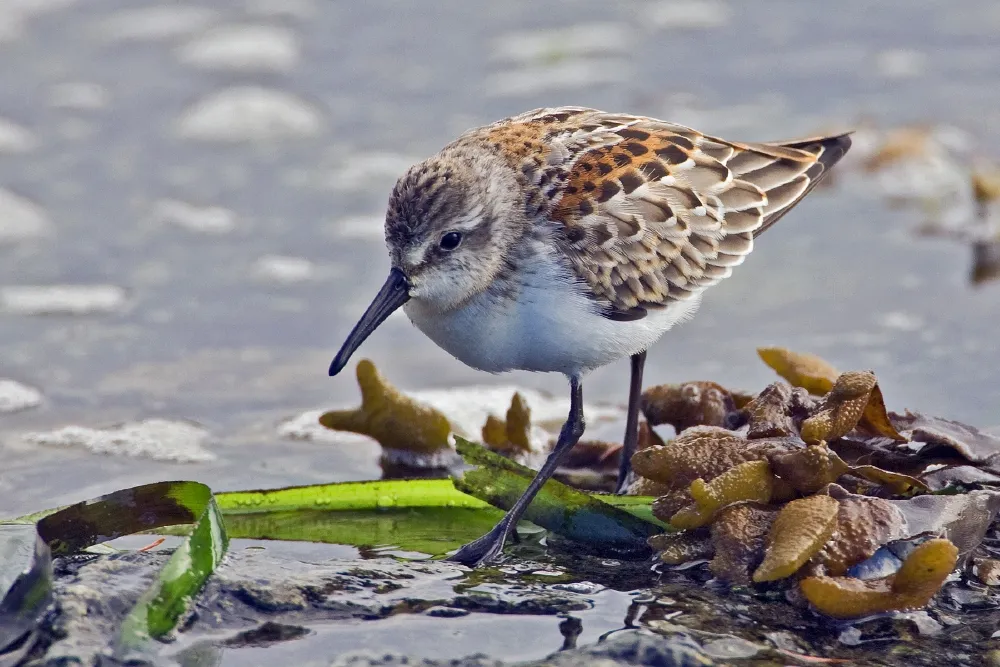
The western sandpiper (Calidris mauri) is a small migratory shorebird. The genus name is from Ancient Greek kalidris or skalidris, a term used by Aristotle for some grey-coloured waterside birds. The specific mauri commemorates Italian botanist Ernesto Mauri (1791–1836). This is one of the most abundant shorebird species in North America, with a population in the millions. Within the genus Calidris the western sandpiper is most closely related to the semipalmated sandpiper (Calidris pusilla).
Description
Adults have dark legs and a short, thin, dark bill, thinner at the tip. The body is brown on top and white underneath. They are reddish-brown on the crown. This bird can be difficult to distinguish from other similar tiny shorebirds, especially the semipalmated sandpiper. This is particularly the case in winter plumage, when both species are plain grey. The western sandpiper acquires winter plumage much earlier in the autumn than the semipalmated sandpiper. Measurements: Length: 14–17 cm (5.5–6.7 in) Wingspan: 35–37 cm (14–15 in) Weight: 22–35 g (0.78–1.23 oz)
Diet
These birds forage on mudflats during migration and the non-breeding season by probing or picking up food by sight. Foraging occurs on tundra and wet meadows during the breeding season. They had been thought to mainly eat insects, spiders, small crustaceans, mollusks, polychaete worms, and seeds, but are now known to heavily graze on biofilm from the surface of intertidal mudflats.
Reproduction
Their breeding habitat is tundra in eastern Siberia and Alaska. They nest on the ground usually under some vegetation. The male makes several scrapes; the female selects one and lays four eggs. Both parents incubate and care for dependent young, who feed themselves. Sometimes the female deserts her mate and brood prior to offspring fledging.
Text from Wikipedia — Western sandpiper, revision 1361276786, CC BY-SA 4.0, retrieved 2026-09-04. Encyclopedic text reused under CC BY-SA 4.0. Sentences about hunting or regulation are removed: on this site, the rule comes from Québec.ca.
Other names
French
English
Presence in Quebec
- Origin
- Indigène
- Occurrence
- Régulier
- Population status
- Migrateur
- Certainty
- Confirmé
Conservation
Québec.ca
Official periods
Source: Québec.ca — tables reproduced as published (retrieved 2026-08-30).
Regulations change. Always check Québec.ca before hunting or trapping.
SIT Québec register
Outfitters hunting this species
82 outfitters list this species among the game they hunt.
Where this data comes from
This species is listed in an official government dataset. The identification and status shown in the data sheet are reproduced from it.
Source: List of Quebec’s vertebrate wildlife (LFVQ) — Ministère de l’Environnement, de la Lutte contre les changements climatiques, de la Faune et des Parcs. File LFVQ_25_03_2026.csv, retrieved 2026-08-30 · CC BY 4.0.
Measurements, habitat, diet and reproduction are not shown: no official source is attached to them yet.