
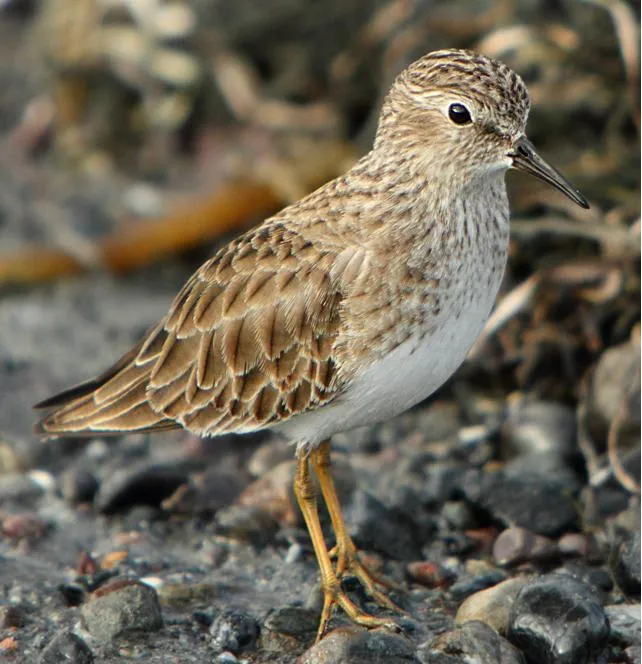
Bécasseau minuscule— Quebec wildlife
Calidris minutilla
ScolopacidaeNo period published by Québec.ca
Québec.ca publishes no hunting or trapping period for this species. Check the official regulations.
Wikipedia
Bécasseau minuscule
The least sandpiper (Calidris minutilla) is the smallest shorebird. The genus name is from Ancient Greek kalidris or skalidris, a term used by Aristotle for some grey-coloured waterside birds. The specific minutilla is Medieval Latin for "very small". Within the genus Calidris, the least sandpiper is most closely related to the white-rumped sandpiper (Calidris fuscicollis).
Description
This species has yellow-green legs and a short, thin, dark bill. Breeding adults are brown with dark brown streaks on top and white underneath. They have a light line above the eye and a dark crown. In winter, Least sandpipers are grey above. The juveniles are brightly patterned above with rufous colour and white mantle stripes. This bird can be difficult to distinguish from other similar tiny shorebirds; these are known collectively as "peeps" or "stints". In particular, least sandpiper is very similar to its Asian counterpart, long-toed stint. It differs from that species in its more compact, shorter-necked appearance, shorter toes, somewhat duller colour, and stronger wingbar. Measurements: Length: 13–15 cm (5.1–5.9 in) Wingspan: 27–28 cm (11–11 in) Weight: 19–30 g (0.67–1.06 oz)
Diet
These birds forage on mudflats, picking up food by sight, sometimes by probing. They mainly eat small crustaceans, insects, and snails. While migrating through the Delaware Bay, least sandpipers eat worms, detritus, and the eggs of horseshoe crabs.
Text from Wikipedia — Least sandpiper, revision 1351004494, CC BY-SA 4.0, retrieved 2026-09-04. Encyclopedic text reused under CC BY-SA 4.0. Sentences about hunting or regulation are removed: on this site, the rule comes from Québec.ca.
Other names
French
English
Presence in Quebec
- Origin
- Indigène
- Occurrence
- Régulier
- Population status
- Reproducteur
- Certainty
- Confirmé
Conservation
Québec.ca
Official periods
Source: Québec.ca — tables reproduced as published (retrieved 2026-08-30).
Regulations change. Always check Québec.ca before hunting or trapping.
SIT Québec register
Outfitters hunting this species
82 outfitters list this species among the game they hunt.
Where this data comes from
This species is listed in an official government dataset. The identification and status shown in the data sheet are reproduced from it.
Source: List of Quebec’s vertebrate wildlife (LFVQ) — Ministère de l’Environnement, de la Lutte contre les changements climatiques, de la Faune et des Parcs. File LFVQ_25_03_2026.csv, retrieved 2026-08-30 · CC BY 4.0.
Measurements, habitat, diet and reproduction are not shown: no official source is attached to them yet.