
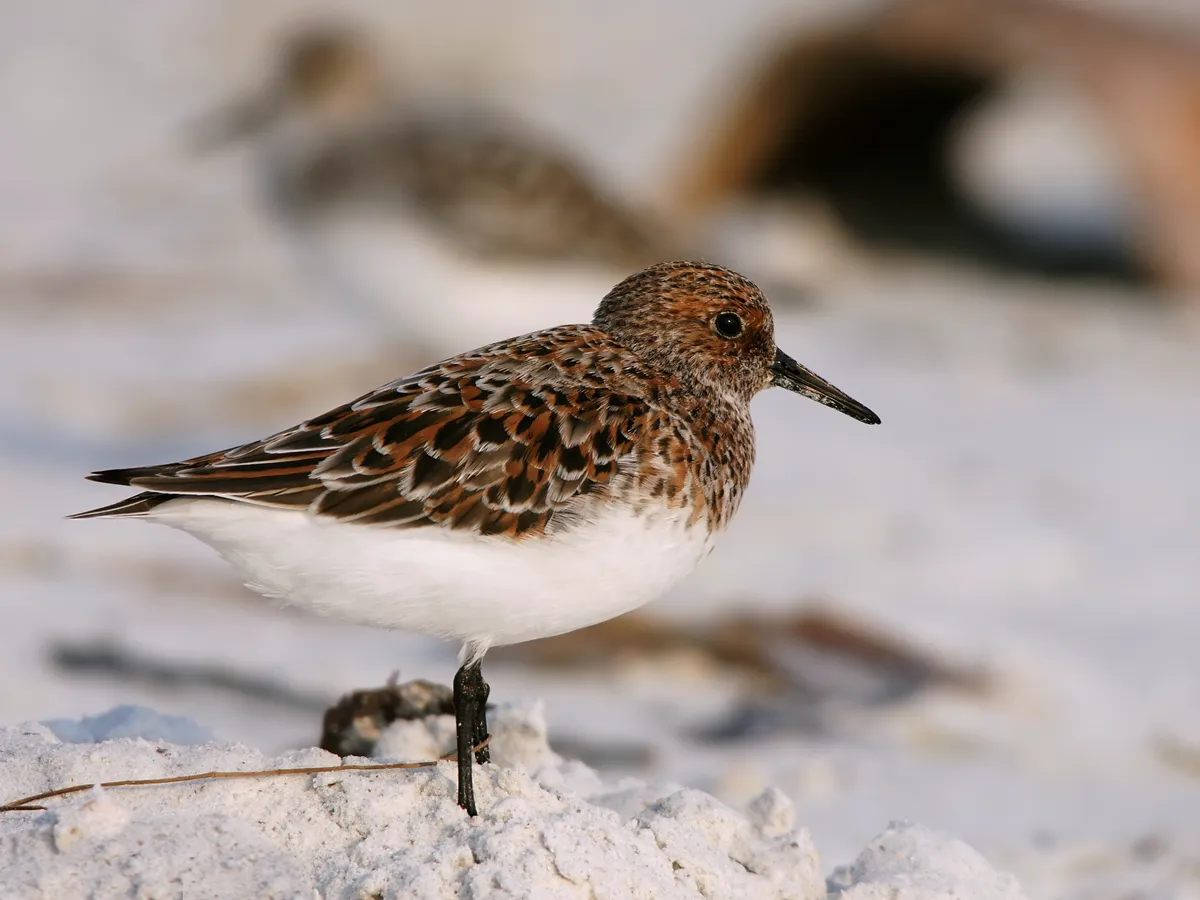
Bécasseau sanderling— Quebec wildlife
Calidris alba
ScolopacidaeNo period published by Québec.ca
Québec.ca publishes no hunting or trapping period for this species. Check the official regulations.
Wikipedia
Bécasseau sanderling
The sanderling (Calidris alba) is a small wading bird. It is a circumpolar Arctic breeder, being among the most extreme northern breeding birds in the world, nesting only on the coldest tundra, north of the 5°C July isotherm; in Europe, its southernmost breeding locality is Svalbard, where only a handful (5–15) pairs breed. It is a long-distance migrant, wintering south to South America, western and southern Europe, Africa, and Australia. It is highly gregarious in winter, sometimes forming large flocks on coastal mudflats or sandy beaches. It is somewhat unlike other small sandpipers in appearance, in particular in lacking a hind toe, which has led to the suggestion that it should be placed into a monotypic genus Crocethia. More recent reviews indicate that the sanderling is a fairly typical "stint" or small sandpiper and should be retained along with the knots and other relatives in the genus Calidris. This bird is similar in size to a dunlin, but stouter, with a thick bill. It shows a strong white wingbar in flight, and runs along the sandy beaches it prefers with a characteristic "bicycling" action of its legs, stopping frequently to pick small food items. It eats small crabs and other small invertebrates. In spring, birds migrating north from South America consume large numbers of horseshoe crab eggs in the Delaware Bay area. In spring, the birds arrive on their High Arctic breeding grounds (see map) at the end of May or in early June, where they lay 3–4 eggs in a ground scrape from mid June to mid July. On the nesting grounds, these birds mainly eat insects and some plant material. The sanderling was described by the German naturalist Peter Simon Pallas in 1764 and given the binomial name Trynga alba. The sanderling is one of the species to which the Agreement on the Conservation of African-Eurasian Migratory Waterbirds (AEWA) applies.
Description
The sanderling is a small plump sandpiper, 18–20 cm (7–8 in) in length. Its weight ranges from 40–100 g (1+1⁄2–3+1⁄2 oz). The winter bird is very pale, almost white apart from a dark shoulder patch. This is the source of the specific name, alba, which is the Latin for "white". Later in the summer, the face and throat become brick-red. The juvenile bird is spangled black and white, and shows much more contrast than the adult. If its size is misjudged, a sanderling in breeding plumage can be mistaken for some varieties of stint, or a sanderling in winter plumage can be mistaken for a dunlin or red knot. It can be told from other small wading birds, given good views, by its lack of a hind toe. Its behaviour is also distinctive.
Text from Wikipedia — Sanderling, revision 1357115377, CC BY-SA 4.0, retrieved 2026-09-04. Encyclopedic text reused under CC BY-SA 4.0. Sentences about hunting or regulation are removed: on this site, the rule comes from Québec.ca.
Other names
French
English
Presence in Quebec
- Origin
- Indigène
- Occurrence
- Régulier
- Population status
- Migrateur
- Certainty
- Confirmé
Conservation
Québec.ca
Official periods
Source: Québec.ca — tables reproduced as published (retrieved 2026-08-30).
Regulations change. Always check Québec.ca before hunting or trapping.
SIT Québec register
Outfitters hunting this species
82 outfitters list this species among the game they hunt.
Where this data comes from
This species is listed in an official government dataset. The identification and status shown in the data sheet are reproduced from it.
Source: List of Quebec’s vertebrate wildlife (LFVQ) — Ministère de l’Environnement, de la Lutte contre les changements climatiques, de la Faune et des Parcs. File LFVQ_25_03_2026.csv, retrieved 2026-08-30 · CC BY 4.0.
Measurements, habitat, diet and reproduction are not shown: no official source is attached to them yet.