
No period published by Québec.ca
Québec.ca publishes no hunting or trapping period for this species. Check the official regulations.
Wikipedia
Bécasseau variable
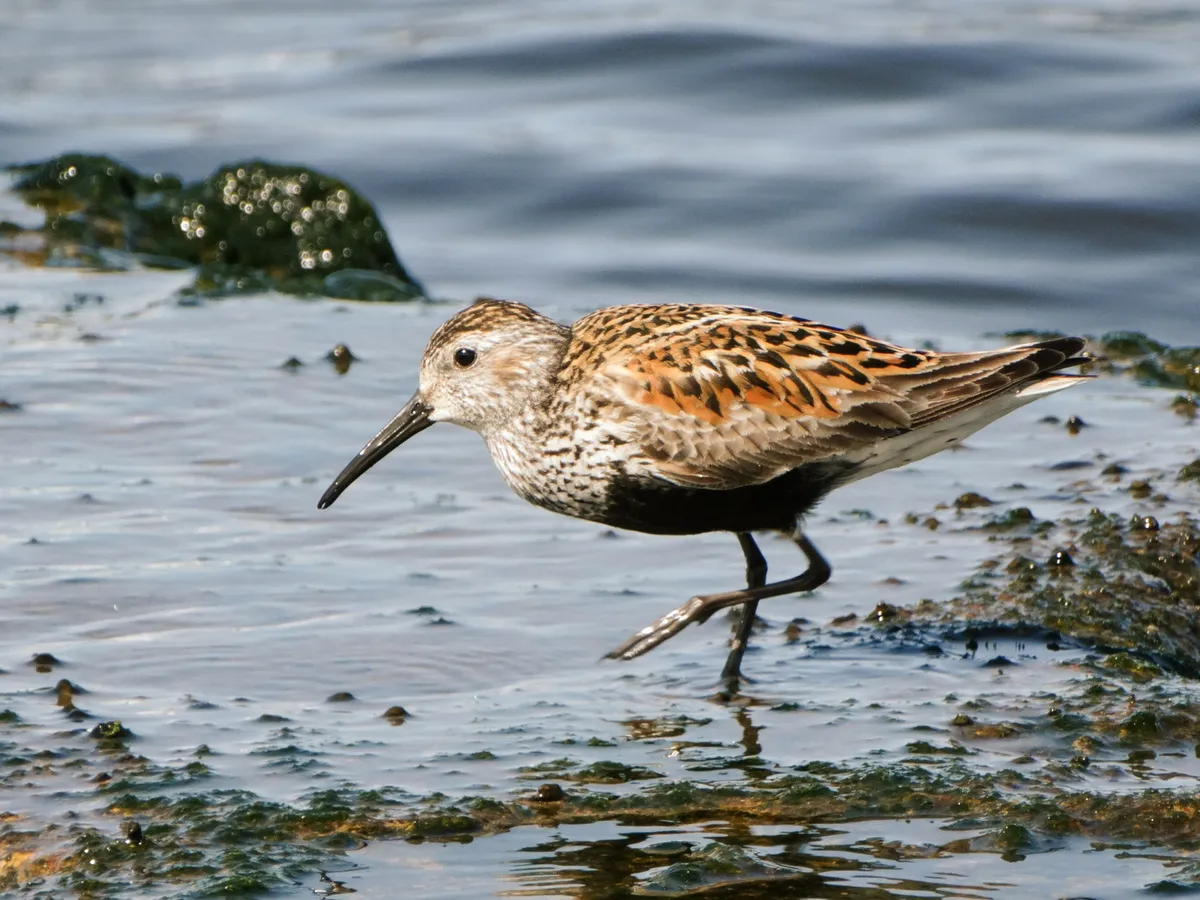
The dunlin (Calidris alpina) is a small wader in the genus Calidris. The English name is a dialect form of "dunling", first recorded in 1531–1532. It derives from dun, "dull brown", with the suffix -ling, meaning a person or thing with the given quality. It is a circumpolar breeder in Arctic or subarctic regions. Birds that breed in western Europe are short-distance migrants largely staying on western and southern European and northwest African coasts; those breeding in far northern Europe and Asia are long-distance migrants, wintering south to Africa, southeast and west Asia. Birds that breed in Alaska and the Canadian Arctic migrate short distances to the Pacific and Atlantic coasts of North America, although those nesting in northern Alaska overwinter in Asia.
Description
Measurements: Length: 16–20 cm (6.3–7.9 in) Weight: 34–77 g (1+1⁄4–2+3⁄4 oz) Wingspan: 38–43 cm (15–17 in) An adult dunlin in breeding plumage shows the distinctive black belly which no other similar-sized wader possesses. In winter, dunlins are greyish-brown above and white below. Juveniles are brown above with two weak whitish "V" shapes on the back, though less obvious than the same feature on little stint and some other species in the genus. They usually have black marks on the flanks or belly. All ages show a narrow white wingbar in flight. The legs and slightly decurved bill are black. The subspecies differ mainly in the extent of rufous plumage and the size of the black belly patch in the breeding season, and the bill length; in winter there are no subspecific distinctions in the plumage, with only the bill length providing a limited guide. Bill length varies between sexes, the females having longer bills than the males, further complicating winter subspecies identification. On the tip of the Dunlin's bill is a soft covering that fills with blood and with many nerve endings, forming a sensitive probe that is used to locate invertebrate prey in mud and sand. Although the bill can look sharp-pointed in dead specimens, in life it is blunt. The call is a typical sandpiper "chreep", and the display song a harsh trill.
Text from Wikipedia — Dunlin, revision 1372293382, CC BY-SA 4.0, retrieved 2026-09-04. Encyclopedic text reused under CC BY-SA 4.0. Sentences about hunting or regulation are removed: on this site, the rule comes from Québec.ca.
Other names
French
Presence in Quebec
- Origin
- Indigène
- Occurrence
- Régulier
- Population status
- Reproducteur
- Certainty
- Confirmé
Conservation
Québec.ca
Official periods
Source: Québec.ca — tables reproduced as published (retrieved 2026-08-30).
Regulations change. Always check Québec.ca before hunting or trapping.
SIT Québec register
Outfitters hunting this species
82 outfitters list this species among the game they hunt.
Where this data comes from
This species is listed in an official government dataset. The identification and status shown in the data sheet are reproduced from it.
Source: List of Quebec’s vertebrate wildlife (LFVQ) — Ministère de l’Environnement, de la Lutte contre les changements climatiques, de la Faune et des Parcs. File LFVQ_25_03_2026.csv, retrieved 2026-08-30 · CC BY 4.0.
Measurements, habitat, diet and reproduction are not shown: no official source is attached to them yet.