
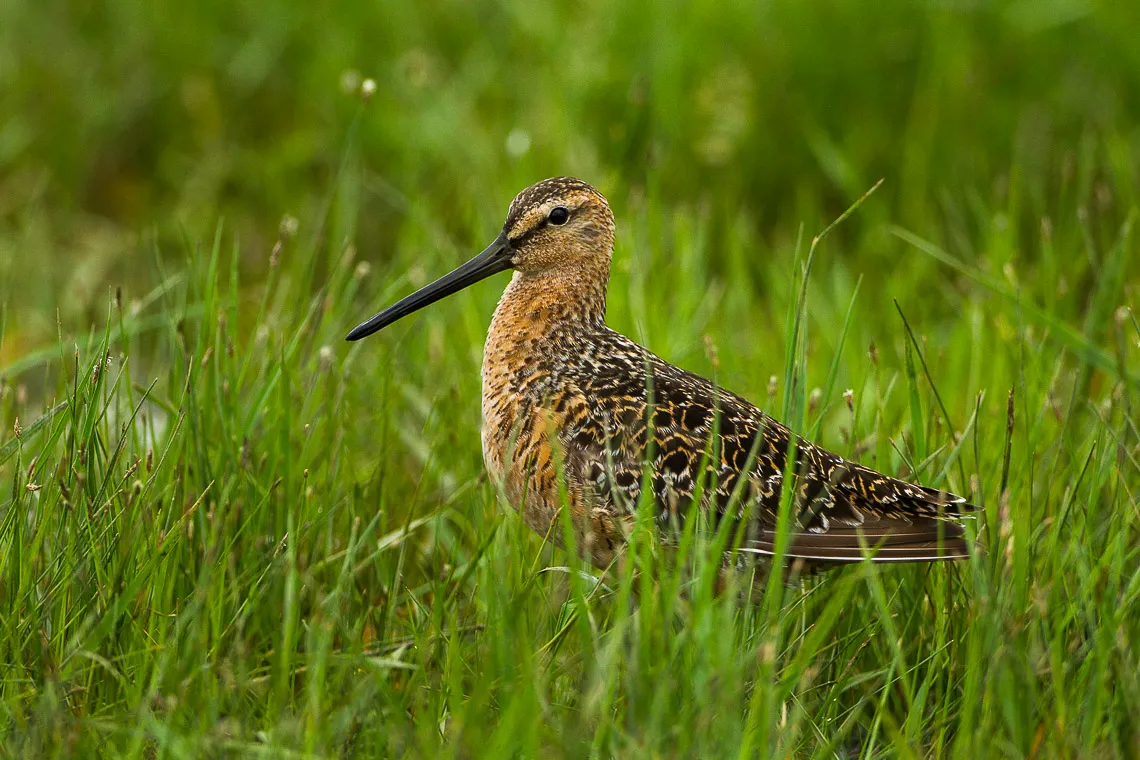
Bécassin à long bec— Quebec wildlife
Limnodromus scolopaceus
ScolopacidaeNo period published by Québec.ca
Québec.ca publishes no hunting or trapping period for this species. Check the official regulations.
Wikipedia
Bécassin à long bec
The long-billed dowitcher (Limnodromus scolopaceus) is a medium-sized shorebird with a relatively long bill belonging to the sandpiper family, Scolopacidae. In breeding plumage, adults are characterized by a rufous head and underparts with a darker mottled back and a large white upper rump only seen in flight. They feed in various freshwater habitats with their bill underwater in a "sewing machine" motion and have a mating display where males chase females in flight. The genus, Limnodromus is Ancient Greek from limne, "marsh" and dromos, "racer". The specific scolopaceus is Neo-Latin for "snipe-like", from Latin scolopax, scolopacis, a snipe or woodcock. The English name is from Iroquois and was first recorded in 1841. The long-billed dowitcher is similar in appearance to the short-billed dowitcher and was only recognized as a separate species in 1950. Between the two, the best distinguishing field mark is their flight call, especially in winter, when the two species' plumage can be nearly identical. However, the two species differ ecologically in their habitat preferences and breeding locations. Long-billed dowitchers generally prefer freshwater habitats, and breed in northern Alaska and Siberia; their short-billed counterparts favor saltwater habitats and breed farther east, from southern Alaska across Canada to the maritime provinces.
Description
The long-billed dowitcher is a medium-sized, stocky sandpiper with a bill about twice the length of its head. In all plumages, the long-billed dowitcher has a whitish supercilium and dark loral stripe that continuous past the eye. The tail is barred black and white with the black being almost twice the width of the white and a large distinctive white rump which extends up to the middle of its back. Long-billed dowitcher are in breeding plumage from approximately May to late August or early September. In breeding plumage, adults are characterized by a dark crown on top of their head and a rufous neck, chest, and belly underneath with black bars on their breast and white barring on flanks when plumage is fresh. The older the feathers get the less the black bars may appear leaving the breast dark redish. The crown and the back are a mix of brown, black and buff markings. Wings and upper-back are mottled with black, buff, and white markings looking overall dark brown. When in the winter plumage the long-billed dowitcher is very difficult to distinguish in the field from the short-billed dowitcher. In non-breeding plumage, adults are drab grey, with darker upperparts and breast contrasting with paler white belly. The gray of the breast also gradually lightens as it reaches the chin. The juvenile plumage of the long-billed dowitcher is similar to that of the breeding adult except for being paler. Juvenile long-billed dowitcher can be distinguished from the short-billed dowitcher by the differences in the tertiary feathers.
Text from Wikipedia — Long-billed dowitcher, revision 1335603630, CC BY-SA 4.0, retrieved 2026-09-04. Encyclopedic text reused under CC BY-SA 4.0. Sentences about hunting or regulation are removed: on this site, the rule comes from Québec.ca.
Other names
French
Presence in Quebec
- Origin
- Indigène
- Occurrence
- Régulier
- Population status
- Migrateur
- Certainty
- Confirmé
Conservation
Québec.ca
Official periods
Source: Québec.ca — tables reproduced as published (retrieved 2026-08-30).
Regulations change. Always check Québec.ca before hunting or trapping.
SIT Québec register
Outfitters hunting this species
82 outfitters list this species among the game they hunt.
Where this data comes from
This species is listed in an official government dataset. The identification and status shown in the data sheet are reproduced from it.
Source: List of Quebec’s vertebrate wildlife (LFVQ) — Ministère de l’Environnement, de la Lutte contre les changements climatiques, de la Faune et des Parcs. File LFVQ_25_03_2026.csv, retrieved 2026-08-30 · CC BY 4.0.
Measurements, habitat, diet and reproduction are not shown: no official source is attached to them yet.