
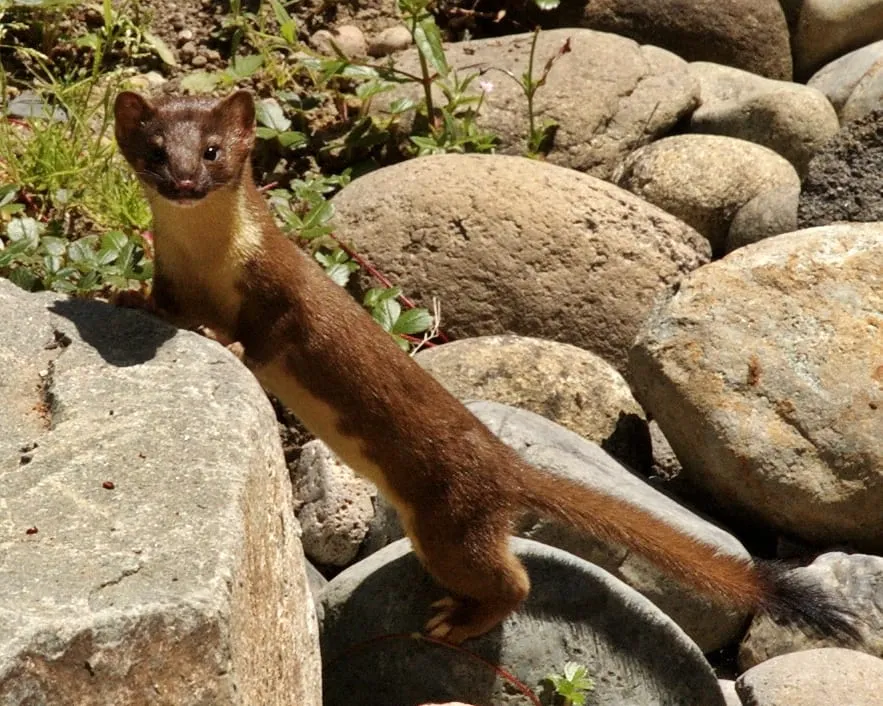
Belette à longue queue— species and hunting in Quebec
Mustela frenata
MustelidaeTrapping periods published by Québec.ca
Official tables below — trapping units (UGAF) and dates.
Wikipedia
Belette à longue queue
The long-tailed weasel (Neogale frenata), also known as the bridled weasel, masked ermine, or big stoat, is a species of weasel found in North, Central, and South America. It is distinct from the short-tailed weasel (Mustela erminea), also known as a "stoat", a close relation in the genus Mustela that originated in Eurasia and crossed into North America some half million years ago; the two species are visually similar, having long, slender bodies and tails with short legs and a black tail tip. Long-tailed weasels exhibit scale-dependent patterns of habitat selection, favoring forest patches, fencerows, and drainage ditches while avoiding agricultural fields. They typically make their habitats in forests and underground in burrows of other small mammals.
Description
The long-tailed weasel is one of the larger weasels (comprising both Neogale and Mustela) in North America. There is substantial disagreement both on the upper end of their size and difference in size by sex by source: one indicates a body length of 300–350 mm (12–14 in) and a tail comprising 40–70% of the head and body length. It adds that in most populations, females are 10–15% smaller than males, thus making them about the same size as large male stoats, according to a second source. A third states they range from 11 to 22 inches (280–560 mm) in length, with the tail measuring an additional 3 to 6 inches (80–150 mm). It maintains the long-tailed weasel weighs between 3 and 9 ounces (85-267 g) with males being about twice as large as the females. The eyes are black in daylight, but glow bright emerald green when caught in a spotlight at night. The dorsal fur is brown in summer, while the underparts are whitish and tinged with yellowish or buffy brown from the chin to the inguinal region. The tail has a distinct black tip. Long-tailed weasels in Florida and the southwestern US may have facial markings of a white or yellowish colour. In northern areas in winter, the long-tailed weasel's fur becomes white, sometimes with yellow tints, but the tail retains its black tip. The long-tailed weasel moults twice annually, once in autumn (October to mid-November) and once in spring (March–April). Each moult takes about 3–4 weeks and is governed by day length and mediated by the pituitary gland. Unlike the stoat, whose soles are thickly furred all year, the long-tailed weasel's soles are naked in summer. The long-tailed weasel has well-developed anal scent glands, which produce a strong and musky odour. Analysis of a dichloromethane extract of the anal gland secretion showed it contained 2,2-dimethylthietane, 2,4-dimethylthietane, 2,3-dimethylthietane, 2-propylthietane, 3,3-dimethyl-1,2-dithiolane, 3-ethyl-1,2-dithiolane, indole and 2-aminoacetophenone. Unlike skunks, which spray their musk, the long-tailed weasel drags and rubs its body over surfaces in order to leave the scent, to mark their territory and, when startled or threatened, to discourage predators.
Text from Wikipedia — Long-tailed weasel, revision 1366214287, CC BY-SA 4.0, retrieved 2026-09-04. Encyclopedic text reused under CC BY-SA 4.0. Sentences about hunting or regulation are removed: on this site, the rule comes from Québec.ca.
Presence in Quebec
- Origin
- Indigène
- Occurrence
- Régulier
- Population status
- Toute l'année
- Certainty
- Confirmé
Conservation
Québec.ca
Official periods
Source: Québec.ca — tables reproduced as published (retrieved 2026-08-30).
Trapping
Long-tailed weasel, least weasel, Eastern grey squirrel, red squirrel, ermine, American marten and fisher
| UGAF | Periods |
|---|---|
| 1, 2, 3, 4, 5, 6, 7, 11, 13, 17, 31, 32, 39, 41, 42, 43, 44, 45, 46, 47, 48, 49, 50, 51, 52, 53 | From October 18 to March 1 |
| 8, 9, 10, 12, 14, 15, 18, 19, 20, 21, 22, 23, 26, 27, 28, 29, 30, 33, 34, 35, 36, 37, 38, 40 | From October 25 to February 15 |
| 16, 70, 71, 72, 73, 74, 75, 76, 77, 78, 79, 80, 81, 82 | From October 25 to February 1 |
| 24, 25, 83, 84, 85, 86 | From October 25 to March 1 |
| 54, 55, 56, 57, 58, 59, 60, 61, 62, 63, 64, 65, 66 | From October 18 to March 15 |
Regulations change. Always check Québec.ca before hunting or trapping.
Where this data comes from
This species is listed in an official government dataset. The identification and status shown in the data sheet are reproduced from it.
Source: List of Quebec’s vertebrate wildlife (LFVQ) — Ministère de l’Environnement, de la Lutte contre les changements climatiques, de la Faune et des Parcs. File LFVQ_25_03_2026.csv, retrieved 2026-08-30 · CC BY 4.0.
Measurements, habitat, diet and reproduction are not shown: no official source is attached to them yet.