
No period published by Québec.ca
Québec.ca publishes no hunting or trapping period for this species. Check the official regulations.
Wikipedia
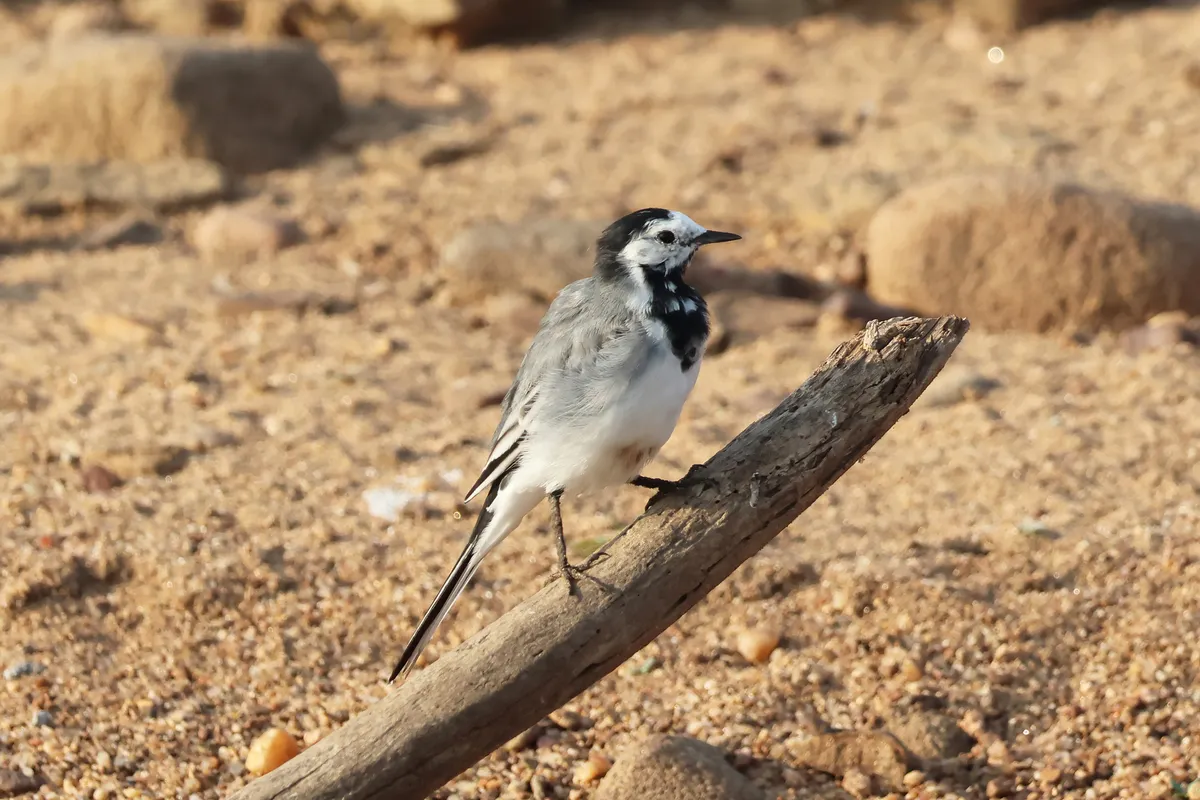
Bergeronnette grise
The white wagtail (Motacilla alba) is a small passerine bird in the family Motacillidae, which also includes pipits and longclaws. The species breeds in the Palearctic zone in most of Europe and Asia and parts of North Africa; it also has a toehold in western Alaska as a scarce breeder. It is resident in the mildest parts of its range, but otherwise migrates to Africa. In total, there are between 9 and 11 subspecies of M. alba; in Ireland and Great Britain, the black-backed subspecies known as the pied wagtail (M. a. yarrellii) predominates. The white wagtail is an insectivorous bird of open country, often near habitation and water. It prefers bare areas for feeding, where it can see and pursue its prey. In urban areas, it has adapted to foraging on paved areas such as car parks. It nests in crevices in stone walls and similar natural and human-made structures. It is the national bird of Latvia and has featured on the stamps of several countries. It is listed as being 'of least concern' by IUCN.
Description
The white wagtail is a slender bird, 16.5 to 19 cm (6.5 to 7.5 in) in length; the East Asian subspecies are slightly longer, measuring up to 21 cm (8.3 in). It has the characteristic long, constantly wagging tail of its genus. Its average weight is 25 g (0.88 oz) and the maximum lifespan in the wild is about 12 years. There are a number of other subspecies, some of which may have arisen because of partial geographical isolation, such as the resident British and Irish form, the pied wagtail M. a. yarrellii, which now also breeds in adjacent areas of the neighbouring European mainland. The pied wagtail, named after the naturalist William Yarrell, exchanges the pale grey colour of the nominate subspecies with black in males, and dark grey in females and juveniles, but is otherwise identical in its behaviour. Other subspecies, the validity of some of which is questionable, differ in the colour of the wings, back, and head, or other features. Some races show sexual dimorphism during the breeding season. As many as six subspecies may be present in the wintering grounds in India or southeast Asia and here they can be difficult to distinguish. Phylogenetic studies using mtDNA suggest that some morphological features have evolved more than once, including the back and chin colour. Breeding M. a. yarrellii look much like the nominate race except for the black back, and M. a. alboides of the Himalayas differs from the Central Asian M. a. personata only by its black back. M. a. personata has been recorded breeding in the Siddar Valley of Kashmir of the Western Himalayas. It has also been noted that both back and chin change colour during the pre-basic moult; all black-throated subspecies develop white chins and throats in winter and some black-backed birds are grey-backed in winter. The call of the white wagtail is a sharp chissick, slightly softer than the version given by the pied wagtail.
Text from Wikipedia — White wagtail, revision 1354921150, CC BY-SA 4.0, retrieved 2026-09-04. Encyclopedic text reused under CC BY-SA 4.0. Sentences about hunting or regulation are removed: on this site, the rule comes from Québec.ca.
Presence in Quebec
- Origin
- Indigène
- Occurrence
- Accidentel/non régulier
- Population status
- Migrateur
- Certainty
- Confirmé
Conservation
Québec.ca
Official periods
Source: Québec.ca — tables reproduced as published (retrieved 2026-08-30).
Regulations change. Always check Québec.ca before hunting or trapping.
Where this data comes from
This species is listed in an official government dataset. The identification and status shown in the data sheet are reproduced from it.
Source: List of Quebec’s vertebrate wildlife (LFVQ) — Ministère de l’Environnement, de la Lutte contre les changements climatiques, de la Faune et des Parcs. File LFVQ_25_03_2026.csv, retrieved 2026-08-30 · CC BY 4.0.
Measurements, habitat, diet and reproduction are not shown: no official source is attached to them yet.