
Migratory game bird — federal regulations
Seasons and bag limits are set by Environment and Climate Change Canada.
Wikipedia
Bernache cravant
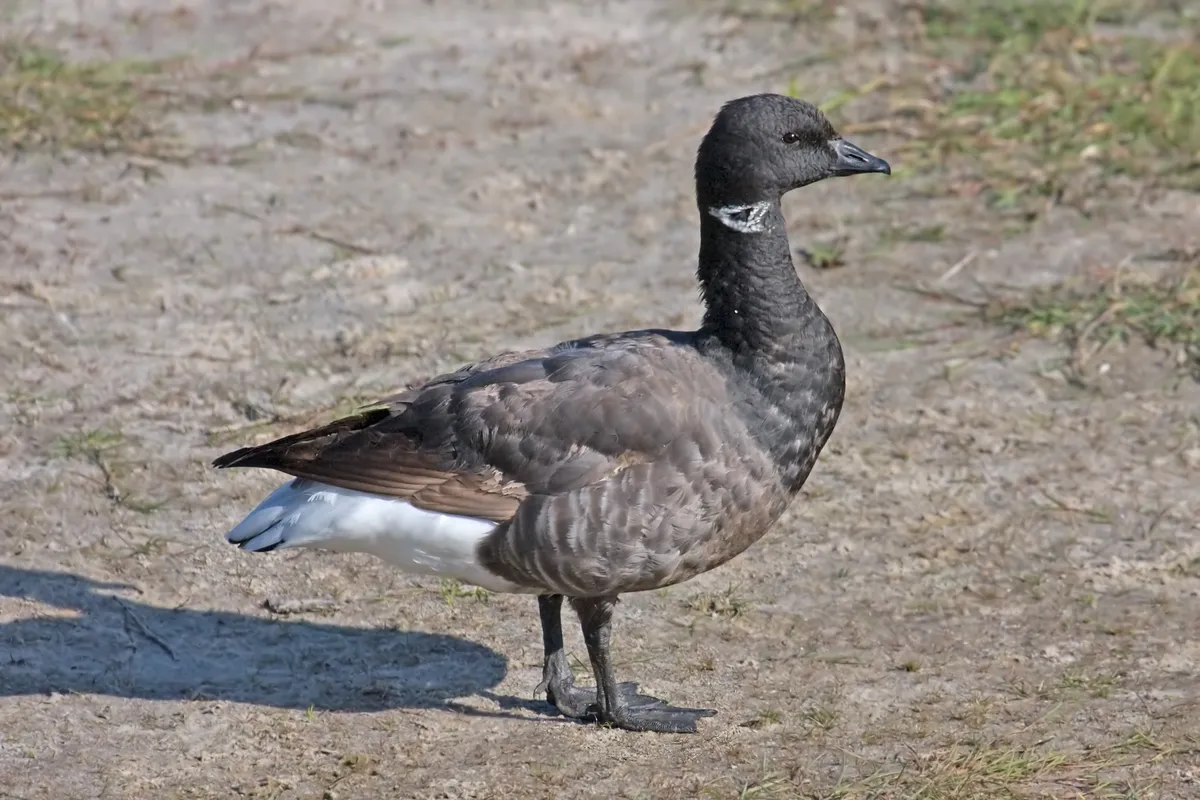
The brant or brent goose (Branta bernicla) is a small goose in the genus Branta. There are three subspecies, all of which winter along temperate-zone sea-coasts and breed on the high-Arctic tundra. The Brent oilfield was named after the species.
Description
The brant is a small goose with a short, stubby bill. It measures 55–66 cm (22–26 in) long, 106–121 cm (42–48 in) across the wings and weighs 0.88–2.2 kg (1.9–4.9 lb). The under-tail is pure white, and the tail black and very short (the shortest of any goose). The body of the dark-bellied nominate subspecies B. b. bernicla is fairly uniformly dark grey-brown all over, the flanks and belly not significantly paler than the back. The head and neck are black, with a small white patch on either side of the neck. With a population of about 250,000, it breeds on the Arctic coasts of central and western Siberia and winters in coastal areas of western Europe, with over half the population in southern England, the rest between northern Germany and south-western France. The pale-bellied form B. b. hrota appears blackish-brown and light grey in colour. The body is different shades of grey-brown all over, the flanks and belly are significantly paler than the back and present a marked contrast. The head and neck are black, with a small white patch on either side of the neck. The total population is about 250,000, with the main population breeding in northeastern Canada and wintering along the Atlantic coast of the U.S. from Maine to Georgia, and two smaller populations, one breeding in Franz Josef Land, Svalbard, and northeastern Greenland and wintering in Denmark, northeast England, and Scotland, and the other breeding in the far-northeastern Canadian islands and wintering in Ireland, southwest England, and in a small but significant area, le havre de Regnéville, centered on the Sienne Estuary in Manche (Northern France). In Ireland it is recorded in winter from a number of areas including Lough Foyle, Strangford Lough, Tralee Bay and Castlemaine Harbour. The black form B. b. nigricans appears blackish-brown and white in colour. This form is a very contrastingly black and white bird, with a uniformly dark sooty-brown back, similarly coloured underparts (with the dark colour extending furthest back of the three forms) and a prominent white flank patch; it also has larger white neck patches, forming a near-complete collar. The population of about 125,000 breeds in northwestern Canada, Alaska and eastern Siberia, and winters mostly on the west coast of North America from southern Alaska to California, but also some in east Asia, mainly Japan, also Korea and China. The population has been as high as 200,000 in 1981, and as low as 100,000 in 1987. The Asian populations of the black brant populations had previously been regarded as a separate subspecies B. b. orientalis based on purported paler upperparts coloration; however, it is generally now believed that this is not correct, and they are assigned to B. b. nigricans.
Text from Wikipedia — Brant (goose), revision 1372515441, CC BY-SA 4.0, retrieved 2026-09-04. Encyclopedic text reused under CC BY-SA 4.0. Sentences about hunting or regulation are removed: on this site, the rule comes from Québec.ca.
Other names
French
English
Presence in Quebec
- Origin
- Indigène
- Occurrence
- Régulier
- Population status
- Migrateur
- Certainty
- Confirmé
Conservation
Québec.ca
Official periods
Source: Québec.ca — tables reproduced as published (retrieved 2026-08-30).
Regulations change. Always check Québec.ca before hunting or trapping.
SIT Québec register
Outfitters hunting this species
44 outfitters list this species among the game they hunt.
On this site
Related articles
Where this data comes from
This species is listed in an official government dataset. The identification and status shown in the data sheet are reproduced from it.
Source: List of Quebec’s vertebrate wildlife (LFVQ) — Ministère de l’Environnement, de la Lutte contre les changements climatiques, de la Faune et des Parcs. File LFVQ_25_03_2026.csv, retrieved 2026-08-30 · CC BY 4.0.
Measurements, habitat, diet and reproduction are not shown: no official source is attached to them yet.