
Migratory game bird — federal regulations
Seasons and bag limits are set by Environment and Climate Change Canada.
Wikipedia
Bernache de Hutchins
The cackling goose (Branta hutchinsii) is a species of goose found in North America and East Asia.
Description
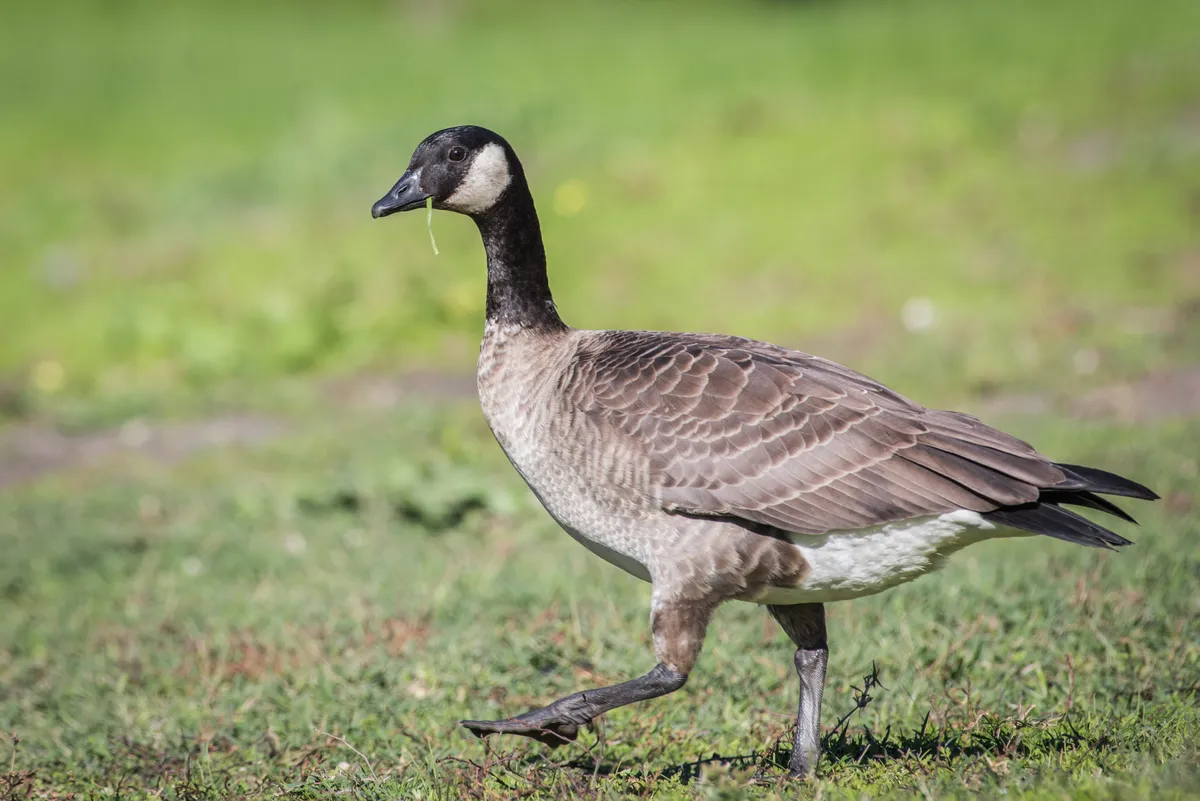
The black head and neck with white "chinstrap" distinguish this goose from all other geese except the larger Canada goose (Branta canadensis) and the similarly sized barnacle goose (B. leucopsis). There are up to five subspecies of cackling goose of varying sizes and plumage details. The female looks virtually identical but is slightly lighter and has a different voice. Some are hard to distinguish from the Canada goose, with which the cackling goose was long assumed to form one species, the cackling goose and the smaller Canada goose subspecies being called the lesser Canada goose. The smallest 1.4 kg (3.1 lb) cackling geese (B. h. minima) are much smaller than any Canada goose, but the subspecies B. h. hutchinsii, at up to 3 kg (6.6 lb), grows to the same size as some Canada geese. The distinctness of the extinct population of the Komandorski and Kuril Islands B. h. asiatica is controversial. The barnacle goose differs in having a black breast and grey, rather than brownish, body plumage. Measurements: Length: 24.8–25.6 in (63–65 cm) Weight: 49.3–84.0 oz (1,400–2,380 g) Wingspan: 42.5–43.7 in (108–111 cm)
Diet
These birds feed mainly on plant material. When feeding in water, they submerge their heads and necks to reach aquatic plants, sometimes tipping forward like a dabbling duck. Flocks of these birds often feed on leftover cultivated grains in fields, especially during migration or in winter. They also eat some insects, molluscs and crustaceans.
Text from Wikipedia — Cackling goose, revision 1352320860, CC BY-SA 4.0, retrieved 2026-09-04. Encyclopedic text reused under CC BY-SA 4.0. Sentences about hunting or regulation are removed: on this site, the rule comes from Québec.ca.
Presence in Quebec
- Origin
- Indigène
- Occurrence
- Régulier
- Population status
- Reproducteur
- Certainty
- Confirmé
Conservation
Québec.ca
Official periods
Source: Québec.ca — tables reproduced as published (retrieved 2026-08-30).
Regulations change. Always check Québec.ca before hunting or trapping.
Where this data comes from
This species is listed in an official government dataset. The identification and status shown in the data sheet are reproduced from it.
Source: List of Quebec’s vertebrate wildlife (LFVQ) — Ministère de l’Environnement, de la Lutte contre les changements climatiques, de la Faune et des Parcs. File LFVQ_25_03_2026.csv, retrieved 2026-08-30 · CC BY 4.0.
Measurements, habitat, diet and reproduction are not shown: no official source is attached to them yet.