
Migratory game bird — federal regulations
Seasons and bag limits are set by Environment and Climate Change Canada.
Wikipedia
Bernache nonnette
The barnacle goose (Branta leucopsis) is a species of goose that belongs to the genus Branta of black geese, which contains species with extensive black in the plumage, distinguishing them from the grey Anser species. Despite its superficial similarity to the brant goose, genetic analysis has shown its closest relative is the cackling goose.
Description
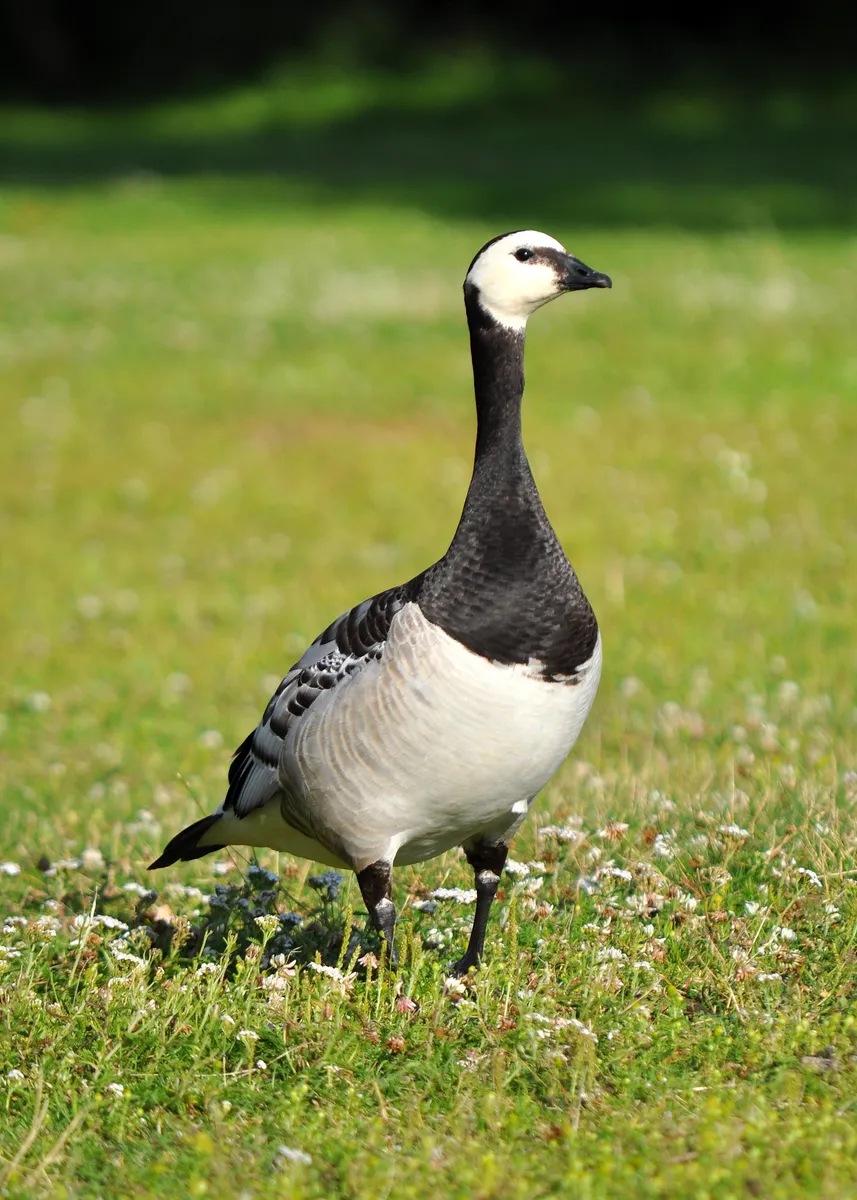
The barnacle goose is a medium-sized goose, 55–70 cm (22–28 in) long, with a wingspan of 120–145 cm (47–57 in) and a weight of 1.21–2.23 kg (2.7–4.9 lb), with black legs and a small, stubby black bill. It has a white face and black head, neck, and upper breast. Its belly is white. The wings and its back are silver-grey with black-and-white bars that look like they are shining when the light reflects on it. During flight, a V-shaped white rump patch and the silver-grey underwing linings are visible. They look similar to cackling geese but have grey and white instead of brown bodies, and more extensive white on the head; from Canada geese they are additionally distinguished by being smaller, and having smaller beaks. The juveniles are similar to the adults, but like with all geese, can be distinguished by the rounded rather than square-ended mantle and flank feathers. A rare leucistic form exists, which is characterised by white plumage, with black eyes, beak, and legs. This morph has been reported in the Svalbard/Solway Firth population.
Text from Wikipedia — Barnacle goose, revision 1369802615, CC BY-SA 4.0, retrieved 2026-09-04. Encyclopedic text reused under CC BY-SA 4.0. Sentences about hunting or regulation are removed: on this site, the rule comes from Québec.ca.
Other names
French
Presence in Quebec
- Origin
- Indigène
- Occurrence
- Régulier
- Population status
- Migrateur
- Certainty
- Confirmé
Conservation
Québec.ca
Official periods
Source: Québec.ca — tables reproduced as published (retrieved 2026-08-30).
Regulations change. Always check Québec.ca before hunting or trapping.
SIT Québec register
Outfitters hunting this species
44 outfitters list this species among the game they hunt.
On this site
Related articles
Where this data comes from
This species is listed in an official government dataset. The identification and status shown in the data sheet are reproduced from it.
Source: List of Quebec’s vertebrate wildlife (LFVQ) — Ministère de l’Environnement, de la Lutte contre les changements climatiques, de la Faune et des Parcs. File LFVQ_25_03_2026.csv, retrieved 2026-08-30 · CC BY 4.0.
Measurements, habitat, diet and reproduction are not shown: no official source is attached to them yet.