
No period published by Québec.ca
Québec.ca publishes no hunting or trapping period for this species. Check the official regulations.
Wikipedia
Bihoreau gris
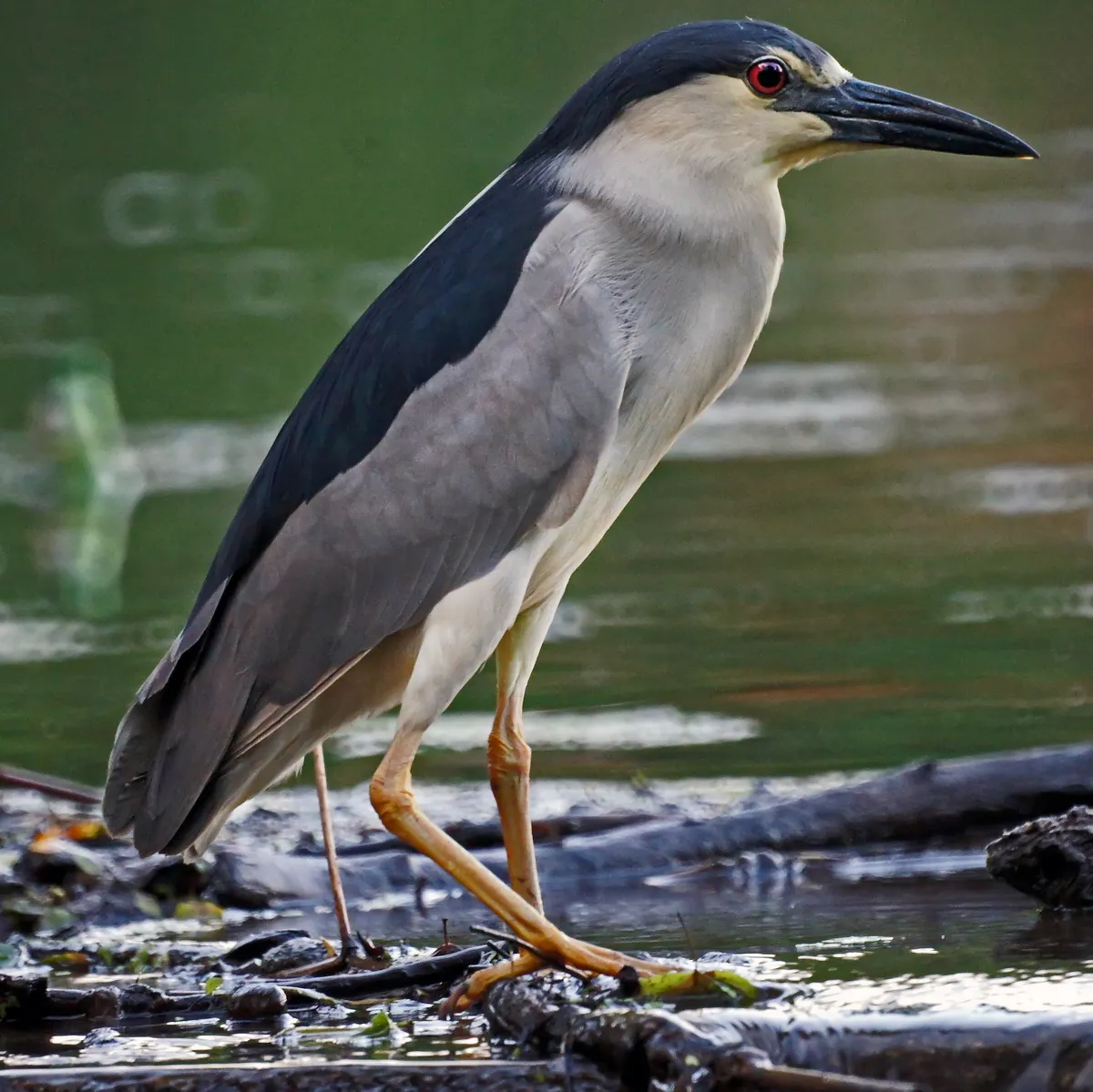
The black-crowned night heron (Nycticorax nycticorax) or black-capped night heron, commonly shortened to just night heron in Eurasia, is a medium-sized heron found throughout a large part of the world, including parts of Europe, Asia, and North and South America. In Australasia it is replaced by the closely related Nankeen night heron (N. caledonicus), with which it has hybridised in the area of contact.
Description
Adults have a black crown and back with the remainder of the body white or grey, red eyes, and short yellow legs. They have pale grey wings and white under parts. One to eight (mostly two to four) long slender white plumes, erected in greeting and courtship displays, extend from the back of the head. The sexes are similar in appearance although the males are slightly larger. Black-crowned night herons do not fit the typical body form of the heron family. They are relatively stocky with shorter bills, legs, and necks than their more familiar cousins, the egrets and "day" herons. For a short period during courtship at the start of the nesting season, the legs of adults turn bright salmon-pink, and the bare skin around the eyes blue. The subspecies differ little; nominate N. n. nycticorax and N. n. hoactli are particularly similar in plumage (some authors have considered N. n. hoactli a synonym of the nominate), but the latter is on average slightly larger. N. n. obscurus is the most distinctive subspecies, clearly darker than N. n. hoactli from further north in South America, but N. n. falklandicus is intermediate, with both paler and darker individuals occurring. Immature birds have dull grey-brown plumage on their heads, wings, and backs, with numerous pale "teardrop" spots. Their underparts are paler and streaked with brown. Second and third year birds attain plumages increasingly similar to adults, but lacking the white head plumes. The young birds have orange eyes and duller yellowish-green legs. They are very noisy birds in their nesting colonies, with calls that are commonly transcribed as quok or woc.
Habitat and range
The breeding habitat is fresh and salt-water wetlands throughout much of the world. The nominate subspecies N. n. nycticorax breeds in Europe, Asia and Africa, subspecies N. n. hoactli in North and South America from Canada as far south as northern Argentina and Chile, N. n. obscurus in southernmost South America, and N. n. falklandicus in the Falkland Islands. Black-crowned night herons nest in colonies on platforms of sticks in a group of trees, or on the ground in protected locations such as islands or reedbeds. Three to eight eggs are laid. This heron is migratory in the northern parts of its range, but is otherwise resident (even in the cold Patagonia). European birds winter in Africa (with a few staying in southern Spain), central and east Asian birds winter in southern Asia, and North American birds winters in Mexico, the southern United States, Central America, and the West Indies.
Text from Wikipedia — Black-crowned night heron, revision 1373033008, CC BY-SA 4.0, retrieved 2026-09-04. Encyclopedic text reused under CC BY-SA 4.0. Sentences about hunting or regulation are removed: on this site, the rule comes from Québec.ca.
Other names
French
Presence in Quebec
- Origin
- Indigène
- Occurrence
- Régulier
- Population status
- Reproducteur
- Certainty
- Confirmé
Conservation
Québec.ca
Official periods
Source: Québec.ca — tables reproduced as published (retrieved 2026-08-30).
Regulations change. Always check Québec.ca before hunting or trapping.
Where this data comes from
This species is listed in an official government dataset. The identification and status shown in the data sheet are reproduced from it.
Source: List of Quebec’s vertebrate wildlife (LFVQ) — Ministère de l’Environnement, de la Lutte contre les changements climatiques, de la Faune et des Parcs. File LFVQ_25_03_2026.csv, retrieved 2026-08-30 · CC BY 4.0.
Measurements, habitat, diet and reproduction are not shown: no official source is attached to them yet.