
No period published by Québec.ca
Québec.ca publishes no hunting or trapping period for this species. Check the official regulations.
Wikipedia
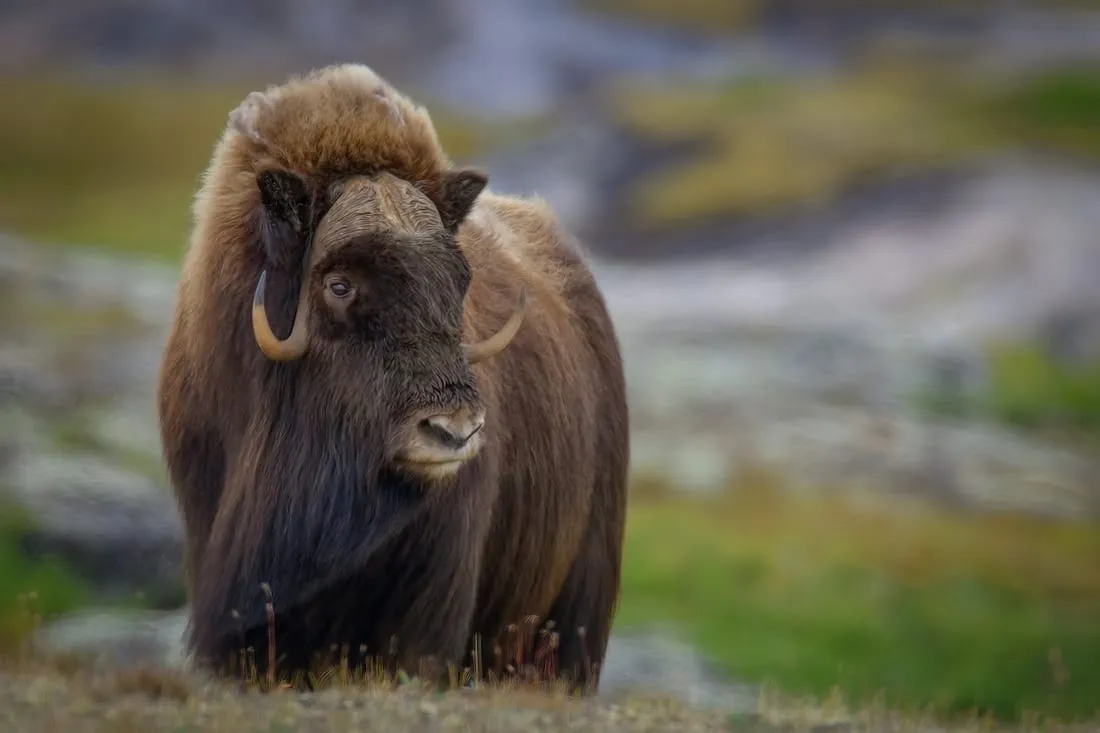
Boeuf musqué
The muskox (Ovibos moschatus) is a hoofed mammal of the family Bovidae. Native to the Arctic, it is noted for its thick coat and for the strong odor emitted by males during the seasonal rut, from which its name derives. This musky odor has the effect of attracting females during mating season. Its Inuktitut name umingmak translates to "the bearded one". Its Woods Cree names mâthi-môs and mâthi-mostos translate to "ugly moose" and "ugly bison", respectively. In historic times, muskoxen primarily lived in Greenland and the Canadian Arctic of the Northwest Territories and Nunavut. They were formerly present in Eurasia, with their youngest natural records in the region dating to around 2,700 years ago, with reintroduced populations in the U.S. state of Alaska, the Canadian territory of Yukon, and Siberia, and an introduced population in Norway, part of which emigrated to Sweden, where a small population now lives.
Text from Wikipedia — Muskox, revision 1367616137, CC BY-SA 4.0, retrieved 2026-09-04. Encyclopedic text reused under CC BY-SA 4.0. Sentences about hunting or regulation are removed: on this site, the rule comes from Québec.ca.
Other names
French
Presence in Quebec
- Origin
- Exotique
- Occurrence
- Régulier
- Population status
- Toute l'année
- Certainty
- Confirmé
Conservation
Official remark
Après son introduction, cette espèce s'est acclimatée dans l'extrême Nord du Québec.
Québec.ca
Official periods
Source: Québec.ca — tables reproduced as published (retrieved 2026-08-30).
Regulations change. Always check Québec.ca before hunting or trapping.
Where this data comes from
This species is listed in an official government dataset. The identification and status shown in the data sheet are reproduced from it.
Source: List of Quebec’s vertebrate wildlife (LFVQ) — Ministère de l’Environnement, de la Lutte contre les changements climatiques, de la Faune et des Parcs. File LFVQ_25_03_2026.csv, retrieved 2026-08-30 · CC BY 4.0.
Measurements, habitat, diet and reproduction are not shown: no official source is attached to them yet.