
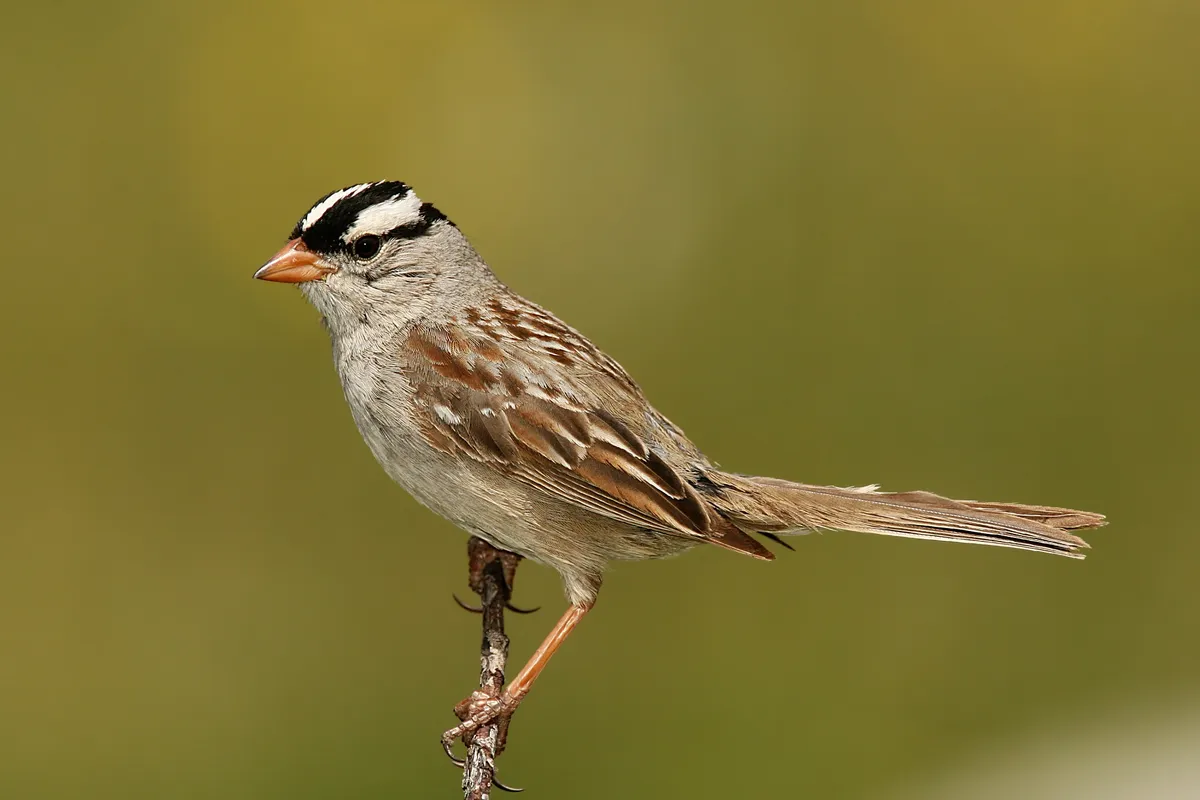
Bruant à couronne blanche— Quebec wildlife
Zonotrichia leucophrys
PasserellidaeNo period published by Québec.ca
Québec.ca publishes no hunting or trapping period for this species. Check the official regulations.
Wikipedia
Bruant à couronne blanche
The white-crowned sparrow (Zonotrichia leucophrys) is a species of passerine bird native to North America. A medium-sized member of the New World sparrow family, this species is marked by a grey face and black and white streaking on the upper head. It breeds in brushy areas in the taiga and tundra of the northernmost parts of the continent and in the Rocky Mountains and Pacific coast. While southerly populations in the Rocky Mountains and coast are largely resident, the breeding populations of the northerly part of its range are migratory and can be found as wintering or passage visitors through most of North America south to central Mexico.
Description
Adults have black and white stripes on their head, a gray face, brown streaked upper parts and a long tail. The wings are brown with bars and the underparts are gray. Their bill is pink or yellow. They are similar in appearance to the white-throated sparrow, but do not have the white throat markings or yellow lores. Measurements: Length: 5.9–6.3 in (15–16 cm) Weight: 0.9–1.0 oz (25–28 g) Wingspan: 8.3–9.4 in (21–24 cm)
Habitat and range
Their breeding habitat is brushy areas across northern Canada and the western United States. The white-crowned sparrow is a very rare vagrant to western Europe. It has been sighted in England, Scotland, Ireland, and Norway. In 2008 a white-crowned sparrow was spotted in Cley next the Sea in Norfolk, England. To commemorate the event an image of the bird was included in a window at St Margaret's Church.
Text from Wikipedia — White-crowned sparrow, revision 1328001560, CC BY-SA 4.0, retrieved 2026-09-04. Encyclopedic text reused under CC BY-SA 4.0. Sentences about hunting or regulation are removed: on this site, the rule comes from Québec.ca.
Other names
French
English
Presence in Quebec
- Origin
- Indigène
- Occurrence
- Régulier
- Population status
- Reproducteur
- Certainty
- Confirmé
Conservation
Québec.ca
Official periods
Source: Québec.ca — tables reproduced as published (retrieved 2026-08-30).
Regulations change. Always check Québec.ca before hunting or trapping.
Where this data comes from
This species is listed in an official government dataset. The identification and status shown in the data sheet are reproduced from it.
Source: List of Quebec’s vertebrate wildlife (LFVQ) — Ministère de l’Environnement, de la Lutte contre les changements climatiques, de la Faune et des Parcs. File LFVQ_25_03_2026.csv, retrieved 2026-08-30 · CC BY 4.0.
Measurements, habitat, diet and reproduction are not shown: no official source is attached to them yet.