
No period published by Québec.ca
Québec.ca publishes no hunting or trapping period for this species. Check the official regulations.
Wikipedia
Bruant à face noire
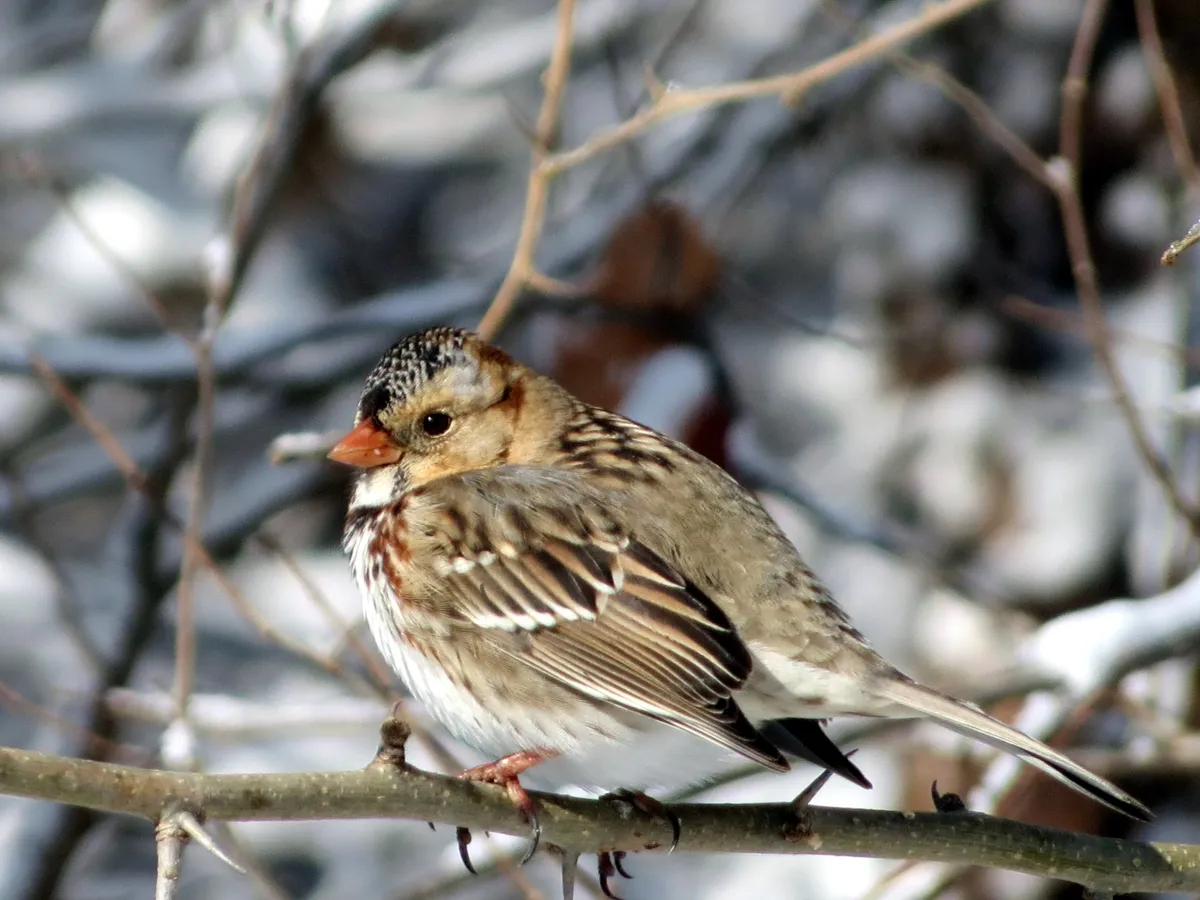
Harris's sparrow (Zonotrichia querula) is a large sparrow. Their breeding habitat is the north part of central Canada (primarily the Northwest Territories and Nunavut, ranging slightly into northern Manitoba and Saskatchewan), making it Canada's only endemic breeding bird. In the winter they migrate to the Great Plains states of the United States, from southern South Dakota to central Texas. The common name of this species commemorates the American amateur ornithologist Edward Harris (1799–1863).
Description
This species is the largest of the sparrows in the family Passerellidae, though other superficially dissimilar species in the family may slightly exceed them in size. They range in total length from 17 to 20 cm (6.7 to 7.9 in), with a 27 cm (11 in) wingspan and weigh from 26 to 49 g (0.92 to 1.73 oz). Among standard measurements, the wing chord is 7.7 to 9.2 cm (3.0 to 3.6 in), the tail is 7.6 to 8.8 cm (3.0 to 3.5 in), the bill is 1.1 to 1.4 cm (0.43 to 0.55 in) and the tarsus is 2.2 to 2.5 cm (0.87 to 0.98 in). This is a very distinctive looking species. Breeding plumage birds have conspicuous pink bills and black on the crown, face, throat and upper breast, contrasting with grey on the sides of the head and neck. The back is brown, overlaid with heavy black streaking. There are two white wing bars. Breeding birds have white lower underparts with some black mottling on flanks. Non-breeding adults are more buffy than grey and brown, with reduced or absent black markings and often have whitish scalloping on the head and throat. Immatures have less black than all adult plumages, normally marked with a white chin and throat, a black malar stripe and a broad smudgy black breast-band. Juveniles have a brownish crown streaked with black and fine dark streaks and some broader black markings on the underside. Birds moult from July to September. Confusion of wintering birds is possible with the winter Lapland longspur (Calcarius lapponicus) but that species is much shorter-tailed with white outer rectrices, has rich rufous in greater coverts, and is strictly terrestrial on open ground. The song of Harris's sparrow is usually delivered from a high perch. The song consists of a series of one or more clear high wavering whistles followed by another series in higher or lower pitch. They have also been known to call out a strong, metallic chink, as well as some variable musical twittering.
Habitat and range
Harris's sparrow breeds in stunted coniferous forests and adjacent scrubs, especially areas of the grand boreal forests where stands of spruce abut mossy bogs. They often nest near the northern limit of tree growth in the forest-tundra ecotone. Typical plant life in the breeding grounds consist of white and black spruce (Picea glauca and P. mariana) and American larch (Larix laricina), dwarf birch-willow, and wet sedge meadow and shrubby tundra with dwarf ericad/lichen plant life.
Text from Wikipedia — Harris's sparrow, revision 1340327882, CC BY-SA 4.0, retrieved 2026-09-04. Encyclopedic text reused under CC BY-SA 4.0. Sentences about hunting or regulation are removed: on this site, the rule comes from Québec.ca.
Other names
French
Presence in Quebec
- Origin
- Indigène
- Occurrence
- Accidentel/non régulier
- Population status
- Migrateur
- Certainty
- Confirmé
Conservation
Québec.ca
Official periods
Source: Québec.ca — tables reproduced as published (retrieved 2026-08-30).
Regulations change. Always check Québec.ca before hunting or trapping.
Where this data comes from
This species is listed in an official government dataset. The identification and status shown in the data sheet are reproduced from it.
Source: List of Quebec’s vertebrate wildlife (LFVQ) — Ministère de l’Environnement, de la Lutte contre les changements climatiques, de la Faune et des Parcs. File LFVQ_25_03_2026.csv, retrieved 2026-08-30 · CC BY 4.0.
Measurements, habitat, diet and reproduction are not shown: no official source is attached to them yet.