
Bruant des prés— Quebec wildlife
Passerculus sandwichensis
PasserellidaeNo period published by Québec.ca
Québec.ca publishes no hunting or trapping period for this species. Check the official regulations.
Wikipedia
Bruant des prés
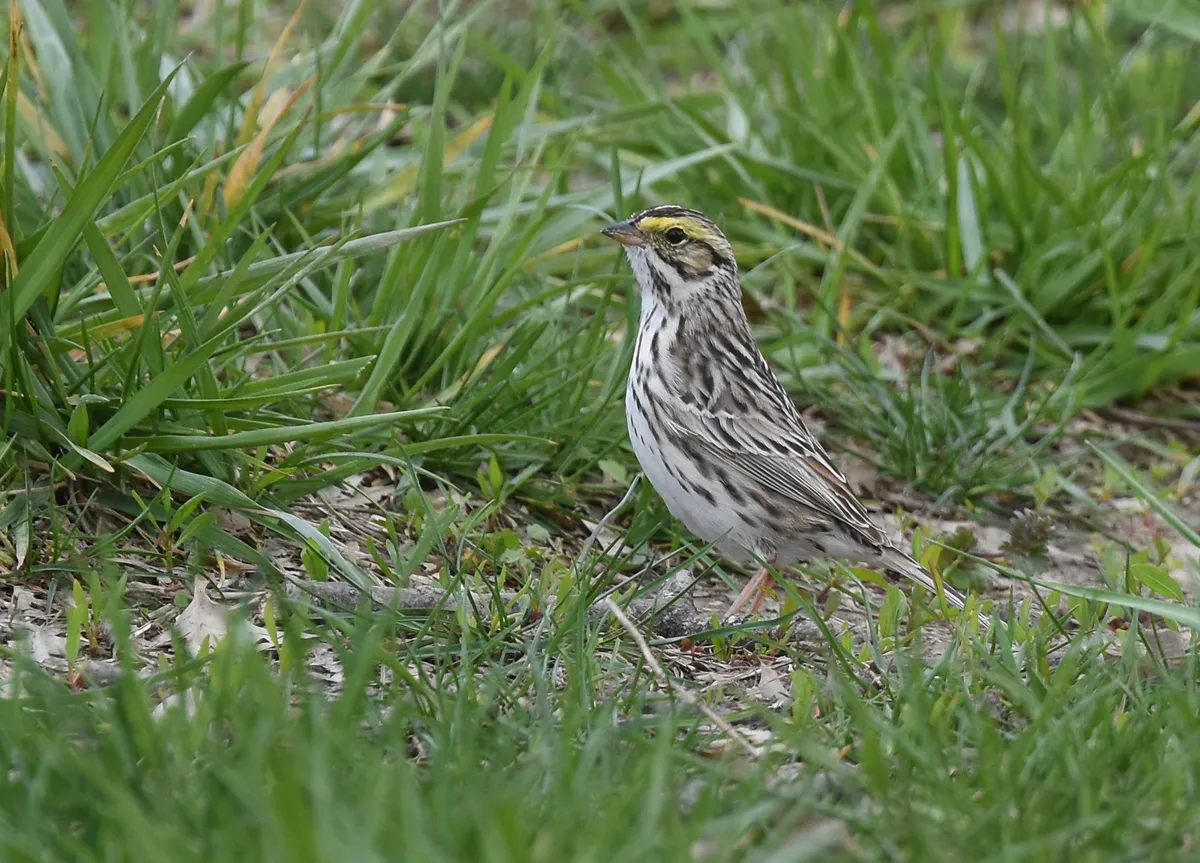
The Savannah sparrow (Passerculus sandwichensis) is a small New World sparrow that is the only member of the genus Passerculus. It is a widespread and abundant species that occupies open grassland habitats in North America. Over most of its range it is migratory, breeding in Canada and the northern United States while wintering in Mexico and the southern United States. It is a sexually monomorphic species that is quite variable in appearance. Around 17 subspecies are currently recognised. These are divided into several groups, some of which have sometimes been considered as separate species. The species name sandwichensis is Latin from Sandwich Sound (now Prince William Sound) in southern Alaska from where the first specimen was collected. The common name refers to Savannah, Georgia, where Alexander Wilson observed the species in 1811.
Description
The Savannah sparrow has a typically sparrow-like dark-streaked brown back, and whitish underparts with brown or blackish breast and flank streaking. It has whitish crown and supercilium stripes, sometimes with some yellow (more often near the beak). The cheeks are brown and the throat white. The flight feathers are blackish-brown with light brown or white border. The eyes are dark. The feet and legs are horn-colored, as is the lower part of the bill, with the upper part being dark grey. It is a very variable species, with numerous subspecies, several of which have been split as separate species at various times. The different forms vary principally in the darkness of the plumage. The variation generally follows Gloger's rule, with Alaskan and interior races the palest, and southwestern coastal forms the darkest. There are some exceptions, though, most conspicuously in some island populations that presumably were strongly affected by founder effects. The general pattern of variation has a fairly clear divide, southwest of which the birds become notably darker; this agrees quite well with the limit between P. sandwichensis and P. (s.) rostratus. Savannah sparrows show some variation in size across subspecies. The total length can range from 11 to 17 cm (4.3 to 6.7 in), wingspan ranges from 18 to 25 cm (7.1 to 9.8 in) and body mass from 15 to 29 g (0.53 to 1.02 oz). In the nominate subspecies, the body weight averages 20.1 g (0.71 oz). The Savannah sparrows proper (see below) are very similar, and migrant birds can not usually be related to a breeding population with certainty. The resident or partially migratory subspecies are well distinguishable by size and, particularly between groups, coloration.
Text from Wikipedia — Savannah sparrow, revision 1359322838, CC BY-SA 4.0, retrieved 2026-09-04. Encyclopedic text reused under CC BY-SA 4.0. Sentences about hunting or regulation are removed: on this site, the rule comes from Québec.ca.
Other names
French
English
Presence in Quebec
- Origin
- Indigène
- Occurrence
- Régulier
- Population status
- Reproducteur
- Certainty
- Confirmé
Conservation
Québec.ca
Official periods
Source: Québec.ca — tables reproduced as published (retrieved 2026-08-30).
Regulations change. Always check Québec.ca before hunting or trapping.
Where this data comes from
This species is listed in an official government dataset. The identification and status shown in the data sheet are reproduced from it.
Source: List of Quebec’s vertebrate wildlife (LFVQ) — Ministère de l’Environnement, de la Lutte contre les changements climatiques, de la Faune et des Parcs. File LFVQ_25_03_2026.csv, retrieved 2026-08-30 · CC BY 4.0.
Measurements, habitat, diet and reproduction are not shown: no official source is attached to them yet.