
No period published by Québec.ca
Québec.ca publishes no hunting or trapping period for this species. Check the official regulations.
Wikipedia
Bruant familier
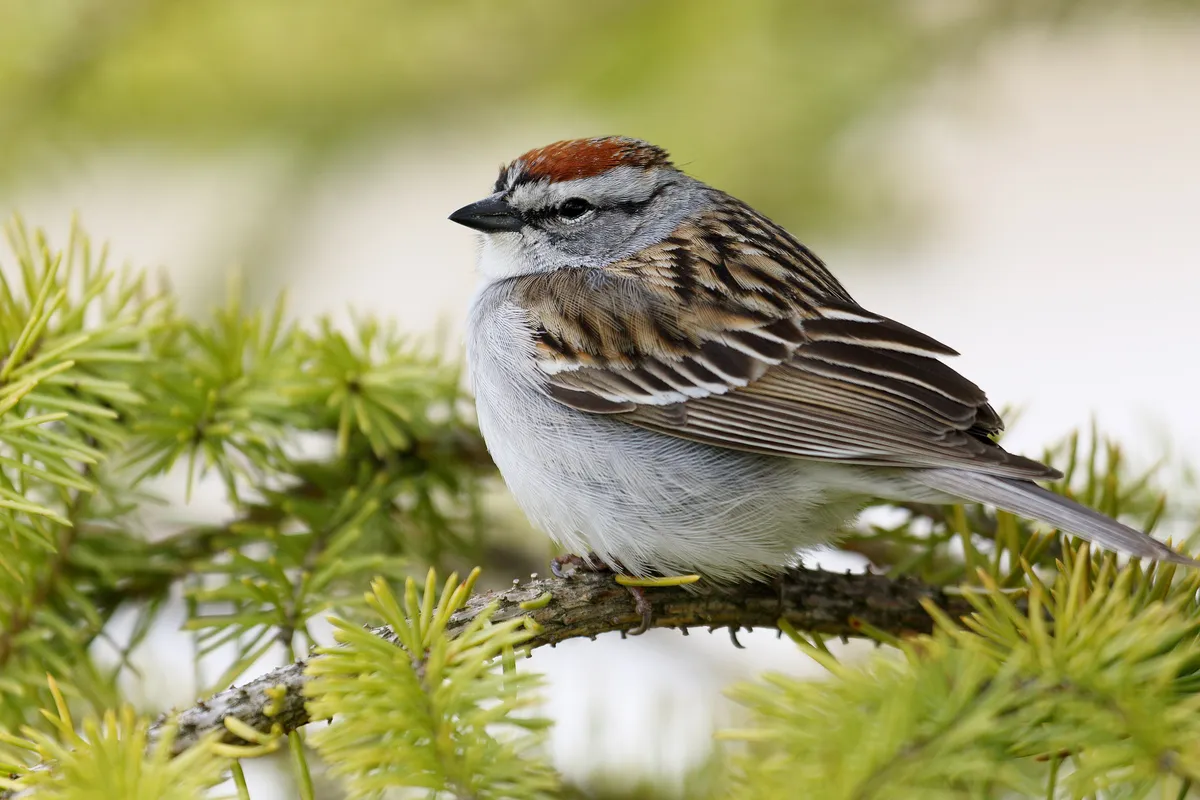
The chipping sparrow (Spizella passerina) is a species of New World sparrow, a passerine bird in the family Passerellidae. It is widespread, fairly tame, and common across most of its North American range. The chipping sparrow has five subspecies. This bird is a partial migrant with northerly populations flying southwards in the fall to overwinter in Mexico and the southern United States, and flying northward again in spring.
Description
Throughout the year, adults are gray below and an orangish-rust color above. Adults in alternate (breeding) plumage have a reddish cap, a nearly white supercilium, and a black trans-ocular line (running through the eye). Adults in basic (nonbreeding) plumage are less prominently marked, with a brownish cap, a dusky eyebrow, and a dark eye-line. Juvenile chipping sparrows are prominently streaked below. Like non-breeding adults, they show a dark eye-line, extending both in front of and behind the eye. The brownish cap and dusky eyebrow are variable but generally obscure in juveniles. Measurements: Length: 4.7–5.9 in (12–15 cm) Weight: 0.4–0.6 oz (11–17 g) Wingspan: 8.3 inches (21 cm)
Diet
The chipping sparrow feeds on seeds year-round, although insects form most of the diet in the breeding season. Spiders are sometimes taken. Taraxacum officinale seeds are important during spring, and seeds from Fallopia convolvulus, Melilotus spp., Stellaria media, Chenopodium album, Avena spp., and others. Throughout the year, chipping sparrows forage on the ground in covered areas, often near the edges of fields.
Reproduction
The male chipping sparrows start arriving at the breeding grounds from March (in more southern areas, such as Texas) to mid-May (in southern Alberta and northern Ontario). The female arrives one to two weeks later, and the male starts singing soon after to find and court a mate. After pair formation, nesting begins (within about two weeks of the female's arrival). The chipping sparrow breeds in grassy, open woodland clearings and shrubby grass fields. The nest is normally above ground but below 6 metres (20 ft) in height, and about 1 metre (3.3 ft) on average, in a tree (usually a conifer, especially those that are young, short, and thick) or bush. The nest itself is constructed by the female in about four days. It consists of a loose platform of grass and rootlets and open inner cup of plant fiber and animal hair. The chipping sparrow lays a clutch of two to seven pale blue to white eggs with black, brown, or purple markings. They are about 17 by 12 millimetres (0.67 by 0.47 in), and incubated by the female for 10 to 15 days. The chipping sparrow is often brood parasitized by brown-headed cowbirds, usually resulting in the nest being abandoned.
Text from Wikipedia — Chipping sparrow, revision 1372764050, CC BY-SA 4.0, retrieved 2026-09-04. Encyclopedic text reused under CC BY-SA 4.0. Sentences about hunting or regulation are removed: on this site, the rule comes from Québec.ca.
Other names
French
English
Presence in Quebec
- Origin
- Indigène
- Occurrence
- Régulier
- Population status
- Reproducteur
- Certainty
- Confirmé
Conservation
Québec.ca
Official periods
Source: Québec.ca — tables reproduced as published (retrieved 2026-08-30).
Regulations change. Always check Québec.ca before hunting or trapping.
Where this data comes from
This species is listed in an official government dataset. The identification and status shown in the data sheet are reproduced from it.
Source: List of Quebec’s vertebrate wildlife (LFVQ) — Ministère de l’Environnement, de la Lutte contre les changements climatiques, de la Faune et des Parcs. File LFVQ_25_03_2026.csv, retrieved 2026-08-30 · CC BY 4.0.
Measurements, habitat, diet and reproduction are not shown: no official source is attached to them yet.