
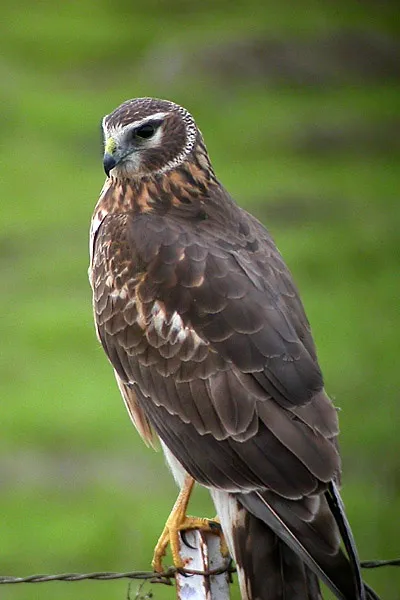
Busard des marais— Quebec wildlife
Circus hudsonius
AccipitridaeNo period published by Québec.ca
Québec.ca publishes no hunting or trapping period for this species. Check the official regulations.
Wikipedia
Busard des marais
The northern harrier (Circus hudsonius), also known as the marsh hawk or ring-tailed hawk, is a bird of prey. It breeds throughout the northern parts of the Northern Hemisphere in Canada and the northernmost United States. The northern harrier migrates south in winter, with breeding birds in Canada and northern Great Plains of the U.S. moving to the American south, Mexico, and Central America. In the midwestern, mountain west, and north Atlantic states of the U.S., they may be present all year. This bird inhabits prairies, open areas, and marshes.
Description
The northern harrier is 41–52 cm (16–20 in) long with a 97–122 cm (38–48 in) wingspan. It resembles other harriers in having distinct male and female plumages. The sexes also differ in weight, with males weighing 290 to 400 g (10 to 14 oz), with an average of 350 g (12 oz), and females weighing 390 to 750 g (14 to 26 oz), with an average of 530 g (19 oz). Among standard measurements, the wing chord is 32.8 to 40.6 cm (12.9 to 16.0 in), the tail is 19.3 to 25.8 cm (7.6 to 10.2 in) and the tarsus is 7.1 to 8.9 cm (2.8 to 3.5 in). It is relatively long-winged and long-tailed, having the longest wing and tail relative to its body size of any raptor occurring in North America. The northern harrier breeds in North America, and its closest relative is the cinereous harrier (C. cinereus) of South America. The male's plumage is darker grey than that of the hen harrier, and the female is also darker and more rufous. The adult male is sometimes nicknamed the "Grey Ghost", because of his striking plumage and spectral aura. The northern harrier is mostly silent, although males and females will both give fast kek notes that will last 1-2 seconds. When faced with predators or surrounded by smaller birds, they still emit kek notes but at a higher pitch. During the mating season, the female emits a loud scream, which causes the male to either mate or provide food.
Text from Wikipedia — Northern harrier, revision 1366603209, CC BY-SA 4.0, retrieved 2026-09-04. Encyclopedic text reused under CC BY-SA 4.0. Sentences about hunting or regulation are removed: on this site, the rule comes from Québec.ca.
Other names
French
Former scientific names
Presence in Quebec
- Origin
- Indigène
- Occurrence
- Régulier
- Population status
- Reproducteur
- Certainty
- Confirmé
Conservation
Québec.ca
Official periods
Source: Québec.ca — tables reproduced as published (retrieved 2026-08-30).
Regulations change. Always check Québec.ca before hunting or trapping.
Where this data comes from
This species is listed in an official government dataset. The identification and status shown in the data sheet are reproduced from it.
Source: List of Quebec’s vertebrate wildlife (LFVQ) — Ministère de l’Environnement, de la Lutte contre les changements climatiques, de la Faune et des Parcs. File LFVQ_25_03_2026.csv, retrieved 2026-08-30 · CC BY 4.0.
Measurements, habitat, diet and reproduction are not shown: no official source is attached to them yet.