
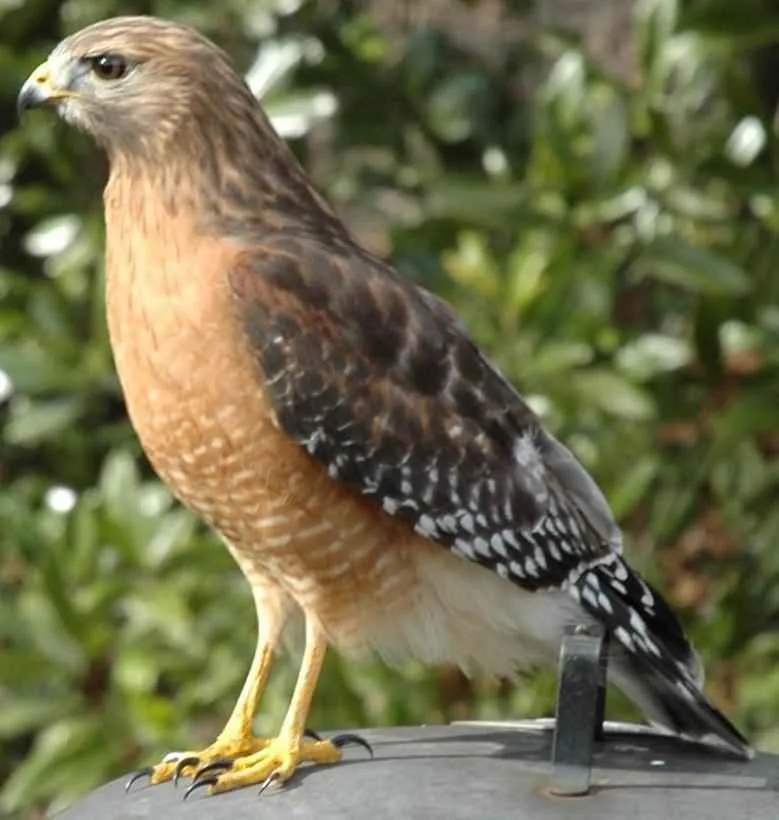
Buse à épaulettes— Quebec wildlife
Buteo lineatus
AccipitridaeNo period published by Québec.ca
Québec.ca publishes no hunting or trapping period for this species. Check the official regulations.
Wikipedia
Buse à épaulettes
The red-shouldered hawk (Buteo lineatus) is a medium-sized buteo. Its breeding range spans eastern North America, along the coast of California and northern to northeastern-central Mexico. It is a permanent resident throughout most of its range, though northern birds do migrate, mostly to central Mexico. The main conservation threat to the widespread species is deforestation.
Description
Males are 38 to 58 cm (15 to 23 in) long and weigh on average 550 g (1.21 lb). Females are slightly larger at 47 to 61 cm (19 to 24 in) in length and a mean weight of 700 g (1.5 lb). The wingspan can range from 90 to 127 cm (35 to 50 in). Adult birds can vary in mass from 460 to 930 g (1.01 to 2.05 lb). Among standard measurements, the wing bone is 28–35 cm (11–14 in) long, the tail is 16–24 cm (6.3–9.4 in) long and the tarsus is 7.5–9 cm (3.0–3.5 in). Adults have brownish heads, reddish chests, and pale bellies with reddish bars. Their tails, which are quite long by Buteo standards, are marked with narrow white bars. Red "shoulders" are visible when the birds are perched. These hawks' upper parts are dark with pale spots and they have long yellow legs. Western birds may appear more red, while Florida birds are generally paler. The wings of adults are more heavily barred on the upper side. Juvenile red-shouldered hawks are most likely to be confused with juvenile broad-winged hawks, but can be distinguished by their long tails, crescent-like wing markings, and a more flapping, Accipiter-like flight style. In direct comparison, it is typically larger and longer proportioned than the broad-wing, though is slightly smaller and more slender than most other common North American Buteo species. This bird is sometimes also confused with the widespread red-tailed hawk. That species is larger and bulkier, with more even-sized, broad wings, and is paler underneath, with a reddish tail often apparent. The red-tail is also more likely to soar steadily, with wings in a slight dihedral.
Text from Wikipedia — Red-shouldered hawk, revision 1372030477, CC BY-SA 4.0, retrieved 2026-09-04. Encyclopedic text reused under CC BY-SA 4.0. Sentences about hunting or regulation are removed: on this site, the rule comes from Québec.ca.
Other names
French
English
Presence in Quebec
- Origin
- Indigène
- Occurrence
- Régulier
- Population status
- Reproducteur
- Certainty
- Confirmé
Conservation
Québec.ca
Official periods
Source: Québec.ca — tables reproduced as published (retrieved 2026-08-30).
Regulations change. Always check Québec.ca before hunting or trapping.
Where this data comes from
This species is listed in an official government dataset. The identification and status shown in the data sheet are reproduced from it.
Source: List of Quebec’s vertebrate wildlife (LFVQ) — Ministère de l’Environnement, de la Lutte contre les changements climatiques, de la Faune et des Parcs. File LFVQ_25_03_2026.csv, retrieved 2026-08-30 · CC BY 4.0.
Measurements, habitat, diet and reproduction are not shown: no official source is attached to them yet.