
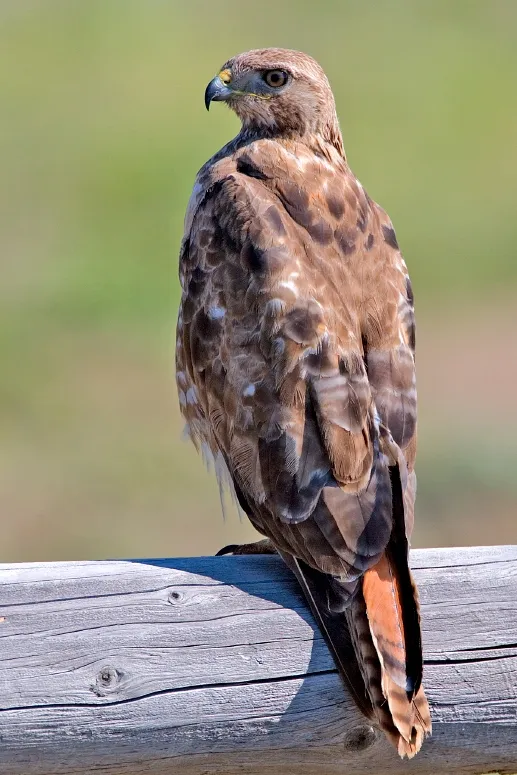
Buse à queue rousse— Quebec wildlife
Buteo jamaicensis
AccipitridaeNo period published by Québec.ca
Québec.ca publishes no hunting or trapping period for this species. Check the official regulations.
Wikipedia
Buse à queue rousse
The red-tailed hawk (Buteo jamaicensis) is a bird of prey and one of the most common hawks in North America. In the United States, it is one of three species colloquially known as the "chickenhawk". The red-tailed hawk breeds throughout most of the continent, from western Alaska and northern Canada to as far south as Panama and the West Indies. The red-tailed hawk occupies a wide range of habitats and altitudes, including deserts, grasslands, coniferous and deciduous forests, agricultural fields, and urban areas. It is absent in areas of unbroken forest and in the high arctic. It is legally protected in Canada, Mexico, and the United States by the Migratory Bird Treaty. The red-tailed hawk is one of the largest members of the genus Buteo in North America, typically weighing from 690 to 1,600 g (1.5 to 3.5 lb) and measuring 45–65 cm (18–26 in) in length, with a wingspan from 110–145 cm (43–57 in). Females are about 25% heavier than males. It has a stocky body with broad wings and can be distinguished from other North American hawks by the eponymous tail, which is uniformly brick-red above and light buff-orange below. The species feeds on a wide range of small animals, such as rodents, birds, and reptiles. Pairs stay together for life, taking a new mate only when the original mate dies. The pair constructs a stick nest in a high tree, in which a clutch of one to three eggs is laid. The 14 recognized subspecies vary in appearance and range. The subspecies Harlan's hawk (B. j. harlani) is sometimes considered a separate species (B. harlani). The feathers and other parts of the red-tailed hawk are considered sacred to many American indigenous people.
Description
The red-tailed hawk is dimorphic in size, as females are up to 25% larger than males. As is typical in large raptors, frequently reported mean body mass for red-tailed hawks is somewhat higher than expansive research reveals. Part of this weight is highly seasonally variable and due to clinal variation; male red-tailed hawks may weigh from 690 to 1,300 g (1.52 to 2.87 lb) and females from 900 to 2,000 g (2.0 to 4.4 lb). Nine studies occurring at migration sites in the United States and two breeding studies, one from the smallest race in Puerto Rico, the other from larger races in Wisconsin, show that males weigh 837 g (1.845 lb) and females weigh 1,040.7 g (2.294 lb) on average, about 15% lighter than prior species-wide published weights. The heaviest surveyed weights came from migrants in Cape May, New Jersey, where females averaged 1,278 g (2.818 lb), while males averaged 990.8 g (2.184 lb) in weight. The lightest were from the breeding population in forest openings of Puerto Rico, where the females and males weighed an average of 1,023 g (2.255 lb) and 795 g (1.753 lb), respectively, also the highest size sexual dimorphism in the species.
Text from Wikipedia — Red-tailed hawk, revision 1359989883, CC BY-SA 4.0, retrieved 2026-09-04. Encyclopedic text reused under CC BY-SA 4.0. Sentences about hunting or regulation are removed: on this site, the rule comes from Québec.ca.
Other names
French
English
Presence in Quebec
- Origin
- Indigène
- Occurrence
- Régulier
- Population status
- Reproducteur
- Certainty
- Confirmé
Conservation
Québec.ca
Official periods
Source: Québec.ca — tables reproduced as published (retrieved 2026-08-30).
Regulations change. Always check Québec.ca before hunting or trapping.
Where this data comes from
This species is listed in an official government dataset. The identification and status shown in the data sheet are reproduced from it.
Source: List of Quebec’s vertebrate wildlife (LFVQ) — Ministère de l’Environnement, de la Lutte contre les changements climatiques, de la Faune et des Parcs. File LFVQ_25_03_2026.csv, retrieved 2026-08-30 · CC BY 4.0.
Measurements, habitat, diet and reproduction are not shown: no official source is attached to them yet.