
No period published by Québec.ca
Québec.ca publishes no hunting or trapping period for this species. Check the official regulations.
Wikipedia
Buse de Swainson
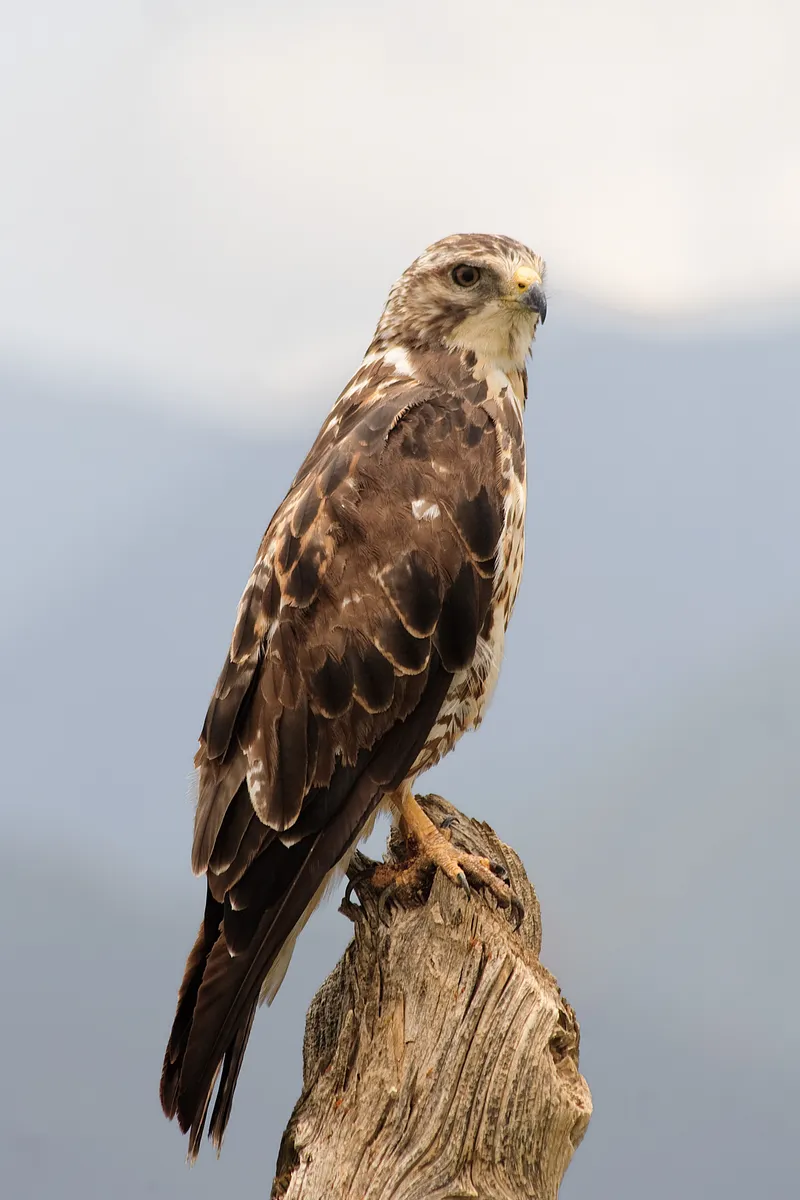
Swainson's hawk (Buteo swainsoni) is a large bird species in the Accipitriformes order. This species was named after William Swainson, a British naturalist. It is colloquially known as the grasshopper hawk or locust hawk, as it is very fond of Acrididae (locusts and grasshoppers) and will voraciously eat these insects whenever they are available. Their breeding habitat is prairie and dry grasslands in western North America. They build a stick nest in a tree or shrub or on a cliff edge. This species is a long-distance migrant, wintering in Argentina; it has been recorded as a vagrant in neighboring Chile, in the island countries of the Dominican Republic, and Trinidad and Tobago, and in Norway. This species or its immediate predecessor is the ancestor of the Galápagos hawk, as demonstrated by recent research. Then later diverged from the mainland birds perhaps 300,000 years ago, a very short time in evolution.
Description
Swainson's hawk is a raptor and a medium-sized member of the genus Buteo. It broadly overlaps in size with the red-tailed hawk (B. jamaicensis), a related species found as a breeding resident almost throughout North America. Swainson's hawk is on average a little shorter in length, 43–56 cm (17–22 in) long, and weighs a bit less, 0.5–1.7 kg (1.1–3.7 lb). However, Swainson's hawk has a slightly longer wingspan at 117–137 cm (46–54 in), with more slender, elongated wings, than the red-tailed hawk. Female Swainson's hawks, at an average weight of 1.15 kg (2.5 lb), are somewhat larger and heavier than males, at an average of 0.81 kg (1.8 lb). Among standard measurements, the wing chord is 36.2–42.7 cm (14.3–16.8 in), the tail is 18.5–23.4 cm (7.3–9.2 in), the tarsus is 6.2–8 cm (2.4–3.1 in) and the bill (from the gape) is 3–3.5 cm (1.2–1.4 in). In flight, Swainson's hawk holds its wings in a slight dihedral; it tips back and forth slightly while soaring. There are two main color variations. Over 90% of individuals are light-morph; the dark morph is most common in the far west of the range: Light-morph adults are white on the underparts with a dark, reddish "bib" on the chest and a noticeable white throat and face patch. The underwings, seen as the bird soars, have light linings (leading edge) and dark flight feathers (trailing edge), a pattern unique among North American raptors. The tail is gray-brown with about six narrow dark bands and one wider subterminal band. The upperparts are brown. Juveniles are similar but dark areas have pale mottling and light areas, especially the flanks, have dark mottling. The chest is pale with some darker marks. The subterminal band of the tail is less obvious. Birds in their first spring may have pale heads because of feather wear. Dark-morph birds are dark brown except for a light patch under the tail. There is a rufous variant that is lighter on the underparts with reddish bars. The tails of both these forms resemble those of the light morph.
Text from Wikipedia — Swainson's hawk, revision 1367626237, CC BY-SA 4.0, retrieved 2026-09-04. Encyclopedic text reused under CC BY-SA 4.0. Sentences about hunting or regulation are removed: on this site, the rule comes from Québec.ca.
Other names
French
English
Presence in Quebec
- Origin
- Indigène
- Occurrence
- Accidentel/non régulier
- Population status
- Migrateur
- Certainty
- Confirmé
Conservation
Québec.ca
Official periods
Source: Québec.ca — tables reproduced as published (retrieved 2026-08-30).
Regulations change. Always check Québec.ca before hunting or trapping.
Where this data comes from
This species is listed in an official government dataset. The identification and status shown in the data sheet are reproduced from it.
Source: List of Quebec’s vertebrate wildlife (LFVQ) — Ministère de l’Environnement, de la Lutte contre les changements climatiques, de la Faune et des Parcs. File LFVQ_25_03_2026.csv, retrieved 2026-08-30 · CC BY 4.0.
Measurements, habitat, diet and reproduction are not shown: no official source is attached to them yet.