
No period published by Québec.ca
Québec.ca publishes no hunting or trapping period for this species. Check the official regulations.
Wikipedia
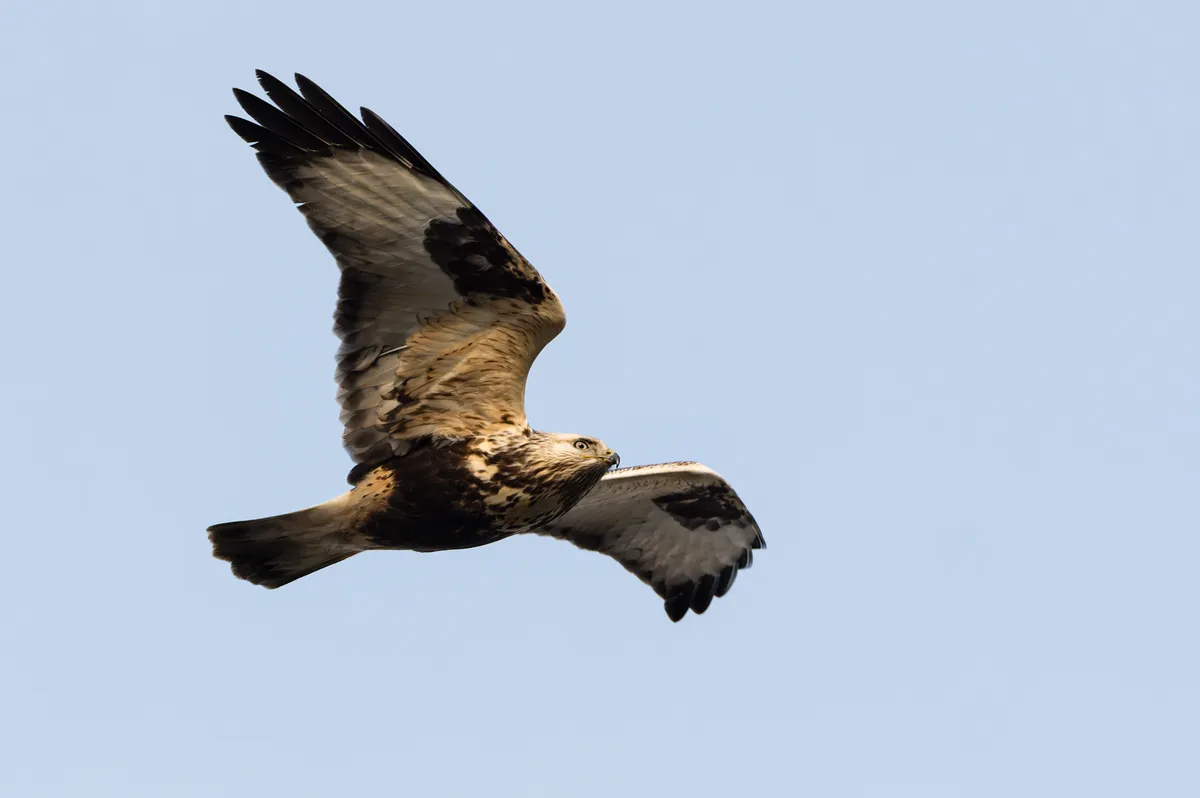
Buse pattue
The rough-legged buzzard (Europe) or rough-legged hawk (North America) (Buteo lagopus) is a medium-large bird of prey. It is found in arctic and subarctic regions of North America, Europe, and Asia during the breeding season, and migrates south for the winter. Historically, it was also known as "rough-legged falcon" in such works as John James Audubon's The Birds of America. Nests are typically located on cliffs, bluffs or in trees. The clutch sizes are variable with food availability, but usually three to five eggs are laid. Along with the kestrels, kites, and osprey, this is one of the few birds of prey to hover regularly.
Description
This fairly large raptorial species is 46–68 cm (18–27 in) with wingspan ranging from 120 to 153 cm (47 to 60 in). Individuals can weigh from 600 to 1,660 g (1.32 to 3.66 lb) with females typically being larger and heavier than males. Weights appear to increase from summer to winter in adults, going from an average of 822 to 1,027 g (1.812 to 2.264 lb) in males and from 1,080 to 1,278 g (2.381 to 2.818 lb) in females. Among the members of the genus Buteo, it is sixth heaviest, the fifth longest, and the fourth longest winged. Among standard measurements in adults, the wing chord is 37.2–48.3 cm (14.6–19.0 in), the tail is 18.6–25.5 cm (7.3–10.0 in), culmen is 3.2–4.5 cm (1.3–1.8 in) and the tarsus is 5.8–7.8 cm (2.3–3.1 in). The plumage is predominantly brown and white, and often shows a high degree of speckling. A broad brown chest-band is present in most plumages and a square dark carpal patch contrasting with the white under-wing is an easily identifiable characteristic in light morph individuals. A wide variety of plumage patterns are exhibited in light vs. dark morphs, males vs. females, and adults vs. juveniles. Extensive field experience is required to distinguish between certain plumage variations. Compared to its more common Palearctic and Nearctic cousins, the common buzzard (Buteo buteo) and the red-tailed hawk (Buteo jamaicensis), it is slightly larger, though may be outweighed by the latter. Its legs are feathered, though not the toes, as an adaptation to cold in its Arctic home range. Its scientific name reflects this feature, as lagopus means "hare-foot". Its talons are relatively small, reflecting their preferred choice of prey. Distinguishing characteristics in all plumages include long white tail feathers with one or more dark subterminal bands. The wing tips are long enough to reach or extend past the tail when it is perched. The common buzzard can be similar-looking, with a similar long-tailed shape and can be notoriously variable in plumage; rough-legged is longer-winged and more eagle-like in appearance.
Text from Wikipedia — Rough-legged buzzard, revision 1368889176, CC BY-SA 4.0, retrieved 2026-09-04. Encyclopedic text reused under CC BY-SA 4.0. Sentences about hunting or regulation are removed: on this site, the rule comes from Québec.ca.
Other names
French
English
Presence in Quebec
- Origin
- Indigène
- Occurrence
- Régulier
- Population status
- Reproducteur
- Certainty
- Confirmé
Conservation
Québec.ca
Official periods
Source: Québec.ca — tables reproduced as published (retrieved 2026-08-30).
Regulations change. Always check Québec.ca before hunting or trapping.
Where this data comes from
This species is listed in an official government dataset. The identification and status shown in the data sheet are reproduced from it.
Source: List of Quebec’s vertebrate wildlife (LFVQ) — Ministère de l’Environnement, de la Lutte contre les changements climatiques, de la Faune et des Parcs. File LFVQ_25_03_2026.csv, retrieved 2026-08-30 · CC BY 4.0.
Measurements, habitat, diet and reproduction are not shown: no official source is attached to them yet.