
No period published by Québec.ca
Québec.ca publishes no hunting or trapping period for this species. Check the official regulations.
Wikipedia
Butor d'Amérique
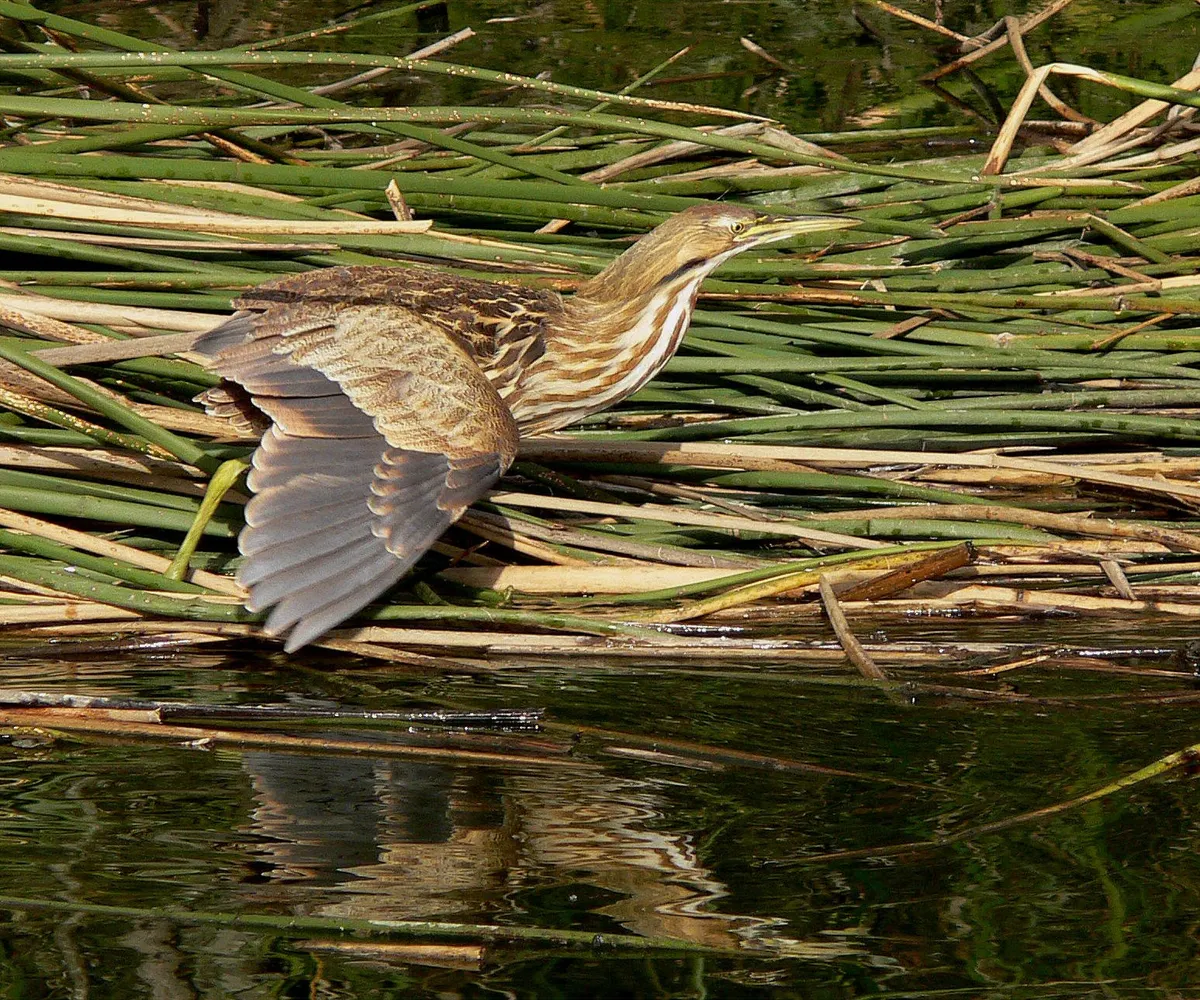
The American bittern (Botaurus lentiginosus) is a species of wading bird in the heron family. It has a Nearctic distribution, breeding in Canada and the northern and central parts of the United States, and wintering in the U.S. Gulf Coast states, all of Florida into the Everglades, the Caribbean islands and parts of Central America. It is a well-camouflaged, solitary brown bird that unobtrusively inhabits marshes and the coarse vegetation at the edge of lakes and ponds. In the breeding season it is chiefly noticeable by the loud, booming call of the male. The nest is built just above the water, usually among bulrushes and cattails, where the female incubates the clutch of olive-colored eggs for about four weeks. The young leave the nest after two weeks and are fully fledged at six or seven weeks. The American bittern feeds mostly on fish but also eats other small vertebrates as well as crustaceans and insects. It is fairly common over its wide range, but its numbers are thought to be decreasing, especially in the south, because of habitat degradation. However the total population is large, and the International Union for Conservation of Nature has assessed its conservation status as being of "Least Concern".
Description
The American bittern is a large, chunky, brown bird, very similar to the Eurasian bittern (Botaurus stellaris), though slightly smaller, and the plumage is speckled rather than being barred. It is 58–85 cm (23–33 in) in length, with a 92–115 cm (36–45 in) wingspan and a body mass of 370–1,072 g (0.816–2.363 lb). The crown is chestnut brown with the centers of the feathers being black. The side of the neck has a bluish-black elongated patch which is larger in the male than in the female. The hind neck is olive, and the mantle and scapulars are dark chestnut-brown, barred and speckled with black, some feathers being edged with buff. The back, rump, and upper tail-coverts are similar in color but more finely speckled with black and with grey bases to the feathers. The tail feathers are chestnut brown with speckled edges, and the primaries and secondaries are blackish-brown with buff or chestnut tips. The cheeks are brown with a buff superciliary stripe and a similarly colored mustachial stripe. The chin is creamy-white with a chestnut central stripe, and the feathers of the throat, breast, and upper belly are buff and rust-colored, finely outlined with black, giving a striped effect to the underparts. The eyes are surrounded by yellowish skin, and the iris is pale yellow. The long, robust bill is yellowish-green, the upper mandible being darker than the lower, and the legs and feet are yellowish-green. Juveniles resemble adults, but the sides of their necks are less olive.
Text from Wikipedia — American bittern, revision 1341642986, CC BY-SA 4.0, retrieved 2026-09-04. Encyclopedic text reused under CC BY-SA 4.0. Sentences about hunting or regulation are removed: on this site, the rule comes from Québec.ca.
Other names
French
English
Presence in Quebec
- Origin
- Indigène
- Occurrence
- Régulier
- Population status
- Reproducteur
- Certainty
- Confirmé
Conservation
Québec.ca
Official periods
Source: Québec.ca — tables reproduced as published (retrieved 2026-08-30).
Regulations change. Always check Québec.ca before hunting or trapping.
Where this data comes from
This species is listed in an official government dataset. The identification and status shown in the data sheet are reproduced from it.
Source: List of Quebec’s vertebrate wildlife (LFVQ) — Ministère de l’Environnement, de la Lutte contre les changements climatiques, de la Faune et des Parcs. File LFVQ_25_03_2026.csv, retrieved 2026-08-30 · CC BY 4.0.
Measurements, habitat, diet and reproduction are not shown: no official source is attached to them yet.