
Migratory game bird — federal regulations
Seasons and bag limits are set by Environment and Climate Change Canada.
Wikipedia
Canard chipeau
The gadwall (Mareca strepera) is a common and widespread dabbling duck in the family Anatidae.
Description
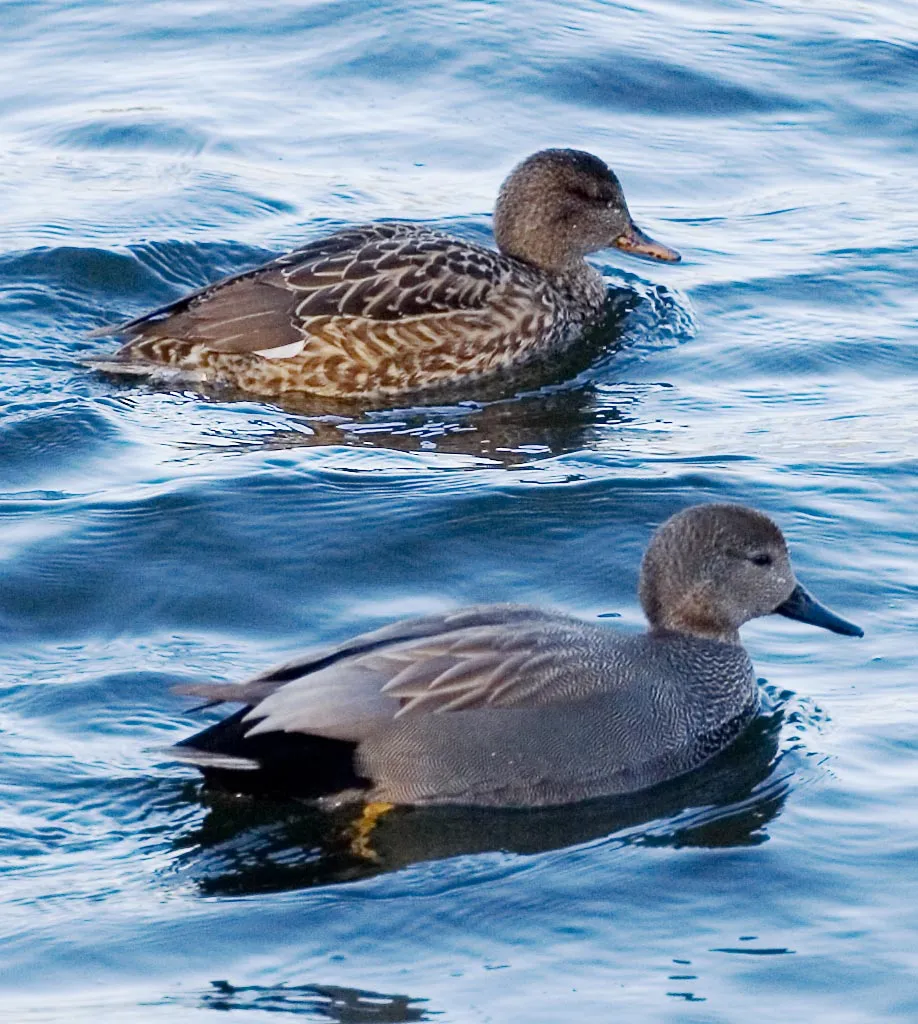
The gadwall is 47–58 cm (19–23 in) long with a 78–85 cm (31–33 in) wingspan. The male is slightly larger than the female, weighing on average 990 g (35 oz) against her 850 g (30 oz). The breeding male is patterned grey, with a black rear end, light chestnut wings, and a brilliant white speculum, obvious in flight or at rest. In non-breeding (eclipse) plumage, the drake looks more like the female, but retains the male wing pattern, and is usually greyer above and has less orange on the bill. The female is light brown, with plumage much like a female mallard. It can be distinguished from that species by the dark orange-edged bill, smaller size, the white speculum, and white belly. Both sexes go through two moults annually, following a juvenile moult. The gadwall is a quieter duck, except during its courtship display. Females give a call similar to the quack of a female mallard but higher-pitched, transcribed as gag-ag-ag-ag. Males give a grunt, transcribed as mep, and a whistle.
Habitat and range
The gadwall breeds in the northern areas of Europe and across the Palearctic, and central North America. In North America, its breeding range lies along the Saint Lawrence River, through the Great Lakes, Alberta, Saskatchewan, the Dakotas, south to Kansas, west to California, and along coastal Pacific Canada and southern coastal Alaska. The range of this bird appears to be expanding into eastern North America. This dabbling duck is strongly migratory, and winters farther south than its breeding range, from coastal Alaska, south into Central America, and east into Idaho, Kansas, Ohio, Virginia, and then south all the way into Central America. In Great Britain, the gadwall is a scarce-breeding bird and winter visitor, though its population has increased in recent years. It is likely that its expansion was partly through introduction, mainly to England, and partly through colonization by continental birds staying to breed in Scotland. In Ireland a small breeding population has recently become established, centred on County Wexford in the south and Lough Neagh in the north. The Gadwall is also seen in some parts of South Asia, particularly the southern part of India.
Text from Wikipedia — Gadwall, revision 1363113424, CC BY-SA 4.0, retrieved 2026-09-04. Encyclopedic text reused under CC BY-SA 4.0. Sentences about hunting or regulation are removed: on this site, the rule comes from Québec.ca.
Other names
Former scientific names
Presence in Quebec
- Origin
- Indigène
- Occurrence
- Régulier
- Population status
- Reproducteur
- Certainty
- Confirmé
Conservation
Québec.ca
Official periods
Source: Québec.ca — tables reproduced as published (retrieved 2026-08-30).
Regulations change. Always check Québec.ca before hunting or trapping.
SIT Québec register
Outfitters hunting this species
90 outfitters list this species among the game they hunt.
Where this data comes from
This species is listed in an official government dataset. The identification and status shown in the data sheet are reproduced from it.
Source: List of Quebec’s vertebrate wildlife (LFVQ) — Ministère de l’Environnement, de la Lutte contre les changements climatiques, de la Faune et des Parcs. File LFVQ_25_03_2026.csv, retrieved 2026-08-30 · CC BY 4.0.
Measurements, habitat, diet and reproduction are not shown: no official source is attached to them yet.