
Migratory game bird — federal regulations
Seasons and bag limits are set by Environment and Climate Change Canada.
Wikipedia
Canard d'Amérique
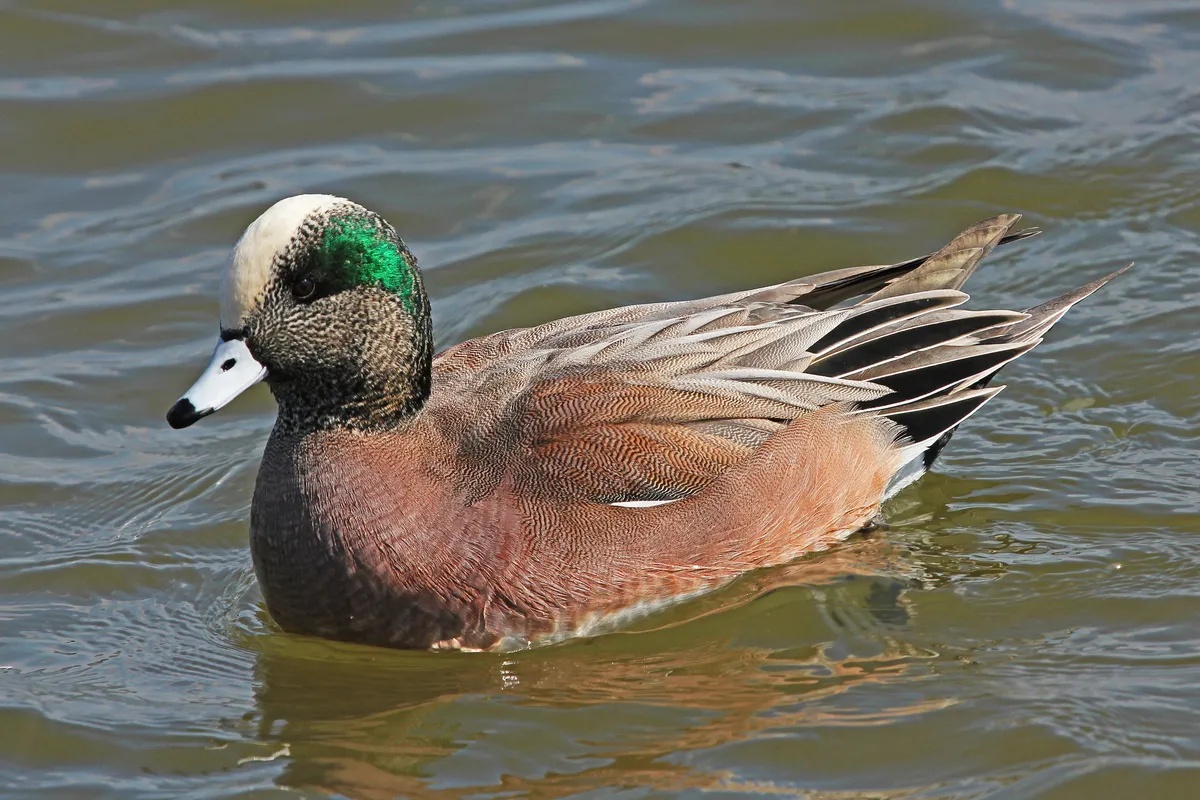
The American wigeon (Mareca americana), also known as the baldpate, is a species of dabbling duck found in North America. Formerly assigned to Anas, this species is classified with the other wigeons in the dabbling duck genus Mareca. It is the New World counterpart of the Eurasian wigeon.
Description
The American wigeon is a medium-sized bird; it is larger than a teal but smaller than a pintail. In silhouette, the wigeon can be distinguished from other dabblers by its round head, short neck, and small bill. It is 42–59 cm (17–23 in) long, with a 76–91 cm (30–36 in) wingspan and a weight of 512–1,330 g (1.129–2.932 lb). This wigeon has two adult molts per year and a juvenile molt in the first year, as well. The breeding male (drake) is a striking bird with a mask of green feathers around its eyes and a cream-colored cap running from the crown of his head to his bill. This white patch gives the wigeon its other common name, baldpate (pate is another word for head). His belly is also white. In flight, drakes can be identified by the large white shoulder patch on each wing. These white patches flash as the birds bank and turn. In nonbreeding (eclipse) plumage, the drake looks more like the female. The hens are much less conspicuous, having primarily gray and brown plumage. Both sexes have a pale blue bill with a black tip, a white belly, and gray legs and feet. The wing patch behind the speculum is gray. They can be distinguished from most ducks, apart from Eurasian wigeon, by shape. However, that species has a darker head and all-grey underwing. The head and neck coloring of the female is different from the Eurasian wigeon. She nests on the ground, near water and under cover, and lays 6–12 creamy white eggs. Flocks often contain American coots. The American wigeon is a noisy species, and in the field can often be identified by its distinctive calls. Drakes produce a three-note whistle, while hens emit hoarse grunts and quacks. The male whistle makes a wheezy whoee-whoe-whoe, whereas the female has a low growl qua-ack.
Text from Wikipedia — American wigeon, revision 1345372721, CC BY-SA 4.0, retrieved 2026-09-04. Encyclopedic text reused under CC BY-SA 4.0. Sentences about hunting or regulation are removed: on this site, the rule comes from Québec.ca.
Other names
French
Former scientific names
Presence in Quebec
- Origin
- Indigène
- Occurrence
- Régulier
- Population status
- Reproducteur
- Certainty
- Confirmé
Conservation
Québec.ca
Official periods
Source: Québec.ca — tables reproduced as published (retrieved 2026-08-30).
Regulations change. Always check Québec.ca before hunting or trapping.
SIT Québec register
Outfitters hunting this species
90 outfitters list this species among the game they hunt.
Where this data comes from
This species is listed in an official government dataset. The identification and status shown in the data sheet are reproduced from it.
Source: List of Quebec’s vertebrate wildlife (LFVQ) — Ministère de l’Environnement, de la Lutte contre les changements climatiques, de la Faune et des Parcs. File LFVQ_25_03_2026.csv, retrieved 2026-08-30 · CC BY 4.0.
Measurements, habitat, diet and reproduction are not shown: no official source is attached to them yet.