
Migratory game bird — federal regulations
Seasons and bag limits are set by Environment and Climate Change Canada.
Wikipedia
Canard noir
The American black duck (Anas rubripes) is a large dabbling duck in the family Anatidae. It was described by William Brewster in 1902. It is the heaviest species in the genus Anas, weighing 720–1,640 g (1.6–3.6 lb) on average and measuring 54–59 cm (21–23 in) in length with an 88–95 cm (35–37 in) wingspan. It somewhat resembles the female and eclipse male mallard in coloration, but has a darker plumage. The male and female are generally similar in appearance, but the male's bill is yellow, while the female's is dull green with dark marks on the upper mandible. It is native to eastern North America. During the breeding season, it is usually found in coastal and freshwater wetlands from Saskatchewan to the Atlantic in Canada and the Great Lakes and the Adirondacks in the United States. It is a partially migratory species, mostly wintering in the east-central United States, especially in coastal areas. It interbreeds regularly and extensively with the mallard, to which it is closely related. The female lays six to 14 oval eggs, which have smooth shells in varied shades of white and buff green. Incubation usually takes 25 to 26 days, with both sexes sharing duties, although the male usually defends the territory until the female reaches the middle of her incubation period. Fledging occurs about 6 weeks after hatching. Once the eggs hatch, the hen leads the brood to rearing areas with abundant invertebrates and vegetation. The American black duck is considered to be a species of least concern by the International Union for Conservation of Nature, although some populations of the species are in decline. It has long been valued as a game bird. Habitat loss due to drainage, global warming, filling of wetlands due to urbanization, and rising sea levels are major reasons for the declining population of the American black duck. The United States Fish and Wildlife Service has been purchasing and managing the habitat of this species in many areas to support the migratory stopover, wintering, and breeding populations. The Atlantic Coast Joint Venture also protects habitat through restoration and land-acquisition projects, mostly within their wintering and breeding areas.
Description
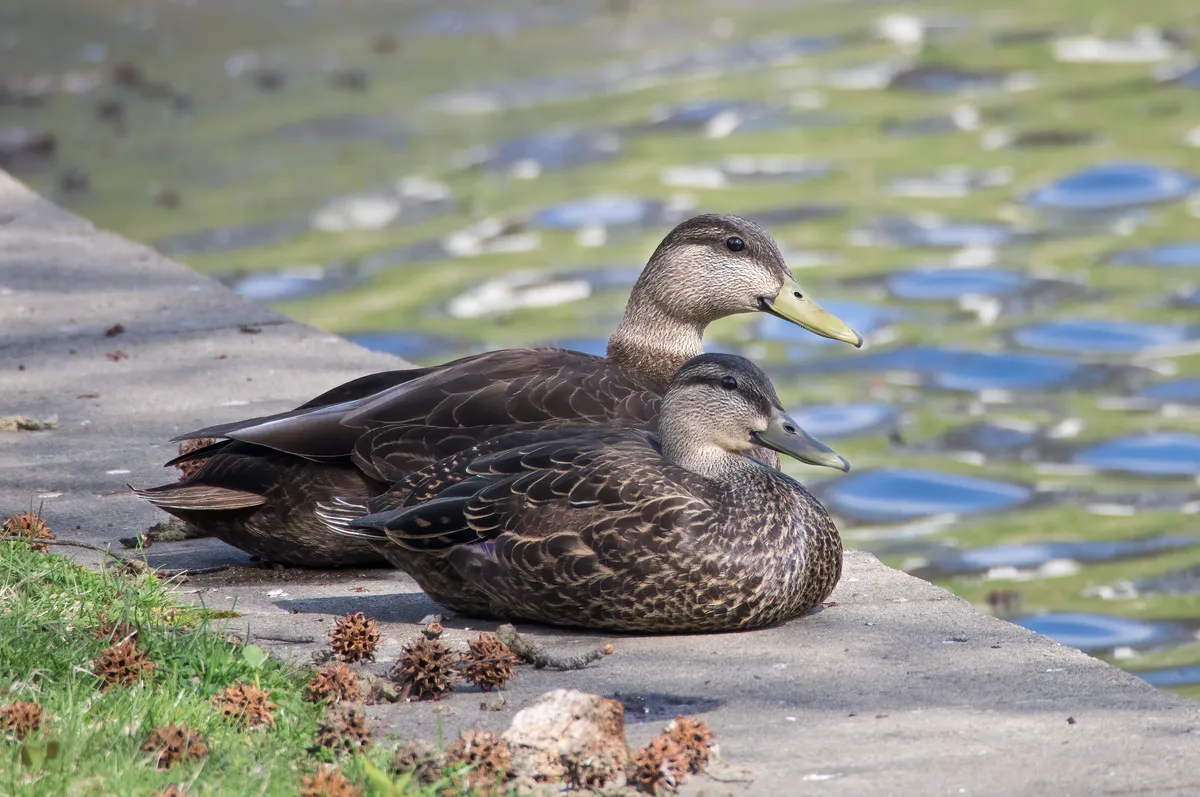
The American black duck weighs 720–1,640 g (1.59–3.62 lb) and measures 54–59 cm (21–23 in) in length with a 88–95 cm (35–37 in) wingspan. This species has the highest mean body mass in the genus Anas, with a sample of 376 males averaging 1.4 kg (3.1 lb) and 176 females averaging 1.1 kg (2.4 lb), although its size is typically quite similar to that of the familiar mallard. The American black duck somewhat resembles the female mallard in coloration, although the black duck's plumage is darker. Males and females are generally similar in appearance, but the male's bill is yellow while the female's is dull green with dark marks on the upper mandible, which is occasionally flecked with black. The head is brown, but is slightly lighter in tone than the darker brown body.
Text from Wikipedia — American black duck, revision 1371601706, CC BY-SA 4.0, retrieved 2026-09-04. Encyclopedic text reused under CC BY-SA 4.0. Sentences about hunting or regulation are removed: on this site, the rule comes from Québec.ca.
Other names
French
English
Presence in Quebec
- Origin
- Indigène
- Occurrence
- Régulier
- Population status
- Reproducteur
- Certainty
- Confirmé
Conservation
Québec.ca
Official periods
Source: Québec.ca — tables reproduced as published (retrieved 2026-08-30).
Regulations change. Always check Québec.ca before hunting or trapping.
SIT Québec register
Outfitters hunting this species
90 outfitters list this species among the game they hunt.
Where this data comes from
This species is listed in an official government dataset. The identification and status shown in the data sheet are reproduced from it.
Source: List of Quebec’s vertebrate wildlife (LFVQ) — Ministère de l’Environnement, de la Lutte contre les changements climatiques, de la Faune et des Parcs. File LFVQ_25_03_2026.csv, retrieved 2026-08-30 · CC BY 4.0.
Measurements, habitat, diet and reproduction are not shown: no official source is attached to them yet.