
Migratory game bird — federal regulations
Seasons and bag limits are set by Environment and Climate Change Canada.
Wikipedia
Canard pilet
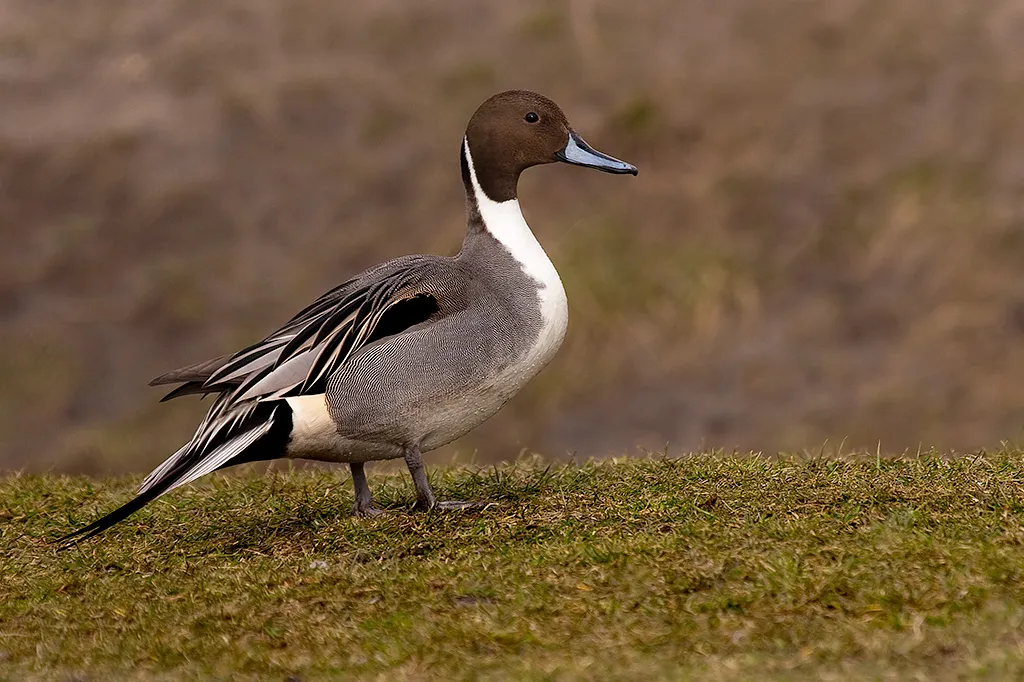
The pintail or northern pintail (Anas acuta) is a duck species with wide geographic distribution that breeds in the northern areas of Europe and across the Palearctic and North America. It is migratory and winters south of its breeding range as far as the equator. Unusually for a bird with such a large range, it has no geographical subspecies, although the possibly conspecific duck Eaton's pintail is considered to be a separate species. The Northern Pintail is a large duck, and the long central tail feathers of the male give the species its English and scientific names. Both sexes have blue-grey bills and grey legs and feet. The drake is more striking, with a thin white stripe running from the back of its chocolate-coloured head down its neck to its mostly white underparts. The drake also has attractive grey, brown, and black markings on its back and sides. The hen's plumage is more subtle and subdued, with drab brown feathers similar to those of other female dabbling ducks. Hens make a rough quacking sound and the drakes a flute-like whistle. The Northern Pintail is a bird of open wetlands that nests on the ground, often some distance from water. It feeds by dabbling for plant food, adding small invertebrates to its diet during the nesting season. It is highly gregarious when not breeding, forming large mixed flocks with other duck species. This duck's population is affected by predators, parasites and avian diseases. Despite this, the species is not globally threatened due to its large range and abundance.
Description
The northern pintail is a fairly large duck with a wing chord of 23.6–28.2 cm (9.3–11.1 in) and wingspan of 80–95 cm (31–37 in). The male is 59–76 cm (23–30 in) in length and weighs 450–1,360 g (0.99–3.00 lb), and therefore is considerably larger than the female, which is 51–64 cm (20–25 in) long and weighs 454–1,135 g (1.001–2.502 lb). The northern pintail broadly overlaps in size with the similarly widespread mallard, but is more slender, elongated and gracile, with a relatively longer neck and (in males) a longer tail. The unmistakable breeding plumaged male has a chocolate-brown head and white breast with a white stripe extending up the side of the neck. Its upperparts and sides are grey, but elongated grey feathers with black central stripes are draped across the back from the shoulder area. The vent area is yellow, contrasting with the black underside of the tail, which has the central feathers elongated to as much as 10 cm (3.9 in). The bill is bluish and the legs are blue-grey. The adult female is mainly scalloped and mottled in light brown with a more uniform grey-brown head, and its pointed tail is shorter than that of the male; it is still easily identified by its shape, long neck, and long grey bill. In non-breeding (eclipse) plumage, the drake pintail looks similar to the female, but retains the male upper wing pattern and long grey shoulder feathers.
Text from Wikipedia — Northern pintail, revision 1368362958, CC BY-SA 4.0, retrieved 2026-09-04. Encyclopedic text reused under CC BY-SA 4.0. Sentences about hunting or regulation are removed: on this site, the rule comes from Québec.ca.
Other names
French
English
Presence in Quebec
- Origin
- Indigène
- Occurrence
- Régulier
- Population status
- Reproducteur
- Certainty
- Confirmé
Conservation
Québec.ca
Official periods
Source: Québec.ca — tables reproduced as published (retrieved 2026-08-30).
Regulations change. Always check Québec.ca before hunting or trapping.
SIT Québec register
Outfitters hunting this species
90 outfitters list this species among the game they hunt.
Where this data comes from
This species is listed in an official government dataset. The identification and status shown in the data sheet are reproduced from it.
Source: List of Quebec’s vertebrate wildlife (LFVQ) — Ministère de l’Environnement, de la Lutte contre les changements climatiques, de la Faune et des Parcs. File LFVQ_25_03_2026.csv, retrieved 2026-08-30 · CC BY 4.0.
Measurements, habitat, diet and reproduction are not shown: no official source is attached to them yet.