
Migratory game bird — federal regulations
Seasons and bag limits are set by Environment and Climate Change Canada.
Wikipedia
Canard siffleur
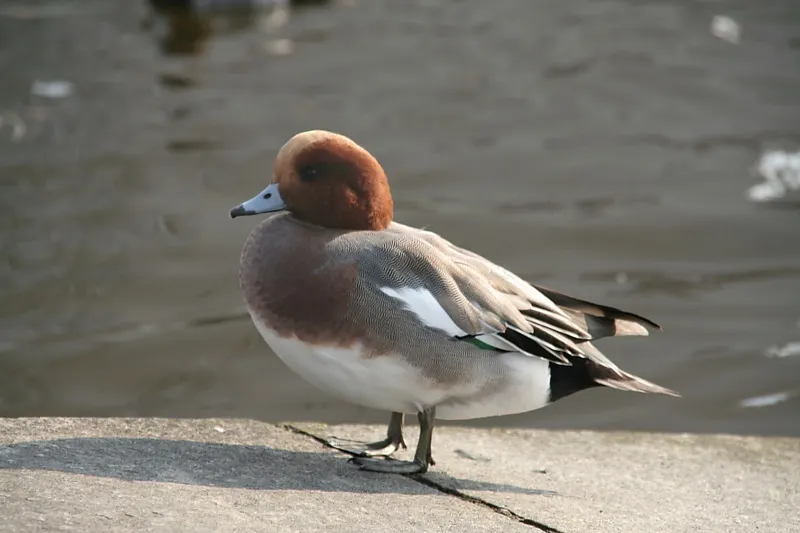
The Eurasian wigeon or European wigeon (Mareca penelope), also known as the widgeon or wigeon, is one of three extant species of wigeon in the dabbling duck genus Mareca. It is common and widespread within its Palearctic range.
Description
This dabbling duck is 42–52 cm (17–20 in) long with a 71–80 cm (28–31 in) wingspan, and a weight of 500–1,073 g (1–2 lb). The breeding male has grey flanks and back, with a black rear end, a dark green speculum and a brilliant white patch on upper wings, visible in flight or at rest. It has a pink breast, white belly, and a chestnut head with a creamy crown. In non-breeding (eclipse) plumage, the drake looks more like the female. The female is light brown, with plumage similar to that of a female American wigeon. It can be distinguished from most other ducks, apart from American wigeon, by its shape. However, that species has a paler head and white axillaries on the underwings. The female can be a rufous morph with a redder head, and a gray morph with a grayer head.
Habitat and range
It breeds in the northernmost areas of Europe and the Palearctic. It is the Old World counterpart of the North American American wigeon. It is strongly migratory and winters further south than its breeding range. It migrates to southern Asia and Africa. In Great Britain and Ireland, the Eurasian wigeon is common as a winter visitor, but scarce as a breeding bird in Scotland, the Lake District, the Pennines and occasionally further south, with only a handful of breeding pairs in Ireland. It can be found as an uncommon winter visitor in the United States on the mid-Atlantic and Pacific coasts. It is a rare visitor to the rest of the United States except for the Four Corners and the southern Appalachians.
Text from Wikipedia — Eurasian wigeon, revision 1371443283, CC BY-SA 4.0, retrieved 2026-09-04. Encyclopedic text reused under CC BY-SA 4.0. Sentences about hunting or regulation are removed: on this site, the rule comes from Québec.ca.
Other names
French
Former scientific names
Presence in Quebec
- Origin
- Indigène
- Occurrence
- Régulier
- Population status
- Migrateur
- Certainty
- Confirmé
Conservation
Québec.ca
Official periods
Source: Québec.ca — tables reproduced as published (retrieved 2026-08-30).
Regulations change. Always check Québec.ca before hunting or trapping.
SIT Québec register
Outfitters hunting this species
90 outfitters list this species among the game they hunt.
Where this data comes from
This species is listed in an official government dataset. The identification and status shown in the data sheet are reproduced from it.
Source: List of Quebec’s vertebrate wildlife (LFVQ) — Ministère de l’Environnement, de la Lutte contre les changements climatiques, de la Faune et des Parcs. File LFVQ_25_03_2026.csv, retrieved 2026-08-30 · CC BY 4.0.
Measurements, habitat, diet and reproduction are not shown: no official source is attached to them yet.