
Migratory game bird — federal regulations
Seasons and bag limits are set by Environment and Climate Change Canada.
Wikipedia
Canard souchet
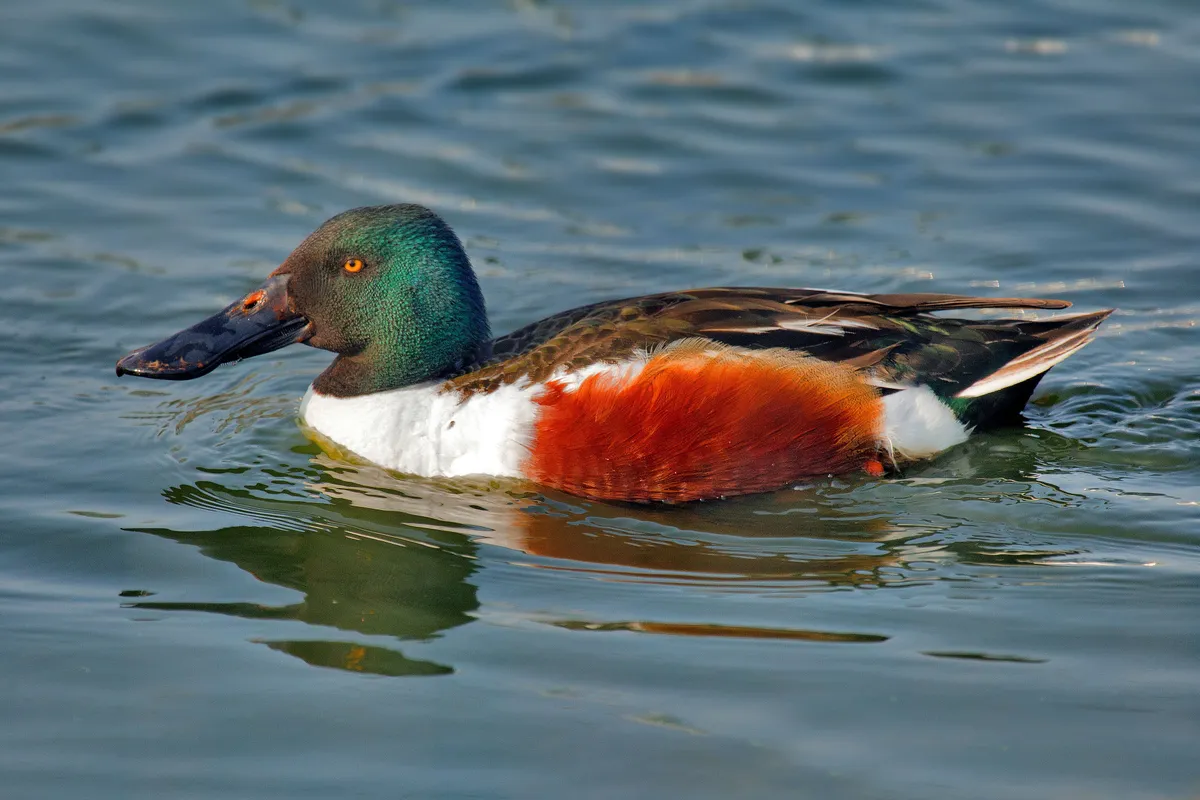
The northern shoveler (; Spatula clypeata), often known simply as the shoveler where other related species do not occur, is a common and widespread duck. It breeds in northern areas of Europe and throughout the Palearctic and across most of North America, and winters in southern Europe, the Indian subcontinent, Southeast Asia, Central America, the Caribbean, and northern South America. It is a rare vagrant to Australia. In North America, it breeds along the southern edge of Hudson Bay and west of this body of water, and as far south as the Great Lakes west to Colorado, Nevada, and Oregon. The northern shoveler is one of the species to which the Agreement on the Conservation of African-Eurasian Migratory Waterbirds (AEWA) applies. The conservation status of this bird is least concern.
Description
This species is unmistakable in the Northern Hemisphere due to its large, spatulated bill. The breeding drake has an iridescent, dark green head, though less intensely iridescent than a drake mallard's head, and appears black at distance or in poor light, white breast, and chestnut belly and flanks, and a black or very dark grey bill. In flight, pale blue forewing feathers are revealed, separated from the green speculum by a white border. In early autumn, the male has a white crescent on each side of the face. In nonbreeding eclipse plumage, the drake resembles the female, except retains the pale blue forewing. The female is a dull, mottled brown like other dabbling ducks, with a plumage similar to that of a female mallard, but easily distinguished by the long,broad bill, which is grey tinged with orange on the cutting edge and lower mandible. The female's forewing is grey. They are 44–52 cm (17.3–20.5 in) long and have a wingspan of 70–84 cm (27.6–33.1 in) with a weight of 500–800 g (1.1–1.8 lb), rarely only 300 g, or as much as 1,000 g. The legs of both sexes are bright orange-red. Vagrant northern shovelers in Australia can be very hard to distinguish from the local Australasian shoveler, particularly if in eclipse plumage when the distinctive white breast is absent.
Text from Wikipedia — Northern shoveler, revision 1356797660, CC BY-SA 4.0, retrieved 2026-09-04. Encyclopedic text reused under CC BY-SA 4.0. Sentences about hunting or regulation are removed: on this site, the rule comes from Québec.ca.
Other names
Former scientific names
Presence in Quebec
- Origin
- Indigène
- Occurrence
- Régulier
- Population status
- Reproducteur
- Certainty
- Confirmé
Conservation
Québec.ca
Official periods
Source: Québec.ca — tables reproduced as published (retrieved 2026-08-30).
Regulations change. Always check Québec.ca before hunting or trapping.
SIT Québec register
Outfitters hunting this species
90 outfitters list this species among the game they hunt.
Where this data comes from
This species is listed in an official government dataset. The identification and status shown in the data sheet are reproduced from it.
Source: List of Quebec’s vertebrate wildlife (LFVQ) — Ministère de l’Environnement, de la Lutte contre les changements climatiques, de la Faune et des Parcs. File LFVQ_25_03_2026.csv, retrieved 2026-08-30 · CC BY 4.0.
Measurements, habitat, diet and reproduction are not shown: no official source is attached to them yet.