
No period published by Québec.ca
Québec.ca publishes no hunting or trapping period for this species. Check the official regulations.
Wikipedia
Caracara huppé
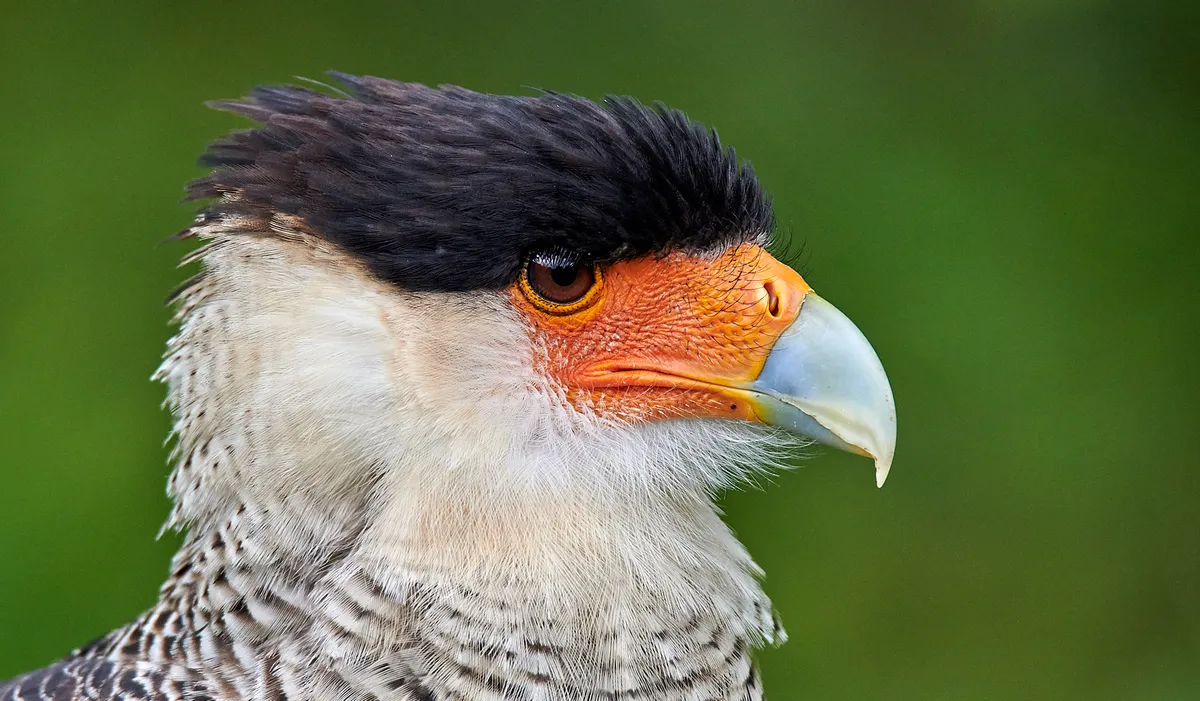
The crested caracara (Caracara plancus) is a bird of prey (raptor) in the falcon family, Falconidae. It was formerly placed in the genus Polyborus before being given in its own genus, Caracara. It is native to and found in the southern and southeastern United States, Mexico (where it is present in every state) and the majority of mainland Latin America, as well as some Caribbean islands. The crested caracara is quite adaptable and hardy, for a species found predominantly in the neotropics; it can be found in a range of environments and ecosystems, including semi-arid and desert climates, maritime or coastal areas, subtropical and tropical forests, temperate regions, plains, swamps, and even in urban areas. Documented, albeit rare, sightings have occurred as far north as Minnesota and the Canadian provinces of Alberta, Ontario, and Prince Edward Island. The southern extent of the crested caracara's distribution can reach as far as Tierra del Fuego and Magallanes Region, Chile.
Description
The crested caracara has a total length of 50–65 cm (20–26 in) and a wingspan of 120–132 cm (47–52 in). Its weight is 0.9–1.6 kg (2.0–3.5 lb), averaging 1,348 g (2.972 lb) in seven birds from Tierra del Fuego. Individuals from the colder southern part of its range average larger than those from tropical regions (as predicted by Bergmann's rule) and are the largest type of caracara. In fact, they are the second-largest species of falcon in the world by mean body mass, second only to the gyrfalcon. The cap, belly, thighs, most of the wings, and tail tip are dark brownish, the auriculars (feathers surrounding the ear), throat, and nape are whitish-buff, and the chest, neck, mantle, back, upper tail coverts, crissum (the undertail coverts surrounding the cloaca), and basal part of the tail are whitish-buff barred dark brownish. In flight, the outer primaries show a large conspicuous whitish-buff patch ('window'), as in several other species of caracaras. The legs are yellow and the bare facial skin and cere are deep yellow to reddish-orange. (The facial color can change depending on the bird's mood.) Juveniles resemble adults, but are paler, with streaking on the chest, neck, and back, grey legs, and whitish, later pinkish-purple, facial skin and cere.
Text from Wikipedia — Crested caracara, revision 1369665165, CC BY-SA 4.0, retrieved 2026-09-04. Encyclopedic text reused under CC BY-SA 4.0. Sentences about hunting or regulation are removed: on this site, the rule comes from Québec.ca.
Other names
French
Former scientific names
Presence in Quebec
- Origin
- Indigène
- Occurrence
- Accidentel/non régulier
- Population status
- Migrateur
- Certainty
- Confirmé
Conservation
Official remark
Présence de l'espèce plutôt imprévisible; elle peut ne pas être observée pendant de longues périodes.
Québec.ca
Official periods
Source: Québec.ca — tables reproduced as published (retrieved 2026-08-30).
Regulations change. Always check Québec.ca before hunting or trapping.
Where this data comes from
This species is listed in an official government dataset. The identification and status shown in the data sheet are reproduced from it.
Source: List of Quebec’s vertebrate wildlife (LFVQ) — Ministère de l’Environnement, de la Lutte contre les changements climatiques, de la Faune et des Parcs. File LFVQ_25_03_2026.csv, retrieved 2026-08-30 · CC BY 4.0.
Measurements, habitat, diet and reproduction are not shown: no official source is attached to them yet.