
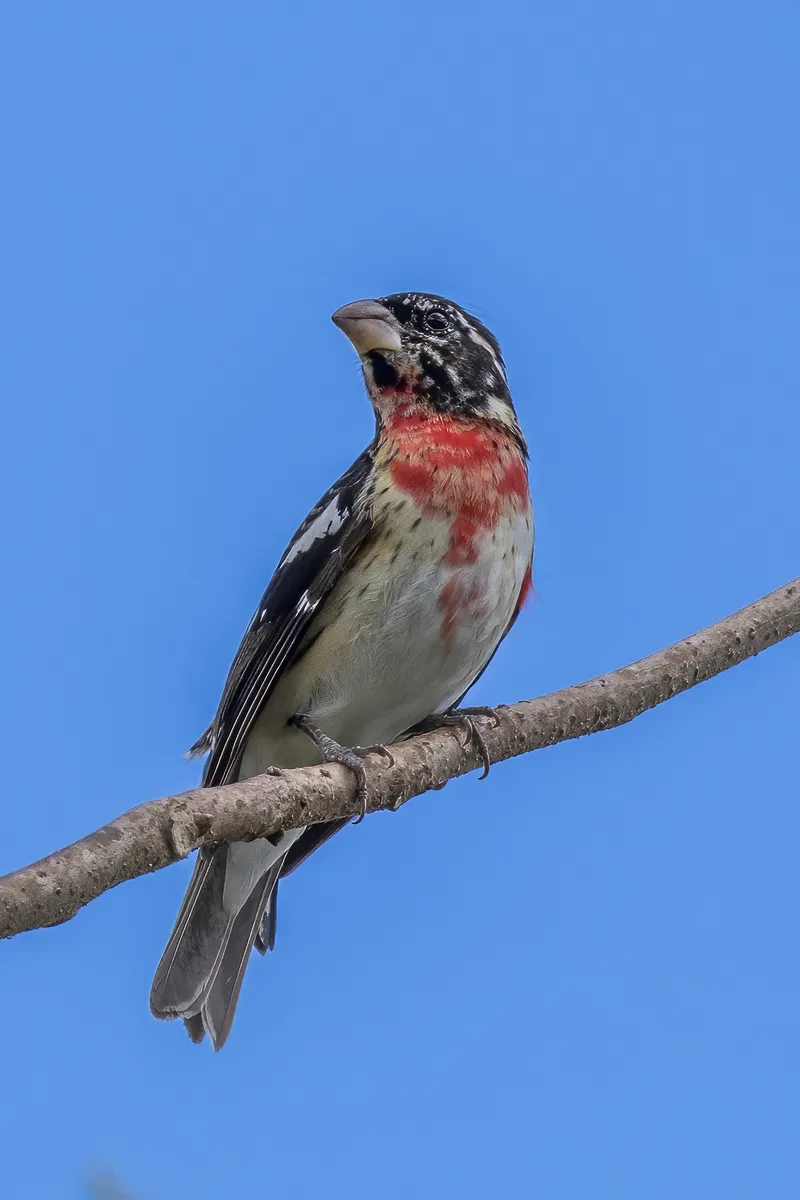
Cardinal à poitrine rose— Quebec wildlife
Pheucticus ludovicianus
CardinalidaeNo period published by Québec.ca
Québec.ca publishes no hunting or trapping period for this species. Check the official regulations.
Wikipedia
Cardinal à poitrine rose
The rose-breasted grosbeak (Pheucticus ludovicianus), colloquially called "cut-throat" due to its coloration, is a large, seed-eating grosbeak in the cardinal family (Cardinalidae). It is primarily a foliage gleaner. Males have black heads, wings, backs, and tails, and a bright rose colored patch on their white breast. Males and females exhibit marked sexual dimorphism. Breeding habitat consists of cool-temperate open deciduous woods throughout much of eastern North America, with migration to tropical America in winter. Rose-breasted grosbeaks have an average maximum lifespan of 7.3 years in the wild, and up to 24 years in captivity. Death in the wild is generally due to collision with objects (buildings, cars, etc.) and predation, to eggs, nestlings and adults.
Description
Adult birds are 18–22 cm (7.1–8.7 in) long, span 29–33 cm (11–13 in) across the wings and weigh 35–65 g (1.2–2.3 oz). Grosbeaks measured during migration in the West Indies averaged 43 g (1.5 oz), while those banded in Pennsylvania average about 45 g (1.6 oz). Very little sexual dimorphism in size is seen; females were found to be marginally smaller in standard measurements, but in some seasons were marginally heavier than males when banded in Pennsylvania. At all ages and in both sexes, the beak is dusky horn-colored, and the feet and eyes are dark. The adult male in breeding plumage has a black head, wings, back, and tail, and a bright rose-red patch on its breast; the wings have two white patches and rose-red linings. Its underside and rump are white. Males in nonbreeding plumage have largely white underparts, supercilium, and cheeks. The upperside feathers have brown fringes, and most wing feathers white ones, giving a scaly appearance. The bases of the primary remiges are also white. The coloration renders the adult male rose-breasted grosbeak (even while wintering) unmistakable if seen well. The adult female has dark grey-brown upperparts – darker on wings and tail – a white supercilium, a buff stripe along the top of the head, and black-streaked white underparts, which except in the center of the belly have a buff tinge. The wing linings are yellowish, and on the upperwing are two white patches like in the summer male. Immatures are similar, but with pink wing-linings and less prominent streaks and usually a pinkish-buff hue on the throat and breast. At one year of age—in their first breeding season—males are scaly above like fully adult males in winter plumage, and still retain the immature's browner wings. Unlike males, females can easily be confused with the black-headed grosbeak (Pheucticus melanocephalus) where their ranges overlap in the central United States and south-central Canada. The rose-breasted grosbeak female has slightly darker brown markings on the underside, paler rather yellowish streaking on both the head and wings and paler, pinkish (rather than bi-colored) bill when compared to the female black-headed grosbeak.
Text from Wikipedia — Rose-breasted grosbeak, revision 1360656074, CC BY-SA 4.0, retrieved 2026-09-04. Encyclopedic text reused under CC BY-SA 4.0. Sentences about hunting or regulation are removed: on this site, the rule comes from Québec.ca.
Other names
French
English
Presence in Quebec
- Origin
- Indigène
- Occurrence
- Régulier
- Population status
- Reproducteur
- Certainty
- Confirmé
Conservation
Québec.ca
Official periods
Source: Québec.ca — tables reproduced as published (retrieved 2026-08-30).
Regulations change. Always check Québec.ca before hunting or trapping.
Where this data comes from
This species is listed in an official government dataset. The identification and status shown in the data sheet are reproduced from it.
Source: List of Quebec’s vertebrate wildlife (LFVQ) — Ministère de l’Environnement, de la Lutte contre les changements climatiques, de la Faune et des Parcs. File LFVQ_25_03_2026.csv, retrieved 2026-08-30 · CC BY 4.0.
Measurements, habitat, diet and reproduction are not shown: no official source is attached to them yet.