
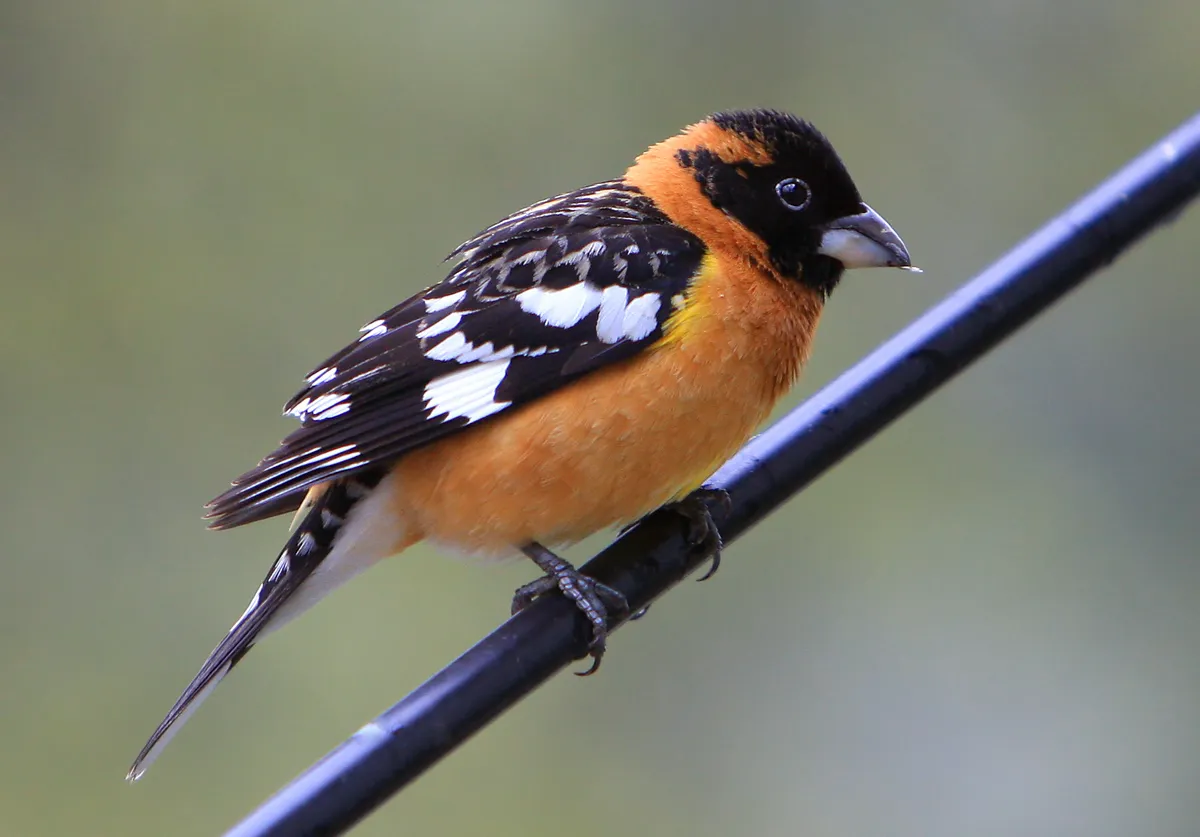
Cardinal à tête noire— Quebec wildlife
Pheucticus melanocephalus
CardinalidaeNo period published by Québec.ca
Québec.ca publishes no hunting or trapping period for this species. Check the official regulations.
Wikipedia
Cardinal à tête noire
The black-headed grosbeak (Pheucticus melanocephalus) is a medium-sized, seed-eating bird in the family Cardinalidae. It is sometimes considered conspecific with the rose-breasted grosbeak (P. ludovicianus) with which it hybridizes on the American Great Plains. The 19 cm (7.5 in) long, 47 g (1.7 oz) black-headed grosbeak is a migratory bird, with nesting grounds from southwestern British Columbia, through the western half of the United States, into central Mexico. It occurs as a vagrant further south in Central America.
Description
Measurements: Length: 7.1–7.5 in (18–19 cm) Weight: 1.2–1.7 oz (34–48 g) Wingspan: 12.6 inches (32 cm) The black-headed grosbeak is similar in size to a common starling. As per its name, the male has a black head, and black wings and tail with prominent white patches. Its breast is dark to tawny orange in color, and its belly is yellow. The female has a brown head, neck, and back with sparrow-like black streaks. She also has white streaks down the middle of her head, over her eyes, and on her cheeks. Her breast is white, and wings and tail are grayish-brown with two white wing bars and yellowish wing edges.
Habitat and range
The black-headed grosbeak prefers to live in deciduous and mixed wooded areas. It likes to be in areas with large trees and thick bushes, such as patches of broadleaved trees and shrubs within conifer forests, including streamside corridors, river bottoms, lakeshores, wetlands, and suburban areas.
Diet
The black-headed grosbeak eats pine and other seeds, berries, insects and spiders, and fruit. During the summer, it mostly eats spiders, snails, and insects. It is one of the few birds, along with the black-backed oriole, that can safely eat the poisonous monarch butterfly. In their wintering grounds, this grosbeak consumes many monarch butterflies, perhaps over one million per year in the overwintering colonies in Mexico. However, only the black-headed grosbeak is physiologically insensitive to the cardiac glycoside heart poisons in the monarchs, which monarch caterpillars sequester from their milkweed host plants and are retained by adults even after metamorphosis, which protects them from most predaceous birds. The same genetic changes that confer resistance to the poisons in the monarch and its relatives were found to have evolved in the black-headed grosbeak in a case of convergent evolution. The cellular target of the heart poisons is the first extracellular loop of the sodium pump, a critical ion pump needed for nerve cells to fire and heart cells to contract. Two of the grosbeak's four copies of the gene encoding this protein have changes that are also found in insects adapted to feeding on plants producing the cardiac glycosides.
Text from Wikipedia — Black-headed grosbeak, revision 1352290768, CC BY-SA 4.0, retrieved 2026-09-04. Encyclopedic text reused under CC BY-SA 4.0. Sentences about hunting or regulation are removed: on this site, the rule comes from Québec.ca.
Presence in Quebec
- Origin
- Indigène
- Occurrence
- Accidentel/non régulier
- Population status
- Migrateur
- Certainty
- Confirmé
Conservation
Québec.ca
Official periods
Source: Québec.ca — tables reproduced as published (retrieved 2026-08-30).
Regulations change. Always check Québec.ca before hunting or trapping.
Where this data comes from
This species is listed in an official government dataset. The identification and status shown in the data sheet are reproduced from it.
Source: List of Quebec’s vertebrate wildlife (LFVQ) — Ministère de l’Environnement, de la Lutte contre les changements climatiques, de la Faune et des Parcs. File LFVQ_25_03_2026.csv, retrieved 2026-08-30 · CC BY 4.0.
Measurements, habitat, diet and reproduction are not shown: no official source is attached to them yet.