
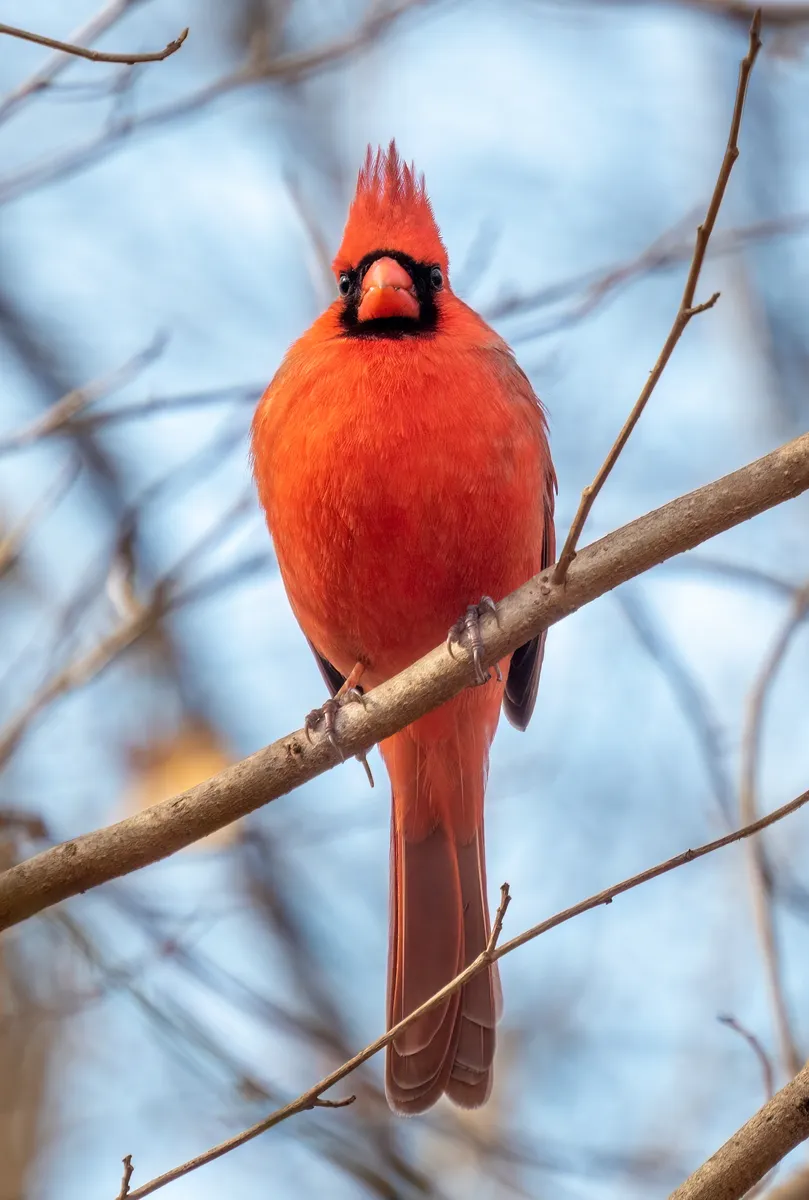
Cardinal rouge— Quebec wildlife
Cardinalis cardinalis
CardinalidaeNo period published by Québec.ca
Québec.ca publishes no hunting or trapping period for this species. Check the official regulations.
Wikipedia
Cardinal rouge
The northern cardinal (Cardinalis cardinalis), also commonly known as the common cardinal, red cardinal, or simply cardinal, is a bird in the genus Cardinalis. It can be found in southeastern Canada, through the eastern United States from Maine to Minnesota to Texas, New Mexico, southern Arizona, southern California and south through Mexico, Belize, and Guatemala. It is also an introduced species in a few locations such as Bermuda and all major islands of Hawaii since its introduction in 1929. Its habitat includes woodlands, gardens, shrublands, and wetlands. It is the state bird of Illinois, Indiana, Kentucky, North Carolina, Ohio, Virginia, and West Virginia. The northern cardinal is a mid-sized perching songbird with a body length of 21–23 cm (8.3–9.1 in) and a crest on the top of its head. The species expresses sexual dimorphism: Females are a reddish olive color, and have a gray mask around the beak, while males are a vibrant red color, and have a black mask on the face, as well as a larger crest. Juvenile cardinals do not have the distinctive red-orange beak seen in adult birds until they are almost fully mature. On hatching, their beaks are grayish-black and they do not become the typical orange-red color until they acquire their final adult plumage in the fall. The northern cardinal is mainly granivorous but also feeds on insects and fruit. The male behaves territorially, marking out his territory with song. During courtship, the male feeds seed to the female beak-to-beak. The northern cardinal's clutch typically contains three to four eggs, with two to four clutches produced each year. It was once prized as a pet, but its sale was banned in the United States by the Migratory Bird Treaty Act of 1918.
Description
The northern cardinal is a mid-sized songbird with a body length of 21–23.5 cm (8.3–9.3 in) and a wingspan of 25–31 cm (9.8–12.2 in). The adult weighs from 33.6–65 g (1.19–2.29 oz), with an average 44.8 g (1.58 oz). The male averages slightly larger than the female. The oldest wild cardinal banded by researchers lived at least 15 years and 9 months, although 28.5 years was achieved by a captive bird. Annual survival rates for adult northern cardinals have been estimated at 60–65%.
Diet
The diet of the adult northern cardinal consists mainly (up to 90%) of weed seeds, grains, and fruits. It is a ground feeder and finds food while hopping on the ground through trees or shrubbery. It will also consume snails and insects, including beetles, cicadas, and grasshoppers, and the young are fed almost entirely on insects. Other common items include corn, oats, sunflower seeds, the blossoms and bark of elm trees, and drinks of maple sap from holes made by sapsuckers.
Reproduction
Pairs may mate for successive years, but some also "divorce" between seasons or choose a new mate when one dies. Pairs generally stay together year-round but are not necessarily monogamous.DNA studies of two populations of cardinals found that 9–35% of nestlings were not fathered by the female's m
Text from Wikipedia — Northern cardinal, revision 1366149563, CC BY-SA 4.0, retrieved 2026-09-04. Encyclopedic text reused under CC BY-SA 4.0. Sentences about hunting or regulation are removed: on this site, the rule comes from Québec.ca.
Other names
French
English
Presence in Quebec
- Origin
- Indigène
- Occurrence
- Régulier
- Population status
- Toute l'année
- Certainty
- Confirmé
Conservation
Québec.ca
Official periods
Source: Québec.ca — tables reproduced as published (retrieved 2026-08-30).
Regulations change. Always check Québec.ca before hunting or trapping.
Where this data comes from
This species is listed in an official government dataset. The identification and status shown in the data sheet are reproduced from it.
Source: List of Quebec’s vertebrate wildlife (LFVQ) — Ministère de l’Environnement, de la Lutte contre les changements climatiques, de la Faune et des Parcs. File LFVQ_25_03_2026.csv, retrieved 2026-08-30 · CC BY 4.0.
Measurements, habitat, diet and reproduction are not shown: no official source is attached to them yet.