
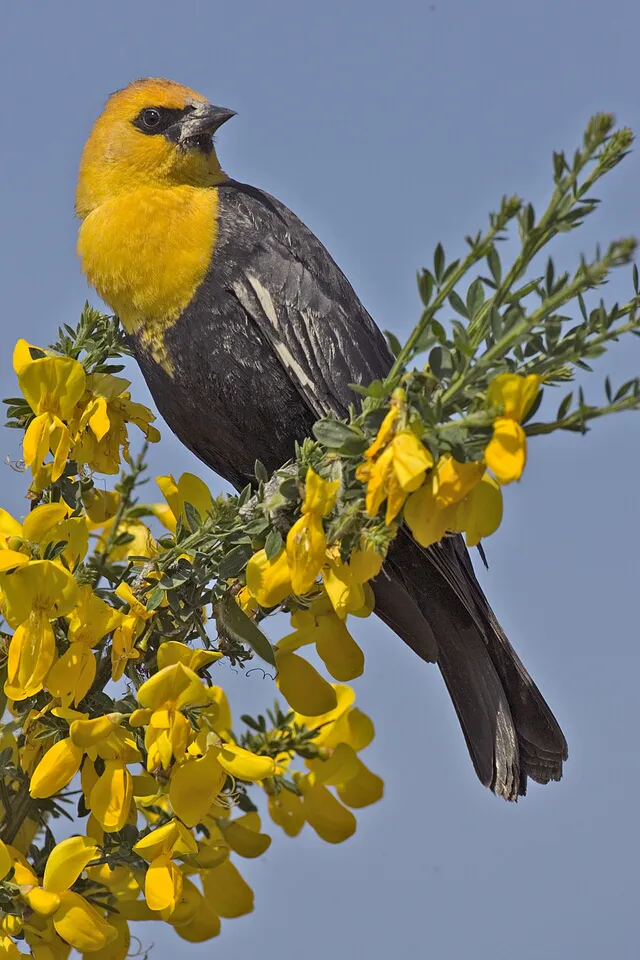
Carouge à tête jaune— Quebec wildlife
Xanthocephalus xanthocephalus
IcteridaeNo period published by Québec.ca
Québec.ca publishes no hunting or trapping period for this species. Check the official regulations.
Wikipedia
Carouge à tête jaune
The yellow-headed blackbird (Xanthocephalus xanthocephalus) is a medium-sized blackbird with a yellow head. It is the only member of the genus Xanthocephalus. Their scientific name derives from the Greek word for yellow, xanthous, and the word for head, cephalus.
Description
Yellow-headed blackbirds are relatively large blackbirds with large, yellow heads. They measure 8.3–10.2 in (21–26 cm) in length, with a wingspan of 16.5–17.3 in (42–44 cm) and a weight of 1.6–3.5 oz (44–100 g). Adults have a pointed bill. The adult male is mainly black with a yellow head and breast; they have a white wing patch sometimes only visible in flight. The adult female is mainly brown with a dull yellow throat and breast. Immature members of both sexes are brown with duller yellow plumage compared to adult males. Immature males also have some white patches on the wing. Both sexes resemble the respective sexes of the smaller yellow-hooded blackbird of South America.
Text from Wikipedia — Yellow-headed blackbird, revision 1349262323, CC BY-SA 4.0, retrieved 2026-09-04. Encyclopedic text reused under CC BY-SA 4.0. Sentences about hunting or regulation are removed: on this site, the rule comes from Québec.ca.
Other names
French
English
Presence in Quebec
- Origin
- Indigène
- Occurrence
- Régulier
- Population status
- Migrateur
- Certainty
- Confirmé
Conservation
Québec.ca
Official periods
Source: Québec.ca — tables reproduced as published (retrieved 2026-08-30).
Regulations change. Always check Québec.ca before hunting or trapping.
Where this data comes from
This species is listed in an official government dataset. The identification and status shown in the data sheet are reproduced from it.
Source: List of Quebec’s vertebrate wildlife (LFVQ) — Ministère de l’Environnement, de la Lutte contre les changements climatiques, de la Faune et des Parcs. File LFVQ_25_03_2026.csv, retrieved 2026-08-30 · CC BY 4.0.
Measurements, habitat, diet and reproduction are not shown: no official source is attached to them yet.