
No period published by Québec.ca
Québec.ca publishes no hunting or trapping period for this species. Check the official regulations.
Wikipedia
Chauve-souris cendrée
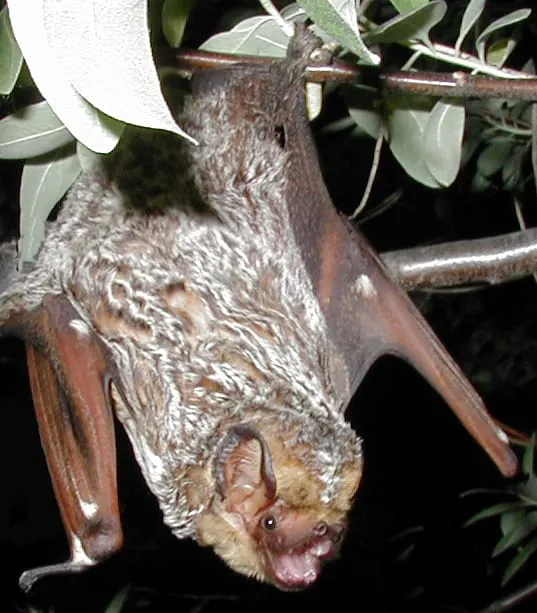
The hoary bat (Lasiurus cinereus) is a species of bat in the vesper bat family, Vespertilionidae. It lives throughout most of North America (and possibly also in Hawaii, although this is disputed).
Description
The hoary bat averages 13 to 14.5 cm (5.1 to 5.7 in) long with a 40 cm (15.5 in) wingspan and a weight of 26 g (0.92 oz). It is the largest bat normally found in Canada. Its coat is dense and dark brown, with white tips to the hairs that give the species its 'hoary' appearance for which it is named. The body is covered in fur except for the undersides of the wings. Males and females are dimorphic in body mass, with females 40% heavier than males.
Habitat and range
It ranges throughout North America, from northern Canada south to Guatemala. Although the Hawaiian subspecies L. semotus was reclassified into a distinct species, studies in 2015 and 2017 found evidence supporting two different colonization events of Hawaii by Lasiurus species; one about 1.4 million years ago by the ancestors of L. semotus, but also a much more recent colonization by true L. cinereus. This would mean that L. cinereus also inhabits the Hawaiian islands, in cryptic sympatry with L. semotus. However, in contrast, a 2020 genetic study found no evidence of multiple bat species on Hawaii, finding the islands to only be inhabited by a single species, L. semotus, and attributed the previous results as a consequence of incomplete lineage sorting.
Reproduction
The reproductive cycle of the hoary bat is not yet fully documented, but it is thought that they mate in August with birth occurring in June of the following year. It is thought that the gestation period is only 40 days and that mammalian embryonic diapause (delayed implantation) may play a role. Females typically bear twins, though litter sizes range from 1–4. Young are typically weaned after 7 weeks.
Text from Wikipedia — Hoary bat, revision 1370845164, CC BY-SA 4.0, retrieved 2026-09-04. Encyclopedic text reused under CC BY-SA 4.0. Sentences about hunting or regulation are removed: on this site, the rule comes from Québec.ca.
Other names
Former scientific names
Presence in Quebec
- Origin
- Indigène
- Occurrence
- Régulier
- Population status
- Reproducteur
- Certainty
- Confirmé
Conservation
Québec.ca
Official periods
Source: Québec.ca — tables reproduced as published (retrieved 2026-08-30).
Regulations change. Always check Québec.ca before hunting or trapping.
Where this data comes from
This species is listed in an official government dataset. The identification and status shown in the data sheet are reproduced from it.
Source: List of Quebec’s vertebrate wildlife (LFVQ) — Ministère de l’Environnement, de la Lutte contre les changements climatiques, de la Faune et des Parcs. File LFVQ_25_03_2026.csv, retrieved 2026-08-30 · CC BY 4.0.
Measurements, habitat, diet and reproduction are not shown: no official source is attached to them yet.