
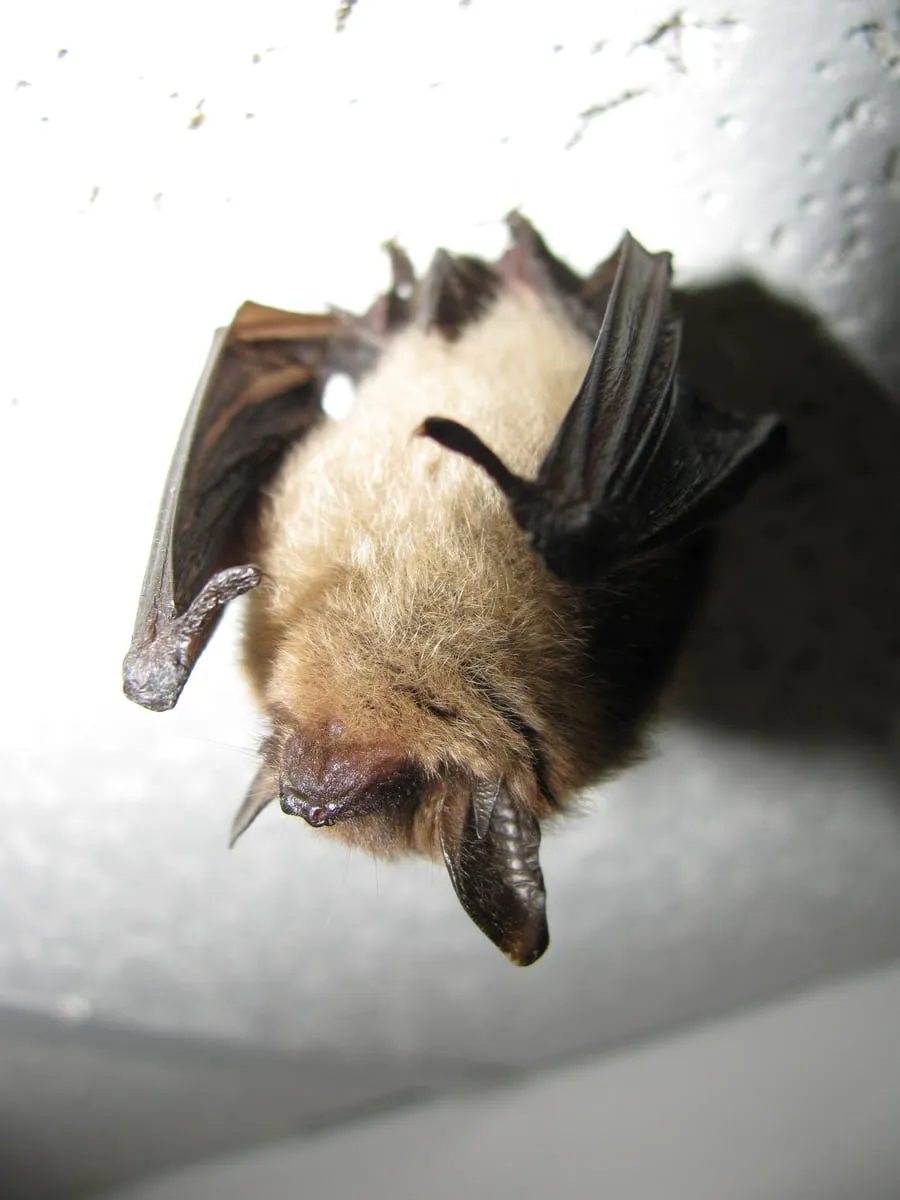
Chauve-souris nordique— Quebec wildlife
Myotis septentrionalis
VespertilionidaeNo period published by Québec.ca
Québec.ca publishes no hunting or trapping period for this species. Check the official regulations.
Wikipedia
Chauve-souris nordique
Myotis septentrionalis, known as the northern long-eared bat or northern myotis, is a species of bat native to North America. There are no recognized subspecies. The northern long-eared bat is about 3–3.7 inches in length, with a wingspan of 9–10 inches. It is distinguishable by its long ears when comparing it to other bats in its genus. This species is commonly found in the northern United States and Southern Canada east of British Columbia. The geographic range includes 37 states.
Description
The northern long-eared bat is a small bat, measuring an average of 8.6 cm (3.4 in) in total length, including a tail about 4 cm (1.6 in) long. Adults weigh between 5 and 8 g (0.18 and 0.28 oz). The fur and wing membranes are light brown in color, and the bat lacks the dark shoulder spots found in the closely related, and otherwise similar Keen's myotis (Myotis keenii). Compared to other Myotis species, these bats have long ears with a relatively long, pointed tragus; when folded forwards the ears extend well past the nose. They also have a longer tail and larger wing area than most comparably sized Myotis bats, giving them increased maneuverability during slow flight.
Text from Wikipedia — Myotis septentrionalis, revision 1321268258, CC BY-SA 4.0, retrieved 2026-09-04. Encyclopedic text reused under CC BY-SA 4.0. Sentences about hunting or regulation are removed: on this site, the rule comes from Québec.ca.
Other names
French
Presence in Quebec
- Origin
- Indigène
- Occurrence
- Régulier
- Population status
- Toute l'année
- Certainty
- Confirmé
Conservation
Québec.ca
Official periods
Source: Québec.ca — tables reproduced as published (retrieved 2026-08-30).
Regulations change. Always check Québec.ca before hunting or trapping.
Where this data comes from
This species is listed in an official government dataset. The identification and status shown in the data sheet are reproduced from it.
Source: List of Quebec’s vertebrate wildlife (LFVQ) — Ministère de l’Environnement, de la Lutte contre les changements climatiques, de la Faune et des Parcs. File LFVQ_25_03_2026.csv, retrieved 2026-08-30 · CC BY 4.0.
Measurements, habitat, diet and reproduction are not shown: no official source is attached to them yet.